
Pheidole vieti
- Sci. Name
- Pheidole vieti
- Tribe
- Attini
- Subfamily
- Myrmicinae
- Author
- Eguchi, 2008
- Distribution
- Found in 3 countries
Introduction
Pheidole vieti is a small ant species native to northern Vietnam and southern China (Yunnan province). Like all Pheidole species, they have two worker castes: larger major workers with distinctive big heads, and smaller minor workers that handle most of the foraging. Both castes are yellowish brown in color. Body size data is unavailable from the research . The species is found in leaf litter of tropical and subtropical forests at elevations between 625-820 meters . It was first described in 2008 . This species is notable for its limited distribution, being known only from northern Vietnam and Yunnan, and it avoids human-modified habitats like rubber plantations .
Quick Summary
- Difficulty: Hard
- Origin & Habitat: Northern Vietnam and Yunnan, China. Found in leaf litter of rain forests, secondary forests, and limestone forests at 625-820m elevation [2][3]. Not found in human-modified habitats like rubber plantations [3].
- Colony Type: Based on Pheidole genus patterns, likely monogyne, but unconfirmed for this species.
- Size & Growth:
- Queen: Size unknown, inferred from Pheidole genus (~5-8 mm)
- Worker: Size unknown, inferred from Pheidole genus (~2-4 mm)
- Colony: Unknown, no data available
- Growth: Unknown
- Development: Unknown, no direct data. Based on typical Pheidole patterns, estimate 6-10 weeks at tropical temperatures. (Development timeline has not been studied for this species.)
- Antkeeping:
- Temperature: Keep warm around 24-28°C, based on their subtropical origin. Avoid temperatures below 20°C.
- Humidity: Keep nest substrate moderately moist but not waterlogged, as they are from humid forest environments [2].
- Diapause: Unknown, no data on overwintering. Based on subtropical origin, may not require true hibernation.
- Nesting: In the wild, they live in leaf litter. In captivity, use moist substrate or plaster nests scaled to their tiny size [2].
- Behavior: Pheidole species are generally non-aggressive. Major workers defend the nest, while minor workers forage. They do not sting and pose no danger to keepers. Their small size requires careful escape prevention.
- Common Issues: escape risk due to tiny size, they can squeeze through standard gaps, lack of species-specific care data increases risk of colony failure, slow growth due to unknown development timeline, wild-caught colonies may have parasites or diseases that are poorly understood
Identification and Appearance
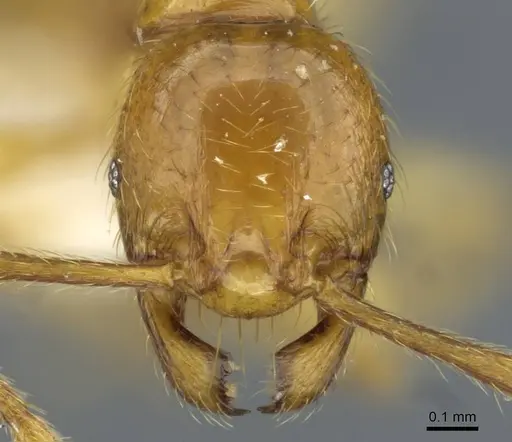
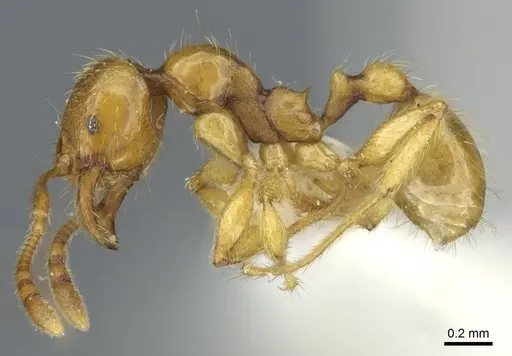
Pheidole vieti has two distinct worker castes. Major workers have a relatively short but high head that is not impressed on the vertex. Their body is yellowish brown, and the head has longitudinal rugae on the frons and anterior vertex. The frontal carina is inconspicuous, and the antennal scrobe is almost absent. Minor workers are much smaller and have a smooth, shining frons and vertex. Both castes have a promesonotal dome that lacks a mound on its posterior slope, and both have a relatively massive postpetiole. The species is similar to Pheidole vulgaris but can be distinguished by the major's shorter but higher head and more massive postpetiole [1].
Distribution and Habitat
This species is known from northern Vietnam and Yunnan province in southern China. In Vietnam, it has been recorded from Ba Vi and Tam Dao areas [4]. In China, it represents a new record for Yunnan province and marks the northern-most extent of the species distribution [2]. Specimens have been collected from leaf litter in rain forest, secondary forest, and limestone forest at elevations between 625-820 meters. This species is found in primary and secondary forest habitats but was not found in rubber plantations, suggesting it requires natural forest environments [3].
Nest Preferences and Housing
In the wild, Pheidole vieti lives in leaf litter and soil of tropical forests. They are a litter-dwelling species. For captive care, a naturalistic setup with moist substrate works well, mimicking the forest floor. Alternatively, a plaster nest or soil nest with narrow chambers scaled to their tiny size provides good housing. The key is maintaining moderate humidity while ensuring adequate ventilation to prevent mold. Because they are so small, any gaps in housing must be sealed with fine mesh or cotton. [2]
Feeding and Diet
Pheidole species are generalist omnivores that collect seeds and small insects. While specific diet preferences for P. vieti are unknown, you can offer typical Pheidole foods: small live prey like fruit flies or mealworm pieces for protein, and sugar sources like honey water or sugar water for energy. Seeds may also be accepted. Remove uneaten food after 24-48 hours to prevent mold. Ensure fresh water is always available.
Temperature and Seasonal Care
Being from northern Vietnam and Yunnan province, this species experiences subtropical conditions with warm temperatures year-round. Based on the elevation range and forest habitat, keep temperatures around 24-28°C. Monitor colony behavior and adjust as needed. During winter months, a slight reduction in temperature may be appropriate, but true hibernation is likely not required. [2]
Challenges and Considerations
The biggest challenge with Pheidole vieti is the lack of biological data. This makes them a poor choice for beginners. If you obtain a colony, document your observations carefully. Escape prevention is critical due to their tiny size. Always use fine mesh barriers and check all connection points.
Frequently Asked Questions
How long does it take for Pheidole vieti to develop from egg to worker?
This has not been documented. Based on typical Pheidole patterns for tropical species, estimate 6-10 weeks at optimal temperatures (around 26°C).
What do Pheidole vieti ants eat?
Their specific diet is unknown, but like other Pheidole species, they likely accept small insects (protein) and sugar sources. Offer live fruit flies, small mealworm pieces, or similar small prey, along with honey water or sugar water.
Can I keep Pheidole vieti in a test tube?
Test tubes can work for founding colonies, but due to their tiny size, you must ensure excellent escape prevention. Use cotton with fine mesh barriers and check regularly. A naturalistic setup or plaster nest may be better long-term housing.
Do Pheidole vieti ants need hibernation?
Unknown. Being from a subtropical region (northern Vietnam, Yunnan), they likely do not require true hibernation. You may reduce temperatures slightly during winter months, but a full diapause is probably not necessary.
How big do Pheidole vieti colonies get?
Colony size is unknown, no data exists on maximum colony size for this species. Most Pheidole colonies reach several hundred to a few thousand workers.
What temperature should I keep Pheidole vieti at?
Based on their origin (northern Vietnam, Yunnan at 625-820m elevation), start around 24-28°C. Monitor your colony, if they avoid heated areas, try slightly cooler temperatures. Avoid temperatures below 18°C [2].
Is Pheidole vieti good for beginners?
No. This species has no documented care information, making it extremely challenging to keep successfully. Without knowledge of their colony structure, founding behavior, or specific requirements, you are essentially experimenting. Choose a better-documented species like Pheidole pallidula or Pheidole megacephala for your first ant.
Where does Pheidole vieti live in the wild?
They are found in northern Vietnam and Yunnan, China, living in leaf litter of rain forests, secondary forests, and limestone forests at 625-820m elevation. They are not found in human-modified habitats like rubber plantations [2][3].
How do I identify Pheidole vieti from similar species?
Major workers have a relatively short but high head that is not impressed on the vertex, and a more massive postpetiole compared to similar species like Pheidole vulgaris. Both castes are yellowish brown with a promesonotal dome lacking a mound on its posterior slope. Identification requires microscopic examination of morphological features [1].
Report an Issue
The current care sheet is based fully on literature. See inconsistencies, or something that's incorrect? Please , it will be resolved after review from an admin. Contributing to the blogs tab also helps providing information, to make us be able to further improve the caresheets. Thank you for your support!
References

This caresheet is licensed under CC BY-SA 4.0 .
Community Blogs
CASENT0911222
View on AntWeb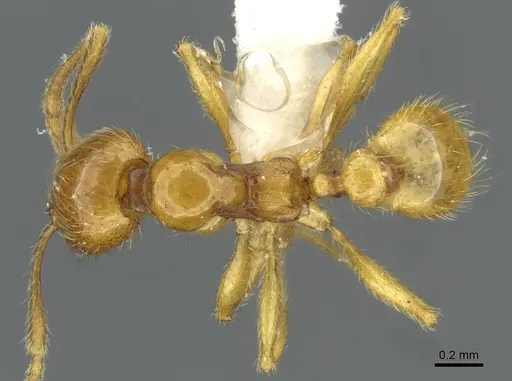
Literature
Loading distribution map...Loading products...