
Pheidole cornicula
- Sci. Name
- Pheidole cornicula
- Tribe
- Attini
- Subfamily
- Myrmicinae
- Author
- Wilson, 2003
- Distribution
- Found in 2 countries
Introduction
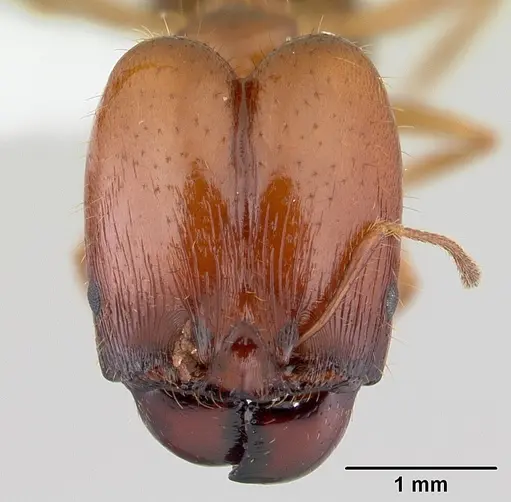
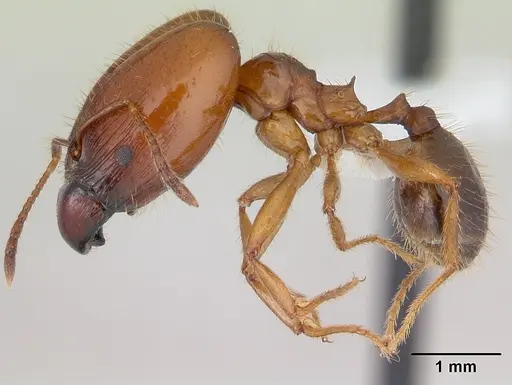
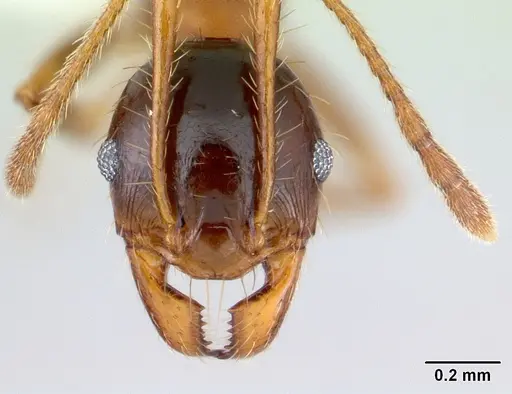
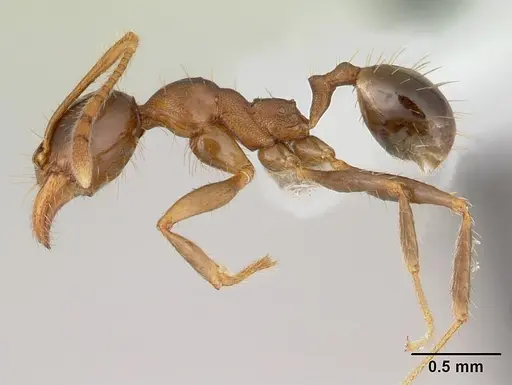
Pheidole cornicula is a small ant species from South America. You can find it in Bolivia, Argentina, and Paraguay . The original specimen came from Club Las Palmas in Santa Cruz, Bolivia, collected by James C. Trager . Major workers show a small horn-like bump on the front of their heads. This bump gives the species its name, which means little horn . The species belongs to a group called the carapuna complex, which includes Pheidole boltoni, Pheidole carapuna, Pheidole cuprina, Pheidole jivaro, Pheidole manuana, and Pheidole celaena . Major workers have reddish-brown heads and mandibles with yellowish-brown bodies. Minor workers are entirely yellowish-brown with dark yellow legs and antennae . Size data is unavailable, but based on Pheidole genus patterns, workers likely measure around 3 to 8 mm in total length. This species thrives in modified landscapes. You will find it in agricultural areas like soybean fields in the Atlantic forest . What stands out about Pheidole cornicula is how little we know about its daily life. Scientists described it in 2003,but no one has tracked its colony development or nesting habits yet . You will need to rely on general Pheidole care methods while you observe your own colony. Like other members of this genus, it splits work between small minor workers and larger major workers. The majors handle tough jobs like cutting seeds or defending the nest.
Quick Summary
- Difficulty: Hard
- Origin & Habitat: Neotropical region, Bolivia (type locality: Club Las Palmas, Santa Cruz), Argentina, and Paraguay. You can find it in agricultural areas like soybean crops in the Atlantic forest [2][3].
- Colony Type: Single-queen colonies are typical for Pheidole, but we have no direct proof for Pheidole cornicula yet.
- Size & Growth:
- Queen: size data unavailable, inferred from Pheidole genus (~4-6 mm)
- Worker: size data unavailable, inferred from Pheidole genus (~3-8 mm)
- Colony: Unknown, no colony size data available
- Growth: Moderate
- Development: 6 to 10 weeks [1], Based on typical Pheidole patterns at warm temperatures, but this is an estimate. (Development speed depends on your exact temperature and humidity settings.)
- Antkeeping:
- Temperature: Unconfirmed, likely prefers warm conditions around 24 to 28°C. Start in this range and watch how your colony reacts.
- Humidity: Unconfirmed, likely prefers moderate to high humidity. Keep the nest substrate consistently moist but not waterlogged.
- Diapause: Unknown, Neotropical species often skip strong winter rest, but you may need a cooler period if you keep them in temperate zones.
- Nesting: Unconfirmed, Pheidole species usually nest in soil, under rocks, or inside rotting wood. A Y-tong nest or plaster nest with moist substrate works well to start.
- Behavior: Unconfirmed, Pheidole species usually stay calm but will defend their nest. Like other Myrmicinae ants, this species carries a functional stinger, but major workers rely on their large jaws for defense instead. Since workers are small, you must seal every gap to stop escapes.
- Common Issues: lack of biological data makes proper care challenging, you must rely on genus-level assumptions, no confirmed information on founding behavior or colony development timeline, wild-caught colonies may carry parasites or diseases since researchers have not studied this species, agricultural origin suggests tolerance to some disturbance, but captive conditions differ significantly
Identification and Distinguishing Features
Pheidole cornicula belongs to the carapuna complex, a group of closely related species [1]. The most obvious feature is the small horn-like bump on the front of the major worker's head [1]. This bump matches the species name, which means little horn [1]. Major workers show reddish-brown heads and mandibles with yellowish-brown bodies [1]. Minor workers are smaller and entirely yellowish-brown with dark yellow legs and antennae [1]. In side view, the spines on the rear of the thorax shrink down to small teeth [1]. Researchers note that Pheidole cornicula might actually be the same species as Pheidole celaena [1]. You need to check the head shape and surface texture to tell them apart [1]. Size data is unavailable, but based on Pheidole genus patterns, workers likely measure around 3 to 8 mm in total length.
Distribution and Habitat
You will find this species in the Neotropical region, specifically Bolivia, Argentina, and Paraguay [1]. The original specimen came from Club Las Palmas in Santa Cruz, Bolivia, collected by James C. Trager [1]. Researchers also spotted it in agricultural settings like soybean fields in the Atlantic forest [2][3]. This shows the species handles human-modified landscapes well. You can expect them to nest in open, disturbed areas rather than deep, untouched forest [2][3].
Care Recommendations Based on Genus Patterns
Since researchers have not tracked Pheidole cornicula biology, you must follow standard Pheidole care methods [1]. These ants eat both protein and carbohydrates. Offer small live insects like fruit flies or pinhead crickets, along with sugar water or honey [1]. Major workers use their large jaws to cut seeds and process tough food [1]. For nesting, use a Y-tong nest or plaster nest with moist substrate [1]. Keep the temperature warm, around 24 to 28°C [1]. Watch your colony closely and adjust conditions based on their activity. You are likely the first keeper to handle this species, so record everything you learn [1].
Challenges and Considerations
Pheidole cornicula presents real challenges because scientists know almost nothing about its daily life [1]. You have no data on how queens start colonies, when they mate, or how fast the colony grows [1]. You will need to test different food types, temperatures, and humidity levels to see what works [1]. Keep detailed notes on your colony's behavior and development. Your observations will help future keepers [1]. Expect to use trial and error to set up the best environment. Adjust your care routine whenever you notice your ants struggling or thriving [1].
Frequently Asked Questions
How long does it take for Pheidole cornicula to produce first workers?
Unknown, no development data exists for this species. Based on typical Pheidole patterns, expect 6 to 10 weeks from egg to first worker at warm temperatures around 26°C, but this is an estimate [1].
What do Pheidole cornicula ants eat?
Unconfirmed for this species specifically, but Pheidole ants eat both protein and carbohydrates [1]. Offer small live insects like fruit flies or pinhead crickets, protein paste, and sugar water or honey [1]. Major workers will handle tough food with their large jaws [1].
Can I keep multiple queens of Pheidole cornicula together?
Not recommended, colony structure has not been studied for this species [1]. Combining unrelated queens of most Pheidole species usually leads to fighting and colony loss [1]. Start with a single queen to avoid problems.
What temperature should I keep Pheidole cornicula at?
Unconfirmed, as a Neotropical species from Bolivia and Argentina, start around 24 to 28°C and watch colony behavior [1]. Adjust the temperature based on activity levels. Workers should move around and forage actively.
Is Pheidole cornicula good for beginners?
This species is not ideal for beginners due to the complete lack of biological data [1]. You cannot rely on proven care sheets, which makes successful cultivation very difficult [1]. Consider starting with well-studied species like Pheidole pallidula or Pheidole megacephala instead.
How big do Pheidole cornicula colonies get?
Unknown, no colony size data is available for this species [1]. Most Pheidole species produce colonies of several hundred workers, but you should expect slower growth until you learn their specific needs.
Does Pheidole cornicula need hibernation?
Unknown, as a Neotropical species, it likely skips strong winter rest [1]. If you keep them in a temperate climate, you may need a slight temperature drop during winter months to around 18 to 20°C, but this is an estimate.
What type of nest should I use for Pheidole cornicula?
Unconfirmed, based on typical Pheidole preferences, use a moist nest setup like a Y-tong nest or plaster nest with chambers scaled to their small size [1]. The species handles agricultural areas well, so moderate humidity works best.
Where can I get Pheidole cornicula ants?
This species is extremely rare in the antkeeping hobby [1]. You will only find a few specimens collected in Bolivia, Argentina, and Paraguay [1]. You need to locate a specialized breeder or collector working with rare South American Pheidole species.
Report an Issue
The current care sheet is based fully on literature. See inconsistencies, or something that's incorrect? Please , it will be resolved after review from an admin. Contributing to the blogs tab also helps providing information, to make us be able to further improve the caresheets. Thank you for your support!
References

This caresheet is licensed under CC BY-SA 4.0 .
Community Blogs
CASENT0178012
View on AntWeb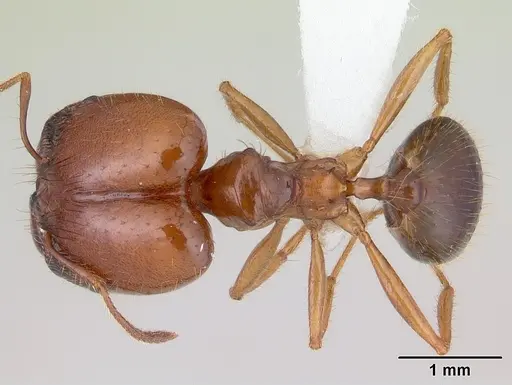
CASENT0178013
View on AntWeb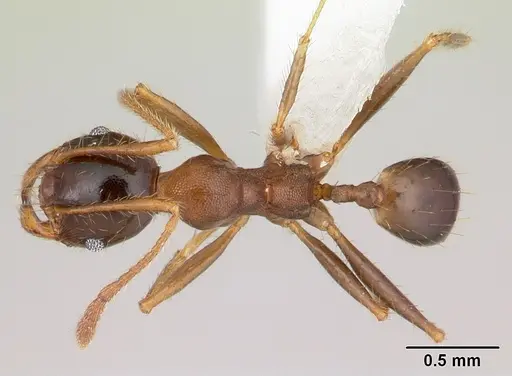
Literature
Loading distribution map...Loading products...