
Tetramorium barbigerum
- Sci. Name
- Tetramorium barbigerum
- Tribe
- Crematogastrini
- Subfamily
- Myrmicinae
- Author
- Bolton, 1980
- Distribution
- Found in 1 countries
Introduction
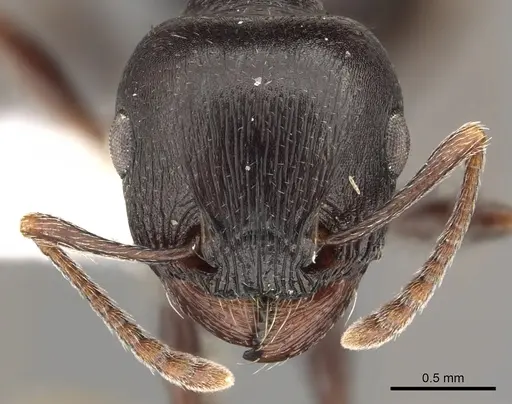
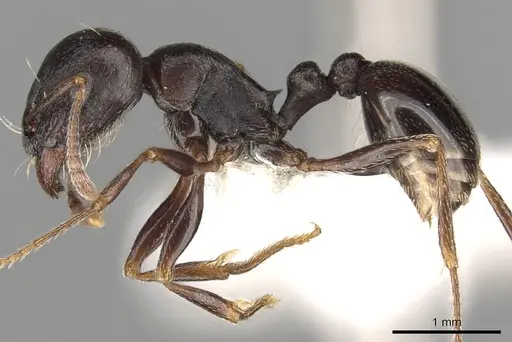
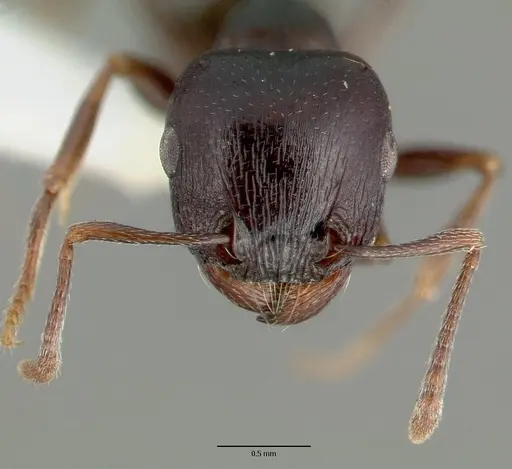
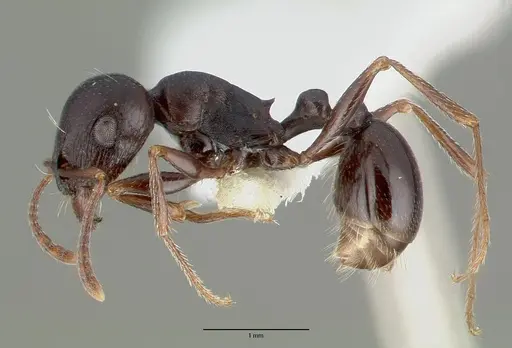
Tetramorium barbigerum is a medium-sized ant from the Myrmicinae subfamily, part of the seed-harvesting Tetramorium solidum group. Workers are 4.8-5.4 mm total length and uniformly blackish-brown with lighter legs and antennae . Their most distinctive feature is the head shape - narrower in front of the eyes than behind - a trait that easily separates them from most other Tetramorium species . The propodeum bears short but distinct spines, and the sculpture on the head is very weak, fading out at eye level . This ant is known from only a single collection near Okombahe, Namibia, making it one of the most geographically restricted Tetramorium in southern Africa . What makes this ant remarkable is its extreme rarity. It has never been recorded again since 1958,and absolutely nothing is known about its behavior, colony structure, or captive care. For antkeepers, it is essentially a ghost species - a scientific curiosity rather than a candidate for the hobby.
Quick Summary
- Difficulty: Expert
- Origin & Habitat: Known only from the type locality near Okombahe, Namibia, about 16 km west of the town at 920 m elevation [1]. The natural habitat is likely arid savanna or dry woodland, though no specific habitat data exist.
- Colony Type: Unknown, colony structure has never been documented. Most Tetramorium are monogyne (single queen), but this cannot be confirmed for T. barbigerum.
- Size & Growth:
- Queen: Undocumented, no queen measurements exist [1][2]
- Worker: 4.8-5.4 mm total length [1]
- Colony: Unknown, no colony size data available
- Growth: Unknown, no development data exists for this species
- Development: Unknown, no direct observations. Based on typical Tetramorium patterns, estimate 6-10 weeks at optimal temperature, but this is a very rough guess. (Development timeline is entirely unstudied. Related solidum-group species may provide rough estimates, but no species-specific data exists.)
- Antkeeping:
- Temperature: Inferred from Namibian origin: likely warm (roughly 22-28 °C), but entirely unconfirmed. Start at room temperature and watch the colony's response.
- Humidity: Inferred from arid habitat: likely prefers dry to moderate conditions. Provide a moisture gradient with one damp area in the nest and a dry outworld. Avoid waterlogging.
- Diapause: Unknown, no data on overwintering. Namibia has mild winters, so this species may not require true diapause. Observe for seasonal slowdowns.
- Nesting: No specific nesting data. Related solidum-group species often nest in soil or under stones in dry areas. A naturalistic setup with a soil or Y-tong/plaster nest and moderate moisture is a starting point.
- Behavior: No behavioral observations documented. As a member of the solidum group, it is presumed to be a seed harvester, collecting seeds and small insects. The presence of a well-developed psammophore (a basket of hairs under the head used to carry seeds) supports this [3]. Escape risk is moderate for a 5 mm ant, standard barriers (fluon or oil) are recommended. Temperament is unknown, but most Tetramorium are not aggressive.
- Common Issues: This species has never been kept in captivity, no care protocols exist and all recommendations are speculative., No biological data (colony size, founding type, development time, etc.), every aspect of care is guesswork., Only known from a single remote location in Namibia, wild colonies are extremely hard to find and likely protected by local laws., Essentially unavailable to antkeepers, no commercial sources or captive-bred colonies exist., Any obtained colony would probably come from scientific collections and require special permits.
Identification and Distinction
You can identify Tetramorium barbigerum by several key features. The most obvious is the head shape, it narrows in front of the eyes, unlike most other Tetramorium [1][2]. Workers are uniformly blackish-brown with lighter legs and antennae, measuring 4.8-5.4 mm in total length [1]. The propodeum (the rear part of the middle section) carries short but distinct spines (PSLI 7-8), which sets it apart from its close relative Tetramorium jordani, which has no propodeal spines at all [1]. The head sculpture is very weak, fine little ridges that fade out at eye level and are replaced by a fine, dotted surface (punctation). In contrast, a similar species like Tetramorium signatum has much stronger head sculpture [1]. Also, there are no standing hairs on the upper surface of the middle body, the petiole, or the postpetiole. The underside of the head has a strongly developed psammophore, a row of long hairs that form a basket for carrying seeds [3]. This feature, along with the lack of erect hairs on the mesosoma, is shared with its closest relatives in the solidum group [1].
Distribution and Rarity
This species is known from a single collection at the type locality near Okombahe, Namibia, about 16 km west of the town at 920 meters elevation [1]. The original specimens were collected on 10 May 1958 by R. E. Ross and R. E. Leech. No additional records exist in scientific literature [1][2]. This makes Tetramorium barbigerum one of the most poorly known and geographically restricted species in the solidum group. It has never been seen in the ant-keeping hobby, and no captive colonies exist. The arid Namibian environment at that location would likely involve extreme temperature swings between day and night, but specific microhabitat data are missing.
Taxonomic Context
Tetramorium barbigerum belongs to the Tetramorium solidum group, a cluster of seed-harvesting ants found only in southern Africa [1]. Within this group, T. barbigerum is most closely related to Tetramorium jordani, Tetramorium signatum, and Tetramorium pogonion. All four are black and lack erect hairs on the mesosoma, but they differ in head shape, propodeal spine development, and head sculpture [1]. Other species in the group, like Tetramorium rufescens and Tetramorium glabratum, are red in colour and unlikely to be confused [1][3].
Keeping Considerations
If you somehow obtain a colony of Tetramorium barbigerum (which is practically impossible for hobbyists), every aspect of care would be experimental. Based on the Namibian origin, you'd want warm temperatures, perhaps 22-28 °C, and a dry setup with only a small moist area in the nest. The natural soil or under-stone nesting suggests a Y-tong, plaster, or soil nest would work. As a seed harvester, the ants likely accept a variety of small seeds (like grass seeds or poppy seeds) along with protein sources such as fruit flies or small crickets. Sugar water may also be taken. However, since no direct observations exist, you'd have to test everything. This species is not recommended for any keeper except those with a specific scientific interest and access to rare specimens through proper permits. The complete lack of captive data means any attempt is pioneering work with no established protocols. [3]
Related Species in the Solidum Group
If you're interested in seed-harvesting Tetramorium, other species in the solidum group are more realistic choices. Tetramorium jordani lacks propodeal spines (PSLI 1-2 vs. 7-8 in T. barbigerum) and has a broader head [1]. Tetramorium signatum has much stronger head sculpture [1]. Tetramorium pogonion is smaller (head width 0.86-0.92 mm) with larger eyes [1]. Tetramorium rufescens and Tetramorium glabratum are red-bodied and not black like T. barbigerum [1]. None of these have established captive care protocols either, but they are at least more likely to be found in nature or in collections.
Frequently Asked Questions
Is Tetramorium barbigerum available for purchase?
No, this species is essentially unavailable to antkeepers. It is only known from a single collection in Namibia in 1958 and has never been documented in the ant-keeping hobby. No commercial sources or captive-bred colonies exist [1][2].
How do I care for Tetramorium barbigerum?
No care protocols exist for this species. Any recommendations would be entirely speculative, based on related species and Namibian habitat conditions. This is not a species for hobbyist keeping, it remains a scientific curiosity with no captive history.
What does Tetramorium barbigerum look like?
Workers are 4.8-5.4 mm total length, uniformly blackish-brown with lighter legs and antennae. The most distinctive feature is the head shape, narrower in front of the eyes than behind. It has short propodeal spines and lacks erect hairs on the upper surface of the middle body [1]. The underside of the head has a strong psammophore (a basket of hairs) for carrying seeds [3].
Where does Tetramorium barbigerum live?
Only known from a single location near Okombahe, Namibia, about 16 km west of the town at 920 m elevation [1][2].
Can I keep multiple queens together?
Unknown, colony structure has never been documented for this species. Most Tetramorium are monogyne (single queen), but this cannot be confirmed for Tetramorium barbigerum.
How long does it take for eggs to become workers?
Unknown, no development data exists for this species. Related Tetramorium species typically take 6-10 weeks from egg to worker at optimal temperatures, but this is a very rough estimate with no species-specific data.
Does Tetramorium barbigerum need hibernation?
Unknown, no data on overwintering requirements. The Namibian climate is mild, so this species may not require a true diapause. However, this is entirely unstudied.
What do Tetramorium barbigerum ants eat?
Likely a seed harvester like other species in the solidum group, but no direct observations exist. Probably accepts small seeds (e.g., grass, poppy) and insects like fruit flies or small crickets. Sugar sources may also be accepted. This is entirely inferred, not observed [1].
Is Tetramorium barbigerum aggressive?
Unknown, no behavioral observations have been documented. Most Tetramorium species are not particularly aggressive, but this cannot be confirmed for this specific species.
Are there similar species that are easier to keep?
Yes, other species in the Tetramorium solidum group like Tetramorium jordani, Tetramorium signatum, or Tetramorium pogonion may be more available. These related species share similar morphology and likely ecology but have more documented distributions and are more likely to be found in nature [1].
Report an Issue
The current care sheet is based fully on literature. See inconsistencies, or something that's incorrect? Please , it will be resolved after review from an admin. Contributing to the blogs tab also helps providing information, to make us be able to further improve the caresheets. Thank you for your support!
References

This caresheet is licensed under CC BY-SA 4.0 .
Community Blogs
CASENT0901181
View on AntWeb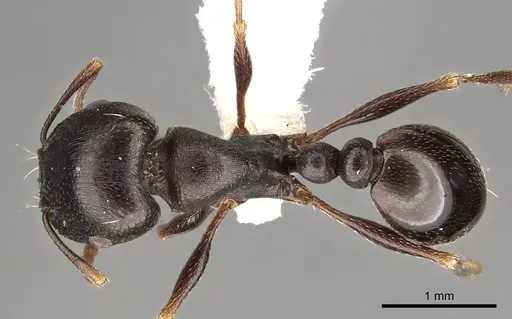
CASTYPE13386
View on AntWeb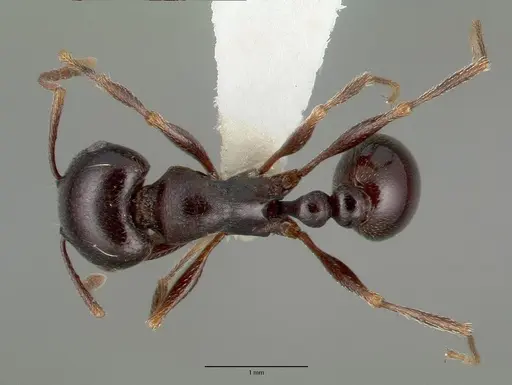
Literature
Loading distribution map...Loading products...