
Oxyepoecus bruchi
- Sci. Name
- Oxyepoecus bruchi
- Tribe
- Solenopsidini
- Subfamily
- Myrmicinae
- Author
- Santschi, 1926
- Distribution
- Found in 2 countries
Introduction
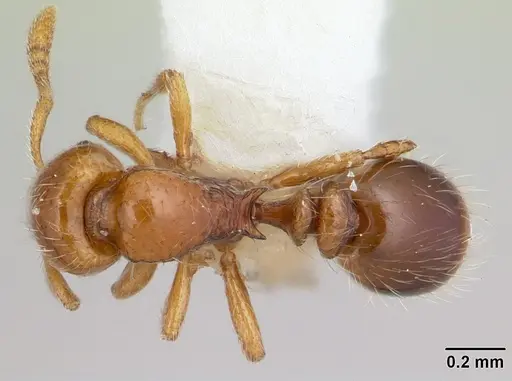
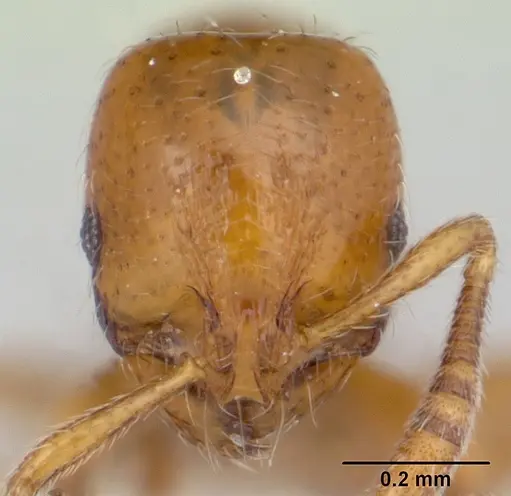
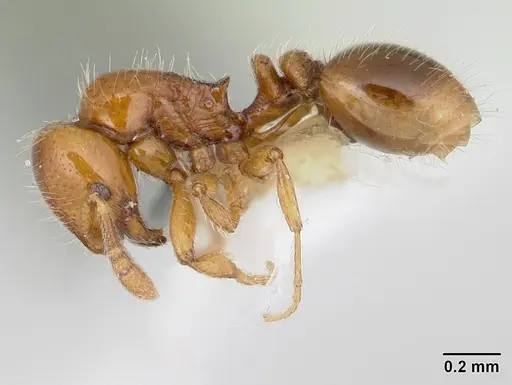
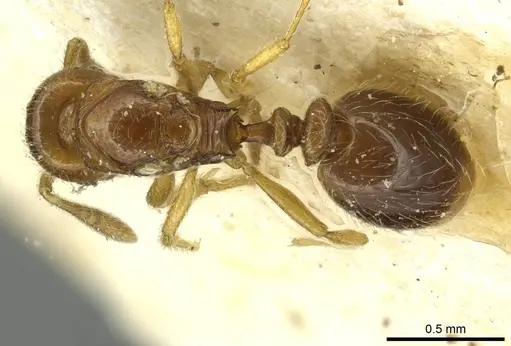
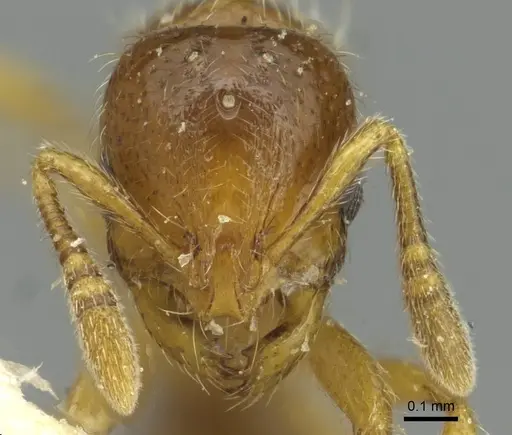
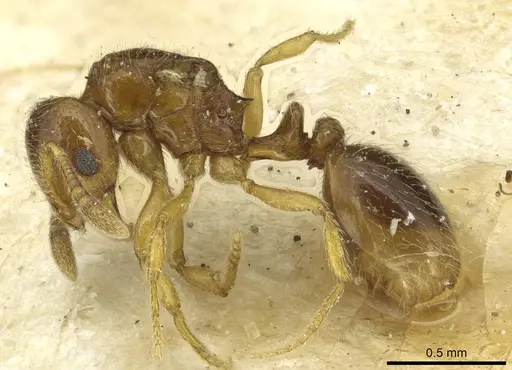
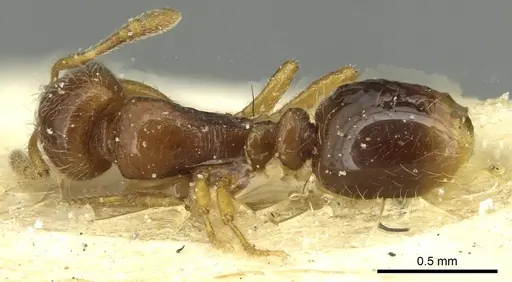
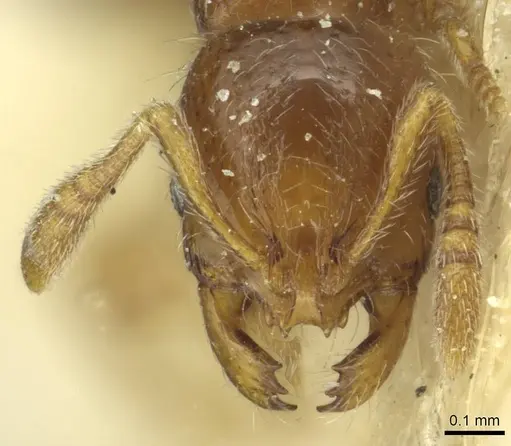
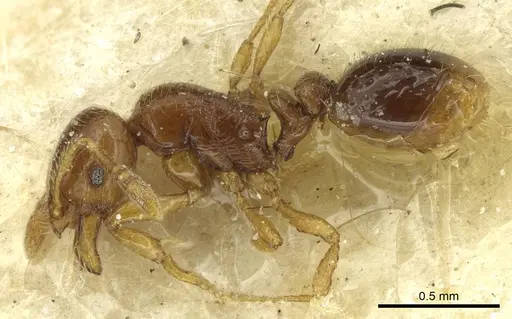
Oxyepoecus bruchi is a tiny, rare ant. Workers measure 2.1-2.3 mm in total length, and queens are 2.4-2.5 mm . Workers are yellowish brown with a chestnut brown gaster . This species belongs to the Solenopsidini tribe and has only ever been collected living inside nests of Pheidole ants – specifically Pheidole obtusopilosa and Pheidole silvestrii . It is known from just a handful of specimens in Argentina (Córdoba and Tucumán), Brazil (Santa Catarina), and Paraguay . Its most distinctive feature is the extremely elongated front part of the subpetiolar process, more than twice as long as the rear part . This ant is an obligate inquiline – a social parasite that cannot survive without a host Pheidole colony . The IUCN lists it as Vulnerable due to its extreme rarity and tiny distribution . Males have never been collected .
Quick Summary
- Difficulty: Expert
- Origin & Habitat: Found in South America: Argentina (Córdoba, Tucumán), Brazil (Santa Catarina), and Paraguay (Central). Lives as an inquiline within nests of Pheidole ants [2][1].
- Colony Type: Obligate inquiline – only found living inside Pheidole ant colonies. No independent colonies have ever been documented [2][1].
- Size & Growth:
- Antkeeping:
- Temperature: Unknown – no captive colonies exist to determine this.
- Humidity: Unknown – depends on the host colony's nest conditions.
- Diapause: Unknown
- Nesting: This species has never been found nesting independently. All specimens were collected from inside Pheidole colonies, suggesting it cannot set up self-sufficient nests [1][2].
- Behavior: Extremely poorly documented. Workers are tiny and likely stay within the host nest. As an obligate inquiline, they cannot survive alone, so escape risk for a colony is meaningless – there is no independent colony to maintain. No aggression data available, they probably avoid confrontation with hosts and rely on chemical camouflage [2].
- Common Issues: this species cannot be kept by hobbyists – it is an obligate inquiline that has never been found living independently., no method exists for starting a captive colony – the founding behavior is completely unknown., the required host ants (Pheidole obtusopilosa or Pheidole rosae) may be difficult or impossible to obtain., even with a host colony, successfully introducing Oxyepoecus bruchi has never been documented., the species is IUCN Vulnerable – wild collecting would threaten it further and is not recommended.
The Inquiline Lifestyle
Oxyepoecus bruchi is an obligate inquiline – it has never been found living outside a host Pheidole colony [2]. Every known specimen was collected from nests of Pheidole obtusopilosa or Pheidole rosae [1]. This isn't a casual association, it seems the species cannot survive without a host. Inquilines are social parasites that live inside the host's nest, often mimicking the host's chemical signature to avoid detection. They exploit the host's food and brood care without contributing. The exact relationship between O. bruchi and its Pheidole hosts is unknown – researchers aren't sure if the host queen is killed, if the parasite is tolerated, or how integration works [2]. What is clear is that this ant has evolved to depend entirely on Pheidole colonies, making it fundamentally different from species that hobbyists can keep. [1][2]
Why This Species Cannot Be Kept
Before you think about keeping any ant, understand that Oxyepoecus bruchi cannot be maintained in captivity by any known method. This isn't about difficulty – it's biologically impossible with current knowledge. Unlike typical ants where you can put a queen in a test tube and raise her first workers, O. bruchi queens seem to need direct introduction into an established Pheidole colony. Their founding behavior is completely unstudied, no one has ever watched how queens get into a host or what triggers them to leave [2]. Also, the host species (Pheidole obtusopilosa and Pheidole rosae) have specific needs and may not be easy to find. Even if you had both host and parasite, no method exists for a successful introduction. This species has been collected only a handful of times in nearly a century, showing how incredibly rare it is [3]. Appreciate it through scientific literature and museum specimens, not captive keeping. [2][3]
Distribution and Rarity
Oxyepoecus bruchi is known from a very small area in South America. Collected at only three Argentine sites (Córdoba: Alta Gracia and La Granja, Tucumán: Quebrada Cainzo), one Brazilian site (Santa Catarina, Palhoça), and one Paraguayan specimen (San Lorenzo, in 1979) [1][2][3]. The species is locally rare – few specimens have turned up even in thorough ant surveys [3]. The IUCN Red List classifies it as Vulnerable D2,meaning high extinction risk due to its tiny range and few known populations [2][3]. Its rarity and dependence on specific Pheidole hosts make field collection extremely difficult. This ant should not be collected for the hobby – doing so could push an already vulnerable species closer to extinction. Males have never been collected [4]. [2][3]
Identification and Distinction
Identifying Oxyepoecus bruchi needs careful examination under a microscope. Workers are 2.1-2.3 mm long, yellowish brown with a darker chestnut brown gaster [1]. The key feature is the subpetiolar process – a small structure beneath the petiole. In O. bruchi, the front part is more than twice as long as the rear part – this is unique among its genus [1]. The head has two patches of fine longitudinal grooves that don't reach the back edge or the eyes. Eyes are small, with about 15 ommatidia [1]. Queens are a bit bigger at 2.4-2.5 mm and are dealate (wingless), which is unusual for queens of most ant species and suggests they may be ergatoid (born without wings) [1]. Distinguishing this species from the similar Oxyepoecus vezenyii requires checking these subtle differences. [1]
Frequently Asked Questions
Can I keep Oxyepoecus bruchi as a pet ant?
No. This species is an obligate inquiline that has never been found living independently of Pheidole colonies. No method exists to start a captive colony, and it cannot be kept by hobbyists. The biology makes independent colony establishment impossible with current knowledge.
How do I start an Oxyepoecus bruchi colony?
You can't. The founding behavior is completely unknown. No researcher has ever seen how queens establish themselves inside host colonies. Unlike typical ants, this species likely needs direct introduction into an established Pheidole colony – a process that has never been attempted successfully.
What do Oxyepoecus bruchi eat?
Unknown. As an inquiline living inside Pheidole nests, they probably take food from the host colony's stores or receive it from host workers via trophallaxis. But nobody has studied their diet because no captive colony has ever been kept.
What temperature and humidity do they need?
This has never been measured since no captive colony exists. They live inside Pheidole nests in South America, so they likely prefer humid, warm conditions, but that's just a guess.
Can I collect Oxyepoecus bruchi from the wild?
You should not. The species is listed as Vulnerable by the IUCN due to extreme rarity. It's been collected only a few times in nearly a century. Also, its host species (Pheidole obtusopilosa and Pheidole rosae) live in South America and may not be where you live. This ant is best appreciated through scientific literature, not wild collection.
What is the difference between an inquiline and a parasitic ant?
An inquiline (like Oxyepoecus bruchi) is a social parasite that lives permanently inside another ant species' nest, using the host's resources without contributing. Unlike slave-making ants that raid other colonies for brood, or temporary social parasites that take over a host nest for founding, inquilines integrate long-term into the host society. Some inquilines are obligate (cannot survive alone) while others are facultative (can live independently). O. bruchi appears to be obligate – no free-living colonies have ever been found. [2]
Report an Issue
The current care sheet is based fully on literature. See inconsistencies, or something that's incorrect? Please , it will be resolved after review from an admin. Contributing to the blogs tab also helps providing information, to make us be able to further improve the caresheets. Thank you for your support!
References

This caresheet is licensed under CC BY-SA 4.0 .
Community Blogs
Literature
Loading distribution map...Loading products...