
Tanipone cognata
- 学名
- Tanipone cognata
- 亚科
- Dorylinae
- 命名者
- Bolton & Fisher, 2012
- 地理分布
- 分布于 0 个国家/地区
物种引言
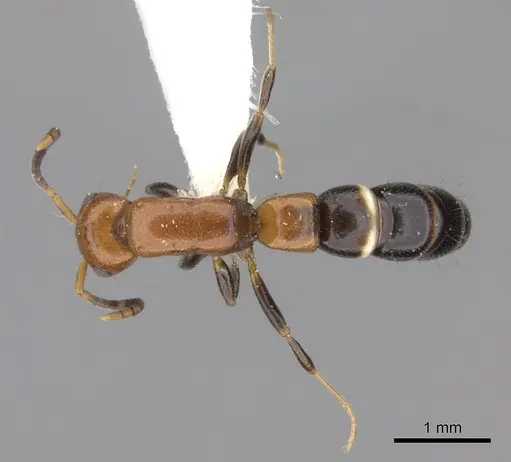
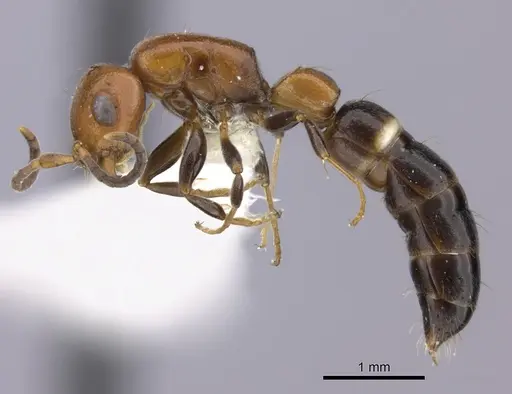
Tanipone cognata is an extremely rare ant from the Dorylinae subfamily, described in 2012 from a single specimen collected in Madagascar. That specimen is an ergatoid queen - a wingless reproductive female that looks worker-like. It has a striking color pattern: the head, body middle (mesosoma), and waist segment (petiole) are orange, the legs are brown, and the rear abdomen (AIII onwards) is dark brown to blackish, with a continuous pale band across the tip of the third abdominal segment. Its entire upper surface is covered with a dense, fine net-like (microreticulate) texture, visible under a microscope. No workers of this species have ever been found, and almost nothing is known about its biology. It belongs to the Tanipone maculata species group .
Quick Summary
- Difficulty: Expert
- Origin & Habitat: Madagascar: Ifaty region (23°09'S,43°37'E). The one known specimen was collected in desert scrub forest using insecticide fogging of a succulent tree, Euphorbia stenoclada [1].
- Colony Type: Only a single ergatoid queen has been documented. No workers, males, or colony structure have ever been observed. The species remains completely unstudied [1].
- Size & Growth:
- Queen: No total body length measurement available. Head dimensions are known but do not represent full body size. The single specimen is comparable in head size to ergatoid queens of Tanipone maculata [1].
- Worker: Workers have never been described or collected [1].
- Colony: Unknown, no colony data exists [1].
- Growth: Unknown
- Development: Unknown, no brood development has ever been observed (Development timeline is entirely unstudied. No workers, larvae, or eggs have been documented for this species.)
- Antkeeping:
- Temperature: Unknown. Based on its dry Madagascar habitat, it may prefer warm, semi-arid conditions, but this is speculation. No specific data exists.
- Humidity: Unknown. The desert scrub forest origin suggests they might tolerate drier air than rainforest ants, but no confirmed data.
- Diapause: Unknown, no seasonal data available.
- Nesting: Unknown. The single specimen was collected from fogging a Euphorbia tree, hinting at possible arboreal nesting in arid vegetation, but unconfirmed.
- Behavior: Behavior is completely unstudied. No observations exist on foraging, aggression, or colony movement. As a Dorylinae, it may be predatory, but this is guesswork. Escape risk cannot be assessed.
- Common Issues: this species is known from a single specimen, no living colony has ever been seen, no workers have ever been described, making captive keeping impossible, the ergatoid queen was collected from a tree canopy, suggesting potential arboreal nesting that would require specialized setups, all care requirements would be pure speculation due to complete lack of data, as a Dorylinae, it may need live prey, but this is unconfirmed
Species Status and Availability
Tanipone cognata is among the least known ant species in the world. It was described in 2012 by Bolton and Fisher based on a single ergatoid queen collected in 1993 from Ifaty, Madagascar. No workers, additional queens, or colonies have ever been documented. This means Tanipone cognata is not available in the antkeeping hobby, it cannot be kept in captivity. The sole specimen was collected through insecticide fogging of a Euphorbia tree in desert scrub forest, which is all we know about its habitat. The fact that only an ergatoid (wingless queen) exists suggests the species may have ergatoid replacement reproductives like some other Dorylinae, but without workers this is unconfirmed [1].
Identification and Morphology
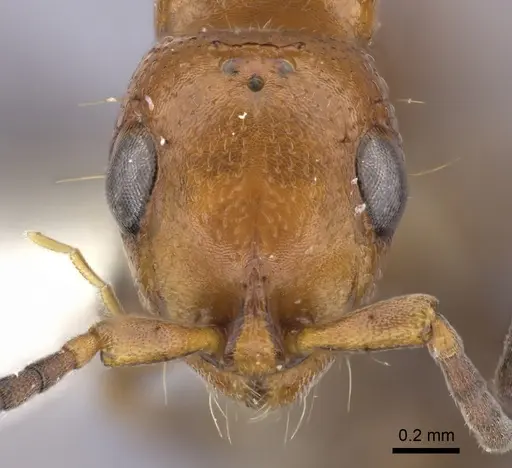
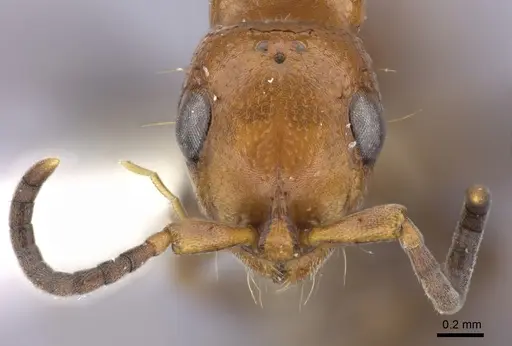
The holotype ergatoid queen has distinctive features. Its head is orange and about 1.00 mm long, but total body length is unknown. The middle part of the body (mesosoma) and the waist segment (petiole, AII) are also orange, while the legs are brown. The abdomen from the third segment (AIII) onward is dark brown to blackish, except for a continuous pale band across the tip of AIII. This band is slightly narrowed in the middle but not broken. A key identifier is the dense, fine net-like (microreticulate) sculpture covering all upper surfaces, you can see it under magnification. This specimen is believed to be an ergatoid gyne (wingless reproductive female), similar to those found in related species like Tanipone maculata [1].
Taxonomy and Relationships
Tanipone cognata belongs to the Tanipone maculata species group within the Dorylinae subfamily. The genus Tanipone was established in 2012 along with Vicinopone and Simopone as part of a major revision of cerapachyine ants. Dorylinae includes army ants known for predatory lifestyles and large colonies, but Tanipone's behavior is unknown. The bright orange coloration, dark abdomen, and pale band make this one of the most visually distinctive Tanipone species. The dense microreticulate sculpture on all dorsal surfaces suggests the specimen is an ergatoid gyne of a species whose workers remain undiscovered [1].
Why This Species Cannot Be Kept
Several reasons prevent keeping Tanipone cognata in captivity. First, no workers have ever been collected or described, you cannot start a colony without any. Second, the only known specimen was collected in 1993,and despite extensive ant surveys in Madagascar, no additional specimens have turned up. This indicates the species is either extremely rare, lives in inaccessible habitats, or may even be extinct. Third, even if a queen were somehow obtained, we have zero data on its biology: diet, temperature, nesting, colony cycle, all unknowns. For all these reasons, Tanipone cognata remains a scientific curiosity rather than a candidate for antkeeping [1].
Frequently Asked Questions
Can I keep Tanipone cognata ants?
No. Only a single ergatoid queen has ever been documented, no workers are known. Without workers, a colony cannot be established. No additional specimens have been found since 1993,so the species is likely extremely rare or localized [1].
What does Tanipone cognata look like?
The ergatoid queen has an orange head, mesosoma, and petiole, brown legs, and a dark brown to blackish abdomen with a continuous pale band across the tip of the third segment. Its entire upper surface is covered in a fine net-like (microreticulate) pattern. Total body length is unknown because only head measurements exist [1].
Where does Tanipone cognata live?
It is known only from Ifaty in southwestern Madagascar (23°09'S,43°37'E). The single specimen was collected by insecticide fogging of a Euphorbia tree in desert scrub forest. This hints at an arboreal lifestyle in arid vegetation [1].
Are there Tanipone cognata colonies in captivity?
No. No captive colonies exist anywhere. The species is known from only a single specimen collected in 1993,and no workers have ever been seen. It is one of the rarest ant species known [1].
What do Tanipone cognata ants eat?
Unknown. As a member of Dorylinae, it is likely predatory, but no feeding observations have been made. There is no dietary data for this species [1].
How big do Tanipone cognata colonies get?
Unknown. No colony size data exists because no workers have ever been collected. Dorylinae species can have large colonies, but we have no information for this species [1].
What temperature do Tanipone cognata ants need?
Unknown. Based on its Madagascar desert scrub forest habitat, it likely prefers warm, drier conditions, but no specific temperature data exists [1].
Why is Tanipone cognata so rare?
Only one specimen has been found. Possible explanations include very small localized populations, an arboreal lifestyle that makes them hard to collect, nocturnal activity, or genuine endangerment. Despite extensive ant surveys in Madagascar, no additional specimens have been found [1].
Is Tanipone cognata related to army ants?
Yes. Tanipone belongs to the Dorylinae subfamily, which includes classic army ants like Dorylus and Eciton. However, since only one specimen exists with no behavioral data, we cannot confirm whether it exhibits typical army ant raiding behavior [1].
Report an Issue
The current care sheet is based fully on literature. See inconsistencies, or something that's incorrect? Please , it will be resolved after review from an admin. Contributing to the blogs tab also helps providing information, to make us be able to further improve the caresheets. Thank you for your support!
References

此饲养指南授权协议为 CC BY-SA 4.0 .
社区博客
CASENT0195405
在 AntWeb 上查看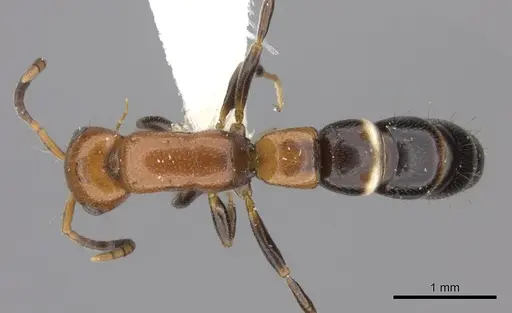
科学文献
正在加载分布地图...正在加载商品...