
Solenopsis abjectior
- 学名
- Solenopsis abjectior
- 族
- Solenopsidini
- 亚科
- Myrmicinae
- 命名者
- Pacheco & Mackay, 2013
- 地理分布
- 分布于 0 个国家/地区
物种引言
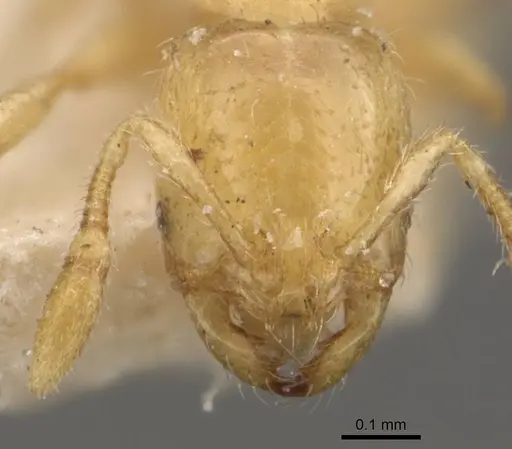
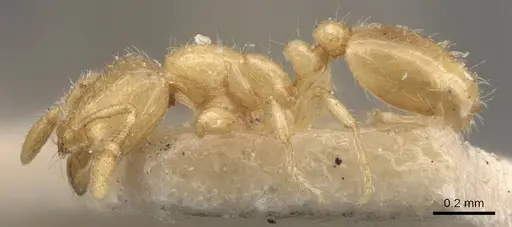
Solenopsis abjectior is an extremely tiny thief ant measuring just 1.31-1.32mm in total length, making it one of the smallest ant species you could keep . Workers are a uniform yellow color throughout their body, with a distinctive densely and coarsely punctate (dotted) head that helps separate this species from similar thief ants . The petiole (the narrow waist section) has a nearly rectangular shape with almost parallel front and back faces, and features a well-developed tooth on the subpeduncular process . This species belongs to the Solenopsis molesta species complex, a group of small ants known for their thieving behavior - they raid the nests of other ant species to steal brood and food . The type series was collected from inside the nest of Pheidole taurus, specifically in a separate chamber within that nest . This suggests these tiny ants may live as temporary social parasites or commensals within the nests of larger ant species, similar to how other thief ants operate. However, the biology of this specific species remains largely unstudied - it's known only from the original type collection, and no colonies have been documented in captivity or in the wild since .
Quick Summary
- Difficulty: Expert
- Origin & Habitat: Native to Buenos Aires, Argentina in the Neotropical region. Found nesting within the chambers of Pheidole taurus nests [1]. The natural habitat would be the temperate to subtropical regions of central Argentina.
- Colony Type: Unknown colony structure. Only worker caste has been described. The association with Pheidole taurus suggests possible temporary parasitic or commensal relationship, but this is unconfirmed.
- Size & Growth:
- Queen: Unknown, queen caste has not been described [2]
- Worker: 1.31-1.32mm total length [1]
- Colony: Unknown, only six workers in the type series ever collected [1]
- Growth: Unknown
- Development: Unknown, no development data exists. Based on similar tiny Solenopsis species, estimate 4-8 weeks at warm temperatures, but this is an educated guess. (Development timeline is entirely unstudied. Estimate based on genus patterns for small thief ants.)
- Antkeeping:
- Temperature: Keep at 22-26°C. This range is based on the temperate climate of Buenos Aires and typical requirements for small Solenopsis species. Provide a gentle temperature gradient so ants can choose their preferred spot.
- Humidity: Keep the nest substrate consistently moist but not waterlogged. These ants were found in a nest chamber, suggesting they prefer stable, moderately humid conditions.
- Diapause: Probably not required. Buenos Aires has mild winters, and related thief ants in temperate regions don't typically undergo true diapause. If your colony becomes less active in winter, you can provide a cooler area around 15-18°C, but this is optional.
- Nesting: Use very small, tight-fitting chambers. Given their tiny size (1.3mm), they need narrow passages and small chambers. A Y-tong (AAC) nest or carefully constructed plaster nest with fine chambers works well.
- Behavior: Extremely small and timid ants that likely avoid confrontation. Their association with larger Pheidole nests suggests they are adapted to living near or within other ant colonies, probably stealing food and brood [1]. They may accept small live prey like springtails, but this is unconfirmed. Escape prevention is critical, at 1.3mm, they can squeeze through gaps that seem sealed. Use fine mesh and check all connections carefully. They are not aggressive and are too small to sting humans.
- Common Issues: Escape prevention is critical, at 1.3mm they can squeeze through tiny gaps, including standard test tube cotton if not properly sealed., No established care guidelines exist, this is an expert-level species with virtually no biological data., Colony establishment may be impossible, only known from six workers ever collected, suggesting colonies are very small or hard to find., Feeding acceptance is unknown, you will need to experiment with various micro-prey items., Temperature and humidity requirements are inferred, not confirmed, monitor colony health closely.
Species Identification and Distinction
Solenopsis abjectior is a member of the Solenopsis molesta species complex, a group of small 'thief ants' known for their habit of raiding other ant nests [1]. This species can be identified by its tiny size (1.31-1.32mm total length), uniform yellow coloration, and most distinctively, its densely and coarsely punctate head, meaning the head surface is covered with coarse dots or pits [1]. The petiole (waist) has a nearly rectangular shape with almost parallel front and back faces, and features a well-developed tooth on the subpeduncular process underneath [2]. The antenna segments 3-8 are notably short [1]. These characteristics help separate it from similar species like Solenopsis decipiens, which also occurs in Argentina but lacks the punctate head [1]. Only the worker caste has been described, queens and males remain unknown [2].
Natural History and Nest Association
The only known specimens of Solenopsis abjectior were found inside the nest of Pheidole taurus in Buenos Aires, Argentina, in a separate chamber [1][2]. This suggests they may live in close association with larger Pheidole ants, possibly as temporary social parasites, commensals, or thief ants that steal from the host colony. This is consistent with the 'thief ant' common name, many Solenopsis species specialize in raiding other ant nests to steal brood and food. However, the exact nature of this relationship has not been studied. The species has never been collected outside of this single association, making it one of the most poorly known ant species in existence.
Housing and Escape Prevention
Given their tiny size of just 1.3mm [1], housing Solenopsis abjectior presents unique challenges. Standard ant keeping equipment is designed for ants at least 3-4mm, so you will need to adapt setups or construct custom housing with very small chambers and narrow passages. A Y-tong (AAC) nest with the smallest available chambers or a carefully poured plaster nest with fine tunnels would work best. Escape prevention cannot be overstated, these ants can squeeze through gaps that seem impossibly small. Use fine mesh (mesh size 0.5mm or finer), seal all connections with silicone or tape, and check regularly. Even standard test tube cotton can have gaps large enough for them to slip through. Consider using a thin layer of petroleum jelly or fluon on barrier surfaces. The outworld should also be small and escape-proof, a small plastic container with a tight-fitting lid works well.
Feeding and Diet
The diet of Solenopsis abjectior is entirely unstudied, but based on typical Solenopsis thief ant behavior, they likely feed on small insects, honeydew from aphids, and may steal brood from neighboring ant colonies [1]. For captive care, start with small live prey items: springtails are an ideal size, as are very small fruit fly larvae and tiny crickets. You might also offer a small drop of diluted honey or sugar water, though acceptance is uncertain. Given their association with Pheidole nests, they may have a specialized diet, perhaps feeding on the brood or food stores of their host. Be prepared to experiment, and remove any uneaten food promptly to prevent mold. Start with very small portions and observe over 24-48 hours before offering more.
Temperature and Seasonal Care
Based on the temperate climate of Buenos Aires (where the type locality is located), these ants likely prefer temperatures in the low-to-mid 20s Celsius. Aim for 22-26°C as a starting point, with a gentle gradient so workers can move to their preferred temperature zone [1]. Buenos Aires has mild winters with temperatures rarely dropping below 5°C, so a true hibernation or diapause is likely not required. However, if your colony shows reduced activity during winter months, providing a cooler area around 15-18°C may be beneficial. Avoid temperature extremes, sudden drops below 15°C or spikes above 30°C could be harmful. Use a small heat mat on one side of the nest if room temperature is below 22°C.
Expert Keeper Notes
Solenopsis abjectior is not a species for beginners. It is known only from six worker specimens collected over a century ago, and no biologist has ever documented a living colony [1][2]. Everything we know about its care is inferred from related species and the limited natural history data available. You will essentially be pioneering the husbandry of a species that has never been kept in captivity. Be prepared for challenges: obtaining a colony may be impossible (they've never been sold or traded), feeding acceptance is uncertain, and even basic questions about colony size and structure remain unanswered. If you do obtain this species, document everything carefully, your observations could be the first biological data ever recorded for this mysterious little ant.
Frequently Asked Questions
How big do Solenopsis abjectior ants get?
Workers are extremely tiny at just 1.31-1.32mm total length, making them one of the smallest ant species in the world [1]. For comparison, a typical house ant is 5-7mm, these are about 4-5 times smaller. Queens have never been described, so their size is unknown [2].
What do Solenopsis abjectior ants eat?
Their exact diet is unknown, but as thief ants in the Solenopsis molesta complex, they likely feed on small insects, honeydew, and may steal brood from neighboring ant colonies [1]. In captivity, offer small live prey like springtails, tiny fruit fly larvae, and a small drop of diluted honey or sugar water. Start with tiny portions and remove uneaten food promptly.
Can I keep Solenopsis abjectior in a test tube?
You can try, but standard test tubes may be too large for these tiny 1.3mm ants. If using a test tube, ensure the cotton is tightly packed and consider adding a barrier like petroleum jelly at the entrance. A better option would be a custom-built nest with very small chambers scaled to their minute size.
Are Solenopsis abjectior good for beginners?
No. This is an expert-level species that has never been documented in captivity. There are no established care guidelines, and the species is known only from six workers collected in 1909 [1][2]. Obtaining a colony may be impossible, and even basic requirements are unknown. This species is for experienced antkeepers who want to pioneer husbandry of an unstudied species.
What temperature do Solenopsis abjectior ants need?
Based on the temperate climate of Buenos Aires, keep them at 22-26°C with a gentle gradient [1]. Avoid temperatures below 15°C or above 30°C. A small heat mat on one side of the nest can help maintain warmth if room temperature is below 22°C.
How fast do Solenopsis abjectior colonies grow?
Unknown, no development data exists for this species. Based on similar tiny Solenopsis species, estimate 4-8 weeks from egg to first worker at warm temperatures, but this is purely an educated guess. Colony size in the wild is unknown, only six workers have ever been collected [1].
Do Solenopsis abjectior need hibernation?
Probably not. Buenos Aires has mild winters, and related thief ants in temperate regions don't typically undergo true diapause [1]. However, if your colony shows reduced activity in winter, providing a cooler area around 15-18°C may be beneficial. A cool period is likely acceptable but not required.
Why is Solenopsis abjectior called a thief ant?
They belong to the Solenopsis molesta species complex, a group commonly called 'thief ants' because they specialize in raiding the nests of other ant species to steal brood and food [1]. The type specimens were found inside a Pheidole taurus nest, confirming this thieving lifestyle [1].
Where is Solenopsis abjectior found?
Only known from Buenos Aires, Argentina, the type locality [1][2]. The species has never been collected anywhere else. It remains one of the rarest and most poorly known ant species in the world, with only six workers ever documented.
Report an Issue
The current care sheet is based fully on literature. See inconsistencies, or something that's incorrect? Please , it will be resolved after review from an admin. Contributing to the blogs tab also helps providing information, to make us be able to further improve the caresheets. Thank you for your support!
References

此饲养指南授权协议为 CC BY-SA 4.0 .
社区博客
CASENT0908829
在 AntWeb 上查看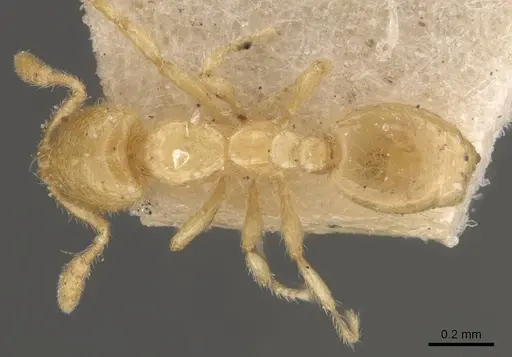
科学文献
正在加载分布地图...正在加载商品...