
Simopone merita
- 学名
- Simopone merita
- 亚科
- Dorylinae
- 命名者
- Bolton & Fisher, 2012
- 地理分布
- 分布于 0 个国家/地区
物种引言
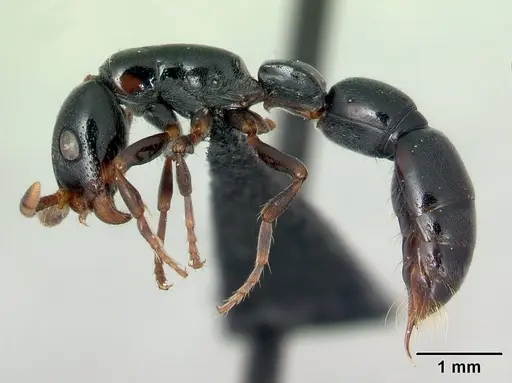
Simopone merita is a small, dark ant native to Madagascar, belonging to the Dorylinae subfamily. Workers are black with lighter-coloured appendages and a dull red spot on the pronotum and the third abdominal segment . The species was described in 2012 from a single worker collected in montane rainforest at 1280 m elevation in the Anjanaharibe-Sud Reserve . So far only the worker caste is known - the queen and male remain undescribed, and no colony-level biology has been documented. This makes Simopone merita one of the most poorly understood ants from Madagascar's rich endemic fauna.
Quick Summary
- Difficulty: Expert
- Origin & Habitat: Montane rainforest in the Anjanaharibe-Sud Reserve, northern Madagascar, at approximately 1280 m elevation [1].
- Colony Type: Unknown, only the worker caste has been described [1].
- Size & Growth:
- Queen: Unknown, queen caste not described [1]
- Worker: Size data unavailable (only head and mesosoma measurements published, no total body length) [1]
- Colony: Unknown
- Growth: Unknown
- Development: Unknown, development has not been studied (No direct observations of colony development exist for this species.)
- Antkeeping:
- Temperature: Unconfirmed. Based on its montane rainforest origin (1280 m), the species likely prefers cooler temperatures than lowland tropical ants, guess around 20-24 °C. This is only an estimate, actual needs require captive observation.
- Humidity: High humidity needed. Keep the nest substrate consistently moist but not waterlogged, reflecting the constantly wet montane environment [1].
- Diapause: Unknown. Madagascar has mild winters, but montane populations may experience seasonal cooling. No data available.
- Nesting: Natural nesting habits are unknown. For captivity, a Y‑tong (AAC), plaster, or soil nest with good moisture retention is a reasonable starting point. Avoid dry setups.
- Behavior: Behavior is unstudied. As a Dorylinae, it is likely a predator of small invertebrates. Give excellent escape prevention because the workers are tiny. Temperament is unknown, some Dorylinae are aggressive, others cryptic.
- Common Issues: complete lack of biological data makes all care guidance speculative, queen and founding method are unknown, cannot reliably start a colony, diet preferences are unknown, no confirmed food source, high escape risk due to small worker size, need very fine mesh or full enclosure sealing, no information on sting or other defence, handle with caution
Species Identification and Description
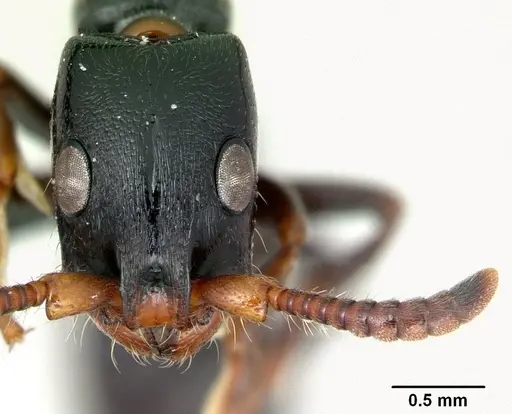
Simopone merita workers are small and black, with lighter-coloured legs and clypeus. A dull red spot is present on the side of the pronotum and on the side of the third abdominal segment [1]. The head is densely punctate between the eyes, and the frontal lobes do not project beyond the front margin of the clypeus. The eyes are positioned near the middle of the head, and the leading edge of the scape (first antennal segment) carries 3-4 long, forward‑pointing setae [1]. The pronotum has a single pair of setae near the humeri, while the mesonotum and propodeum lack setae entirely. This species belongs to the emeryi species group, which is defined by a combination of morphological traits [1].
Distribution and Habitat
Simopone merita is known only from the type locality in Madagascar: the Anjanaharibe‑Sud Reserve, about 9.2 km west‑southwest of Befingotra (14°45′S,49°28′E) [1]. The single worker was collected at 1280 m elevation in montane rainforest using a Malaise trap [1]. This is a high‑altitude tropical forest with constant moisture and moderate temperatures. No other collecting records exist, which may indicate a restricted distribution or simply a lack of sampling. The habitat suggests this ant is adapted to cool, humid conditions.
Taxonomy and Classification
Simopone merita was described by Barry Bolton and Brian Fisher in 2012 during a comprehensive revision of the cerapachyine ant genera [1]. It is placed in the subfamily Dorylinae, which includes the true army ants and their relatives. Within Simopone, the species belongs to the emeryi species group. The holotype (the single specimen on which the description is based) is a worker housed at the California Academy of Sciences [1]. This species is part of Madagascar's exceptionally diverse but poorly documented ant fauna.
Keeping Simopone merita in Captivity
Because almost nothing is known about the biology of this ant, keeping it in captivity is a true challenge. The queen has never been seen, colony size and founding method are unknown, and even basic behaviours have not been observed. If a colony were obtained, housing should mimic the natural habitat: a Y‑tong, plaster, or soil nest that retains moisture well, with temperatures roughly 20-24 °C and high humidity. A small outworld with fine ventilation but no gaps is essential, the workers are very small and will escape through the tiniest openings. Diet is speculative, but given the subfamily, offer small live prey such as springtails (Collembola) or fruit‑fly larvae. This species is only for expert antkeepers who are prepared to experiment and document their findings. [1]
Research Gaps and Future Study
Simopone merita represents one of the biggest knowledge gaps in the hobby. The queen, male, colony founding, colony size, diet, nuptial flight timing, development rate, all remain completely unknown. The species was described only in 2012,and no subsequent biological studies have been published. Captive keepers who manage to obtain and maintain a colony would make a significant contribution by recording any observations of behaviour, reproduction, and food acceptance. Because the natural habitat is montane rainforest, humidity and temperature likely differ from typical lowland tropical species. Every piece of information, even negative results (e.g., what foods are rejected), would help future keepers. [1]
Frequently Asked Questions
What does Simopone merita look like?
Workers are small and black, with lighter‑coloured legs and clypeus. They have a dull red spot on the side of the pronotum and on the side of the third abdominal segment. The head is densely punctate and the eyes are positioned near the middle of the head [1].
Where is Simopone merita found?
This species is known only from montane rainforest in the Anjanaharibe‑Sud Reserve in northern Madagascar, at approximately 1280 m elevation [1].
Is Simopone merita available for antkeeping?
This species is extremely rare in the hobby. It was described only in 2012 and has a very limited known distribution. No commercial sources or established captive colonies are known.
What do Simopone merita ants eat?
Diet is unconfirmed. As a Dorylinae ant, it is likely a predator of small invertebrates. Related army ants often hunt springtails (Collembola) and other tiny arthropods. In captivity, offer small live prey such as springtails or fruit‑fly larvae.
How big do Simopone merita colonies get?
Colony size is unknown. No data exists on maximum colony size or typical colony structure for this species.
What temperature do Simopone merita ants need?
Unconfirmed. Based on the montane rainforest habitat (1280 m), they likely prefer cooler temperatures than typical tropical ants, approximately 20-24 °C. This is a rough estimate, not confirmed by direct observation.
Do Simopone merita ants need hibernation?
Diapause requirements are unknown. Madagascar has mild winters, but montane populations may experience cooler periods. More research is needed.
Can I keep Simopone merita in a test tube?
A test tube might work temporarily, but this species probably requires higher humidity than a standard test‑tube setup provides. A Y‑tong, plaster, or soil nest with better moisture retention would be more appropriate.
How long does it take for Simopone merita to develop from egg to worker?
The development timeline is completely unknown. No observations of brood development exist for this species.
Is Simopone merita good for beginners?
No. This species is not recommended for beginners due to the complete lack of biological data. Even expert antkeepers would be working with speculation rather than established care guidelines.
What is the queen of Simopone merita like?
Unknown. The queen caste has not been described in scientific literature. Only workers are known from the type specimen [1].
Report an Issue
The current care sheet is based fully on literature. See inconsistencies, or something that's incorrect? Please , it will be resolved after review from an admin. Contributing to the blogs tab also helps providing information, to make us be able to further improve the caresheets. Thank you for your support!
References

此饲养指南授权协议为 CC BY-SA 4.0 .
社区博客
CASENT0004543
在 AntWeb 上查看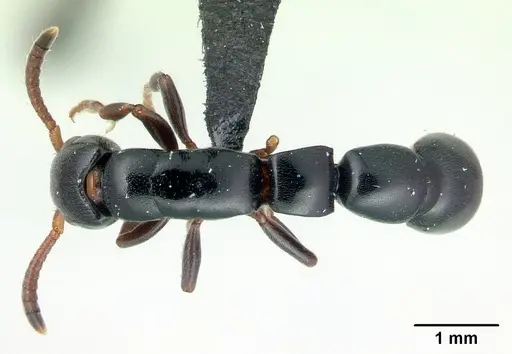
科学文献
正在加载分布地图...正在加载商品...