
Recurvidris nuwa
- 学名
- Recurvidris nuwa
- 族
- Crematogastrini
- 亚科
- Myrmicinae
- 命名者
- Xu & Zheng, 1995
- 地理分布
- 分布于 0 个国家/地区
物种引言
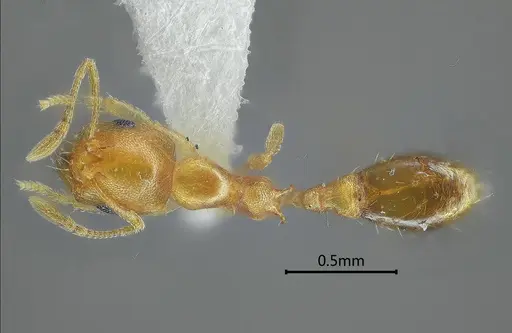
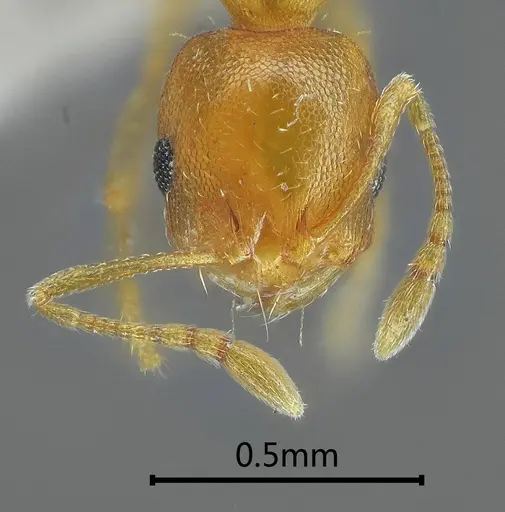
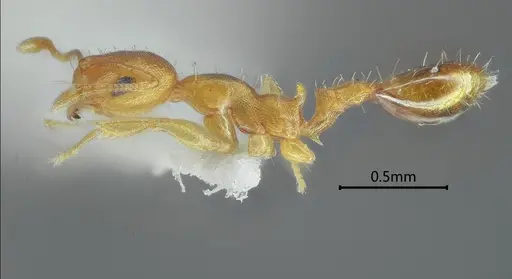
Recurvidris nuwa is a tiny Myrmicinae ant species endemic to southern China, found in Yunnan and Guizhou provinces . Workers are small, measuring approximately 2-3mm, with the characteristic recurved (hooked) mandibles that give the genus its name - they have 4 teeth on the masticatory margin, the basal tooth being acute . The head behind the frontal lobes is unsculptured, and the propodeum lacks the ridge or lamella that connects the spines to the metapleural lobe . This species lives in secondary forests and rubber plantations at elevations around 780m but is absent from primary forest . The genus Recurvidris is poorly studied, and this species is almost unknown in captivity.
Quick Summary
- Difficulty: Unknown
- Origin & Habitat: Southern China (Yunnan and Guizhou provinces), subtropical forest edges and disturbed habitats including rubber plantations [3][1]. Found at elevations around 780m in secondary forest and agricultural areas, not in primary forest [3].
- Colony Type: Unknown, but based on typical Recurvidris patterns, likely single-queen (monogyne) colonies.
- Size & Growth:
- Queen: Unknown, no queen measurements are documented for this species.
- Worker: Approximately 2-3mm, inferred from the Recurvidris genus. No specific measurements exist for this species.
- Colony: Unknown, no data available.
- Growth: Unknown
- Development: Estimated 6-8 weeks, based on typical Myrmicinae development under warm subtropical conditions. (This timeline is a rough estimate from related species. No studies have been done on this species.)
- Antkeeping:
- Temperature: Aim for 22-26°C. Being from subtropical southern China, it prefers warmth. Room temperature is usually fine, but you may need a heating cable on one side in cooler months.
- Humidity: Moderate to high, think forest edge conditions. Keep the nest substrate moist but not waterlogged, and provide a humidity gradient.
- Diapause: Likely no strong diapause needed, from subtropical southern China, they probably stay active year-round with slower activity in winter.
- Nesting: They probably nest in soil or under stones in nature. In captivity, a small test tube setup or Y-tong nest with fine chambers works well for their tiny size.
- Behavior: These tiny ants are docile and not aggressive. They have a modified stinger used for smearing venom rather than piercing (typical of Crematogastrini), but they pose no real threat to humans. Their small size means you must use excellent escape prevention, fine mesh on all openings and check seals regularly.
- Common Issues: tiny size makes escape likely without fine mesh barriers, no captive breeding history means established protocols don't exist, unknown founding behavior may lead to queen failure, humidity control is critical to prevent desiccation, limited availability makes this species very rare in the hobby
Natural History and Distribution
Recurvidris nuwa is endemic to southern China, specifically Yunnan and Guizhou provinces [1]. The type locality is Duyun City in Guizhou, at about 780m elevation [1]. This species prefers disturbed habitats, it has been found in secondary forests and rubber plantations, but it is absent from primary forest [3]. That pattern suggests it does well in edge habitats and open areas rather than dense canopy. Distribution records confirm it is a China-endemic with a restricted range in the southwest.
Identification and Morphology
Workers are small (about 2-3mm). The genus is known for its recurved mandibles, 'Recurvidris' means 'bent backward.' The masticatory margin of the mandible has 4 teeth, with an acute basal tooth [2]. The head behind the frontal lobes is smooth (unsculptured), and the propodeal declivity lacks the ridge or lamella that connects the spines to the metapleural lobe in some related genera [2]. The propodeal dorsum has fine dense reticulate-rugulae and lacks the short decumbent hairs seen in some other Recurvidris species [2]. These features set it apart from similar species.
Housing and Nesting
Given their natural habitat (secondary forest edges and rubber plantations), these ants likely nest in soil or under stones where moisture is retained. For captive care, a small test tube setup works well for founding. Because workers are tiny (2-3mm), use appropriately scaled nest chambers, narrow passages and small chambers make the colony feel secure. A Y-tong (AAC) nest with fine chambers or a small plaster nest is also suitable. Always use excellent escape prevention: these ants can slip through incredibly small gaps. Put fine mesh over all ventilation holes and check lid seals frequently.
Feeding and Diet
Like most Myrmicinae, Recurvidris nuwa is probably a generalist forager that takes both protein and sugar. Offer small insects such as fruit flies, pinhead crickets, or tiny mealworms as protein. Provide sugar water, honey, or diluted honey continuously. Because the ants are small, prey items should be small too, very tiny insects or pre-killed arthropods work better than large prey. Watch what your colony accepts and adjust. Always have fresh water available.
Temperature and Humidity
Coming from subtropical southern China (Yunnan and Guizhou), this species likes warmth, aim for 22-26°C. Room temperature is usually fine, but you can use a heating cable on one side of the nest during cooler months. For humidity, provide moderate to high levels, the natural forest-edge habitat stays humid. Keep the nest substrate moist but not soaked, and create a humidity gradient so the ants can choose. A water tube attached to the test tube or nest helps maintain moisture.
Colony Development
No specific development data exists for this species. Based on typical Myrmicinae development in warm subtropical conditions, you can expect eggs to turn into workers in about 6-8 weeks at 24-26°C. The first workers (nanitics) will probably be smaller than mature workers. Growth is likely slow at first, a founding colony may take several months to build up a stable worker force. Be patient and avoid disturbing the queens unnecessarily. Once the colony grows, development should speed up.
Frequently Asked Questions
How long does it take for Recurvidris nuwa to produce first workers?
The exact timeline is unknown, but based on typical Myrmicinae development in subtropical conditions, expect 6-8 weeks from egg to worker at optimal temperatures (22-26°C).
What do Recurvidris nuwa ants eat?
They likely take small insects (fruit flies, tiny crickets) for protein and sugar sources (honey water, sugar water). Because they are tiny, prey should be very small.
Can I keep Recurvidris nuwa in a test tube?
Yes, a test tube setup works well for founding. Make sure it has a water reservoir and a cotton plug, with enough humidity but not flooding.
Do Recurvidris nuwa ants sting?
This is a small Myrmicinae ant. They have a stinger, but it is modified for smearing venom rather than piercing (typical of Crematogastrini). They are not aggressive and pose no danger to humans.
What temperature do Recurvidris nuwa ants need?
Keep them at 22-26°C. They come from subtropical southern China and prefer warmth. Room temperature is often fine, but you may need extra heat in cooler climates.
Are Recurvidris nuwa good for beginners?
Difficulty level is unknown because this species is rarely kept. Their tiny size and specific habitat needs may be challenging. They are best for experienced antkeepers who want rare species.
How big do Recurvidris nuwa colonies get?
Colony size is unconfirmed. Based on small worker size and genus patterns, colonies likely stay under a few hundred workers at most, but this is just a guess.
Do Recurvidris nuwa need hibernation?
Likely no strong hibernation needed. They are from subtropical southern China and probably stay active year-round, with slower activity in winter. No formal diapause is required.
Why are my Recurvidris nuwa escaping?
Their tiny size (2-3mm) lets them slip through really small gaps. Use fine mesh over all ventilation, check lid seals often, and apply barrier such as fluon or PTFE to edges.
Where is Recurvidris nuwa found in the wild?
This species is endemic to southern China, specifically Yunnan and Guizhou provinces. It lives in secondary forests and rubber plantations at around 780m elevation, but not in primary forest [3][1].
Report an Issue
The current care sheet is based fully on literature. See inconsistencies, or something that's incorrect? Please , it will be resolved after review from an admin. Contributing to the blogs tab also helps providing information, to make us be able to further improve the caresheets. Thank you for your support!
References

此饲养指南授权协议为 CC BY-SA 4.0 .
社区博客
ANTWEB1060573
在 AntWeb 上查看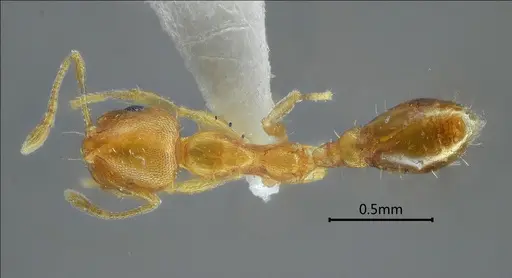
科学文献
正在加载分布地图...正在加载商品...