
Protanilla izanagi
- 学名
- Protanilla izanagi
- 族
- Leptanillini
- 亚科
- Leptanillinae
- 命名者
- Terayama, 2013
- 地理分布
- 分布于 0 个国家/地区
物种引言
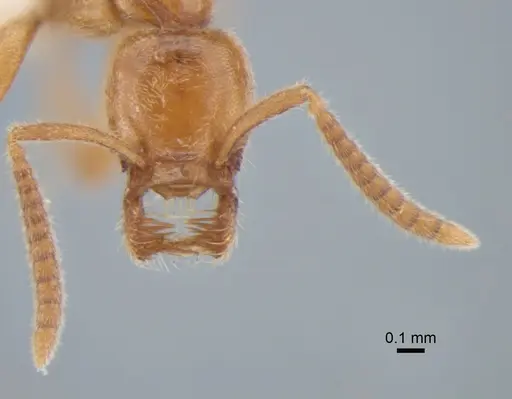
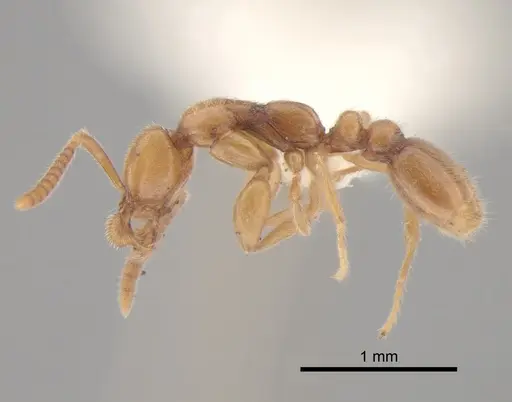
Protanilla izanagi is a tiny ant species from the Leptanillinae subfamily, native to Japan. Workers measure 3.5 mm in total length, and queens are 3.9 mm . They have a reddish-brown body with yellowish antennae and legs . Their mandibles feature a large longitudinal groove, a key identifying characteristic . They are completely blind, with no eyes . This species belongs to the Protanilla izanagi species group . This is an extremely rare species in antkeeping, with very limited captive care information. As a Leptanillinae, they are likely subterranean predators. Specimens have been collected from mountainous areas in central Japan at elevations around 830 meters .
Quick Summary
- Difficulty: Expert
- Origin & Habitat: Japan (Honshu island) in mountainous areas at elevations around 830 meters [1][4].
- Colony Type: Unconfirmed, no direct observations, but type specimens suggest single-queen colonies [1].
- Size & Growth:
- Antkeeping:
- Temperature: Unknown, no thermal studies exist.
- Humidity: Unknown, no specific data, but likely requires moist conditions due to subterranean nature.
- Diapause: Unknown, no seasonal studies exist.
- Nesting: Unknown, no specific data, but based on subterranean lifestyle, a dark, humid nest might be suitable.
- Behavior: This species is completely blind and relies on chemical cues for navigation. They are likely slow-moving and cryptic. Escape risk is high due to their tiny size (3.5 mm), so fine barriers are recommended.
- Common Issues: no documented captive breeding success, this species may be extremely difficult to establish in captivity, blind and subterranean lifestyle means they are stress-sensitive to light and disturbance, complete lack of natural history data makes care recommendations highly speculative, extremely rare in the hobby with no established protocols for husbandry, high humidity requirements can lead to mold issues if ventilation is inadequate
Species Identification and Physical Characteristics
Protanilla izanagi workers are tiny at 3.5 mm total length, while queens reach 3.9 mm [1]. The most distinctive feature is their mandibles with a large longitudinal groove running from the base to the terminal quarter [1][2]. Their body is reddish-brown with yellowish antennae and legs [1]. They completely lack eyes, typical of subterranean Leptanillinae [1]. The head is longer than wide, with almost straight posterior margin and convex sides [1]. Antennae have 12 segments, with the scape exceeding the posterior margin of the head [1].
Distribution and Habitat
This species is endemic to Japan, specifically Honshu island. Type specimens were collected from Nishibora in Gifu Prefecture at approximately 830 meters elevation, and additional specimens from Hiroshima Prefecture [1][4]. This mountainous distribution suggests cooler, damp forest floor environments [1].
Taxonomy and Phylogeny
Protanilla izanagi belongs to the subfamily Leptanillinae. Within the genus, it is part of the P. izanagi species group, sister to the P. bicolor species group based on phylogenomic analysis [3]. The species was described by Mamoru Terayama in 2013 [1].
Known Biology and Care Speculation
Almost no natural history information exists for Protanilla izanagi. As a Leptanillinae, they are presumed to be predatory on small soil invertebrates, similar to related genera like Opamyrma [5]. Their blindness suggests a subterranean lifestyle [1]. No captive colonies have been documented, so care protocols are unconfirmed.
Housing Recommendations
No specific housing data exists for Protanilla izanagi. Based on their blind and subterranean nature [1], a dark, humid nest is likely needed, but protocols are unconfirmed. General Leptanillinae biology suggests avoiding light and maintaining moisture.
Feeding and Diet
Diet is unconfirmed. As Leptanillinae, they are likely predatory on small soil invertebrates [5], but no specific data for this species. In captivity, offering small live prey like springtails could be experimented with, but success is unknown.
Frequently Asked Questions
How big do Protanilla izanagi ants get?
Workers are 3.5 mm total length, and queens are 3.9 mm [1].
Where is Protanilla izanagi found in the wild?
This species is endemic to Japan, specifically Honshu island, from mountainous areas at elevations around 830 meters [1][4].
Are Protanilla izanagi ants blind?
Yes, completely blind. They have no eyes [1].
What do Protanilla izanagi ants eat?
Their diet is unconfirmed, but based on related Leptanillinae, they are likely predatory on small soil invertebrates [5].
How long does it take for Protanilla izanagi to develop from egg to worker?
Unknown, no development timing data exists for this species.
Do Protanilla izanagi ants need hibernation?
Unknown, no seasonal studies exist.
Are Protanilla izanagi good for beginners?
No. This species is not recommended for beginners due to extreme rarity and lack of captive care information.
What makes Protanilla izanagi different from other ants?
They have uniquely grooved mandibles, are completely blind, tiny (3.5 mm workers), and one of the rarest species in antkeeping [1][2].
Can I keep multiple Protanilla izanagi queens together?
Not recommended. The species is likely monogyne based on type specimens, but no data on multiple queens exists [1].
What temperature should I keep Protanilla izanagi at?
Unknown, no specific data exists.
How do I identify Protanilla izanagi?
Look for the distinctive mandibular groove, tiny size (3.5 mm workers), blindness, and reddish-brown body [1][2].
Why is there so little information about Protanilla izanagi?
This is an extremely rare species with a limited distribution in central Japan. Very few specimens have been collected, and there are no documented captive breeding attempts [1].
Report an Issue
The current care sheet is based fully on literature. See inconsistencies, or something that's incorrect? Please , it will be resolved after review from an admin. Contributing to the blogs tab also helps providing information, to make us be able to further improve the caresheets. Thank you for your support!
References

此饲养指南授权协议为 CC BY-SA 4.0 .
社区博客
CASENT0842850
在 AntWeb 上查看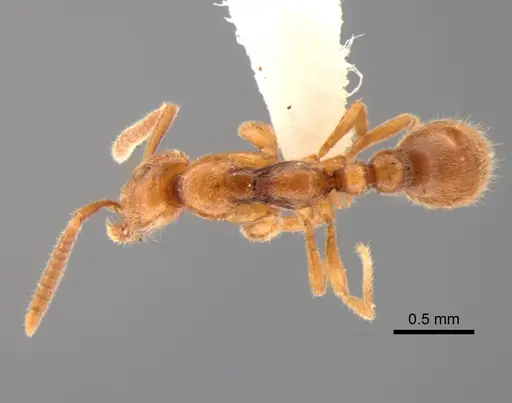
科学文献
正在加载分布地图...正在加载商品...