
Polyrhachis lama
- 学名
- Polyrhachis lama
- 亚属
- Myrmhopla
- 族
- Camponotini
- 亚科
- Formicinae
- 命名者
- Kohout, 1994
- 地理分布
- 分布于 0 个国家/地区
物种引言
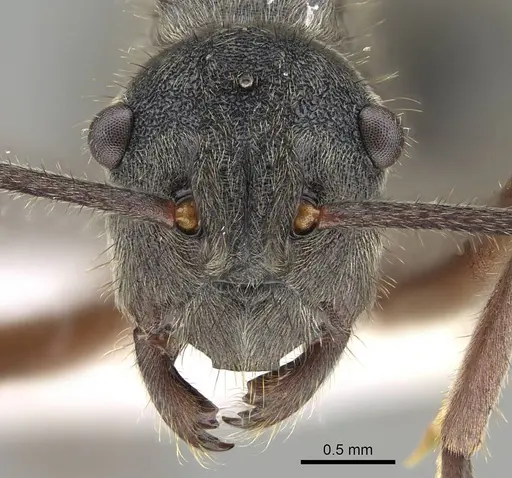
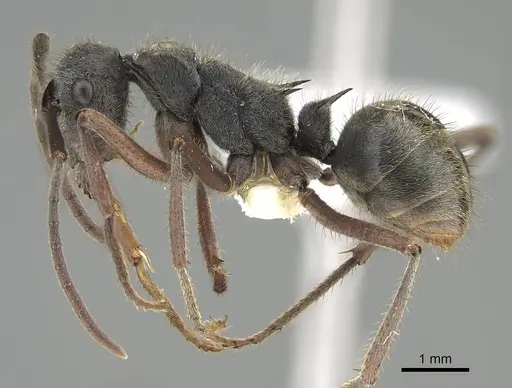
Polyrhachis lama is a parasitic ant species native to Tibet, Indonesia, the Philippines, and southern China . Workers have a total length of approximately 8.1-8.7 mm, with dark reddish-brown coloration and well-developed propodeal and petiolar spines . This species is extraordinary because it is an obligatory social parasite that lives exclusively in nests of Diacamma species, a host from a different subfamily . Unlike typical slave-making ants, P. lama workers invade neighboring host colonies, carry their own eggs and larvae, and have host workers raise them .
Quick Summary
- Difficulty: Expert
- Origin & Habitat: Found in Tibet, Indonesia, the Philippines, and southern China. In Java, it inhabits subterranean nests of Diacamma sp. [5][3][2].
- Colony Type: Parasitic species living within Diacamma host colonies. Single-queen colonies, with workers capable of invading neighboring host nests [3][4]. Workers are not inseminated and produce only males [3].
- Size & Growth:
- Antkeeping:
- Temperature: Temperature needs are unclear, based on host Diacamma from tropical Java, start around 24-28°C and observe [3].
- Humidity: Subterranean nesting suggests moderate humidity. Keep nest substrate consistently moist but not waterlogged [5].
- Diapause: Unknown, Tibetan populations may experience cooler temperatures, but no specific data [1].
- Nesting: Obligate inquiline, must be kept with live Diacamma host colonies. Subterranean nesting in natural conditions [5].
- Behavior: P. lama workers integrate with Diacamma hosts through chemical camouflage. The parasite brood is accepted only when adult P. lama workers are present [2]. Workers actively invade neighboring host colonies to expand their colony [2]. This species is not aggressive and relies on host integration. Escape risk is moderate given worker size.
- Common Issues: this species cannot be kept without a living Diacamma host colony, it is an obligatory inquiline, finding and maintaining a Diacamma colony is extremely difficult as they are specialized ponerine ants, the dual-species setup makes care exponentially more complex than standard ant keeping, p. lama workers cannot reproduce independently, they can only produce males, the species has never been documented in captive breeding and may be impossible to maintain long-term
The Parasitic Lifestyle
Polyrhachis lama represents one of the most unusual cases of social parasitism in ants [6][3]. It parasitizes Diacamma species from the subfamily Ponerinae, a rare cross-subfamily association [6]. Integration works through chemical allomones that allow host workers to accept parasite brood, but only when adult P. lama workers are present [2]. Workers invade neighboring Diacamma colonies carrying eggs or larvae, which host workers raise using their own food [2]. A single P. lama colony can exploit multiple host colonies simultaneously.
Housing Requirements
Housing P. lama is extremely challenging because it is an obligatory inquiline that cannot survive without a living Diacamma host colony [5][3]. You must first establish a Diacamma colony and then introduce the parasite. Diacamma species are specialized ants with complex care requirements. If attempting this setup, use a naturalistic nest with multiple chambers for both species. Temperature and humidity should match Diacamma needs, roughly 24-28°C with moderate humidity [3][5].
Reproduction and Colony Structure
P. lama has an unusual reproductive system. The queen produces female offspring, but workers are not inseminated and can only produce males through parthenogenesis [3]. Most parasitized Diacamma nests contain only P. lama workers and mixed brood, with few containing a queen [3][4]. Workers can invade new host colonies to establish satellite nests, allowing a single parasite colony to span multiple host nests.
Why This Species Is Not Recommended for Keepers
Polyrhachis lama should not be kept by anyone except specialized researchers. It is an obligatory social parasite that requires a living Diacamma host colony, which is difficult to obtain and maintain. The dual-species relationship has never been successfully replicated in captivity. Ethical concerns include disrupting wild colonies and harming the host. For antkeepers interested in parasites, temporary social parasites like Formica or Polyergus are more practical options. [3][4]
Frequently Asked Questions
Can I keep Polyrhachis lama in a test tube setup?
No. Polyrhachis lama is an obligatory inquiline that cannot survive without a living Diacamma host colony. A test tube setup is completely unsuitable, you need a complex naturalistic setup with both species established, which has never been documented in captivity [5][3].
How do I get a Polyrhachis lama colony?
You cannot obtain or maintain a P. lama colony. This species is an obligatory social parasite that lives exclusively within Diacamma nests. There are no documented cases of successful captive breeding, and obtaining both species would require field collection that harms wild populations [3][4].
Do Polyrhachis lama workers have a queen?
Some parasitized nests contain a P. lama queen, but most contain only workers and mixed brood [3]. The queen produces female offspring while workers produce only males through parthenogenesis [3].
What do Polyrhachis lama eat?
P. lama workers participate in prey items brought into the nest by host Diacamma workers [3]. They do not forage independently but rely on the host colony for food.
Are Polyrhachis lama ants dangerous?
P. lama workers are about 8 mm and not particularly aggressive, they rely on chemical integration. However, their host Diacamma species may have functional stingers. The real danger is that you cannot keep this species without its host.
How long do Polyrhachis lama live?
This is unknown. Their lifecycle is intertwined with their Diacamma hosts, and no captive studies exist. In the wild, they live within host colonies where the queen may persist for years.
Can I keep multiple queens together?
This has not been studied in captivity. In the wild, some nests contain a P. lama queen while others contain only workers, suggesting flexibility. However, combining unrelated foundresses would be irrelevant since this species cannot found colonies independently [3].
Do Polyrhachis lama need hibernation?
Unknown. Tibetan populations may experience cooler temperatures, but specific diapause requirements have not been documented [1].
Why is Polyrhachis lama a special ant?
P. lama is one of the few ant species that parasitizes a host from a completely different subfamily. It has evolved an exceptional integration strategy using chemical allomones, and its workers can establish satellite nests by invading neighboring host colonies [6][3].
Is Polyrhachis lama good for beginners?
Absolutely not. This species is among the most difficult ants to keep, effectively impossible for anyone except specialized researchers. Even experienced antkeepers should not attempt it.
Report an Issue
The current care sheet is based fully on literature. See inconsistencies, or something that's incorrect? Please , it will be resolved after review from an admin. Contributing to the blogs tab also helps providing information, to make us be able to further improve the caresheets. Thank you for your support!
References

此饲养指南授权协议为 CC BY-SA 4.0 .
社区博客
CASENT0919909
在 AntWeb 上查看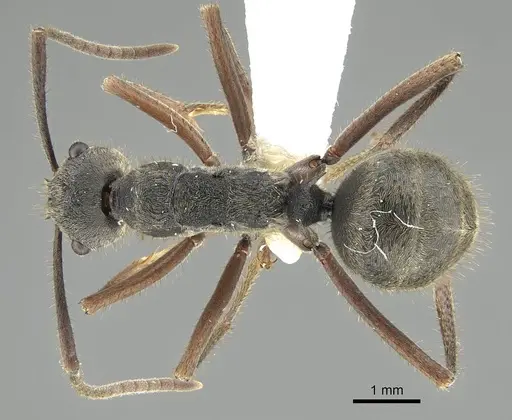
科学文献
正在加载分布地图...正在加载商品...