
Neivamyrmex curvinotus
- 学名
- Neivamyrmex curvinotus
- 亚科
- Dorylinae
- 命名者
- Watkins, 1994
- 地理分布
- 分布于 0 个国家/地区
物种引言
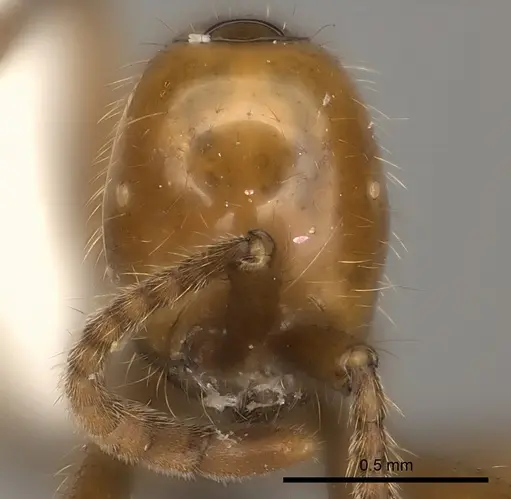
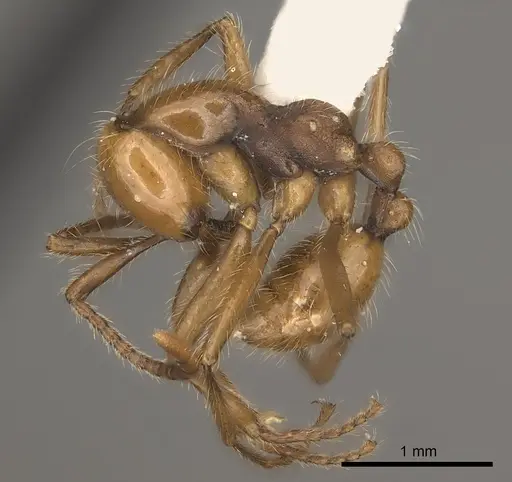
Neivamyrmex curvinotus is a small army ant species belonging to the subfamily Dorylinae, found only in the tropical rainforests of Colombia and Peru in South America . Workers measure 2.5-5.5mm and are yellowish brown to light reddish brown in color, with a distinctive double-arched profile on the mesosoma that gives the species its name ('curvinotus' means curved back) . The head is oval with a posterior concavity, and the mandibles have a straight upper margin that meets the masticatory surface at a sharp angle. These ants belong to Borgmeier's 'Group III' and are most similar to Neivamyrmex pilosus but can be distinguished by their more arched propodea and more concave mesopropodeal junctions . As a Neivamyrmex species, these are predatory army ants that raid other ant colonies and arthropods in the leaf litter and upper soil layers of tropical forests. However, nothing specific has been documented about the biology, colony structure, or behavior of N. curvinotus in the scientific literature . This species represents a poorly studied member of a genus known for their subterranean raiding behavior.
Quick Summary
- Difficulty: Expert
- Origin & Habitat: Tropical rainforests of Colombia (Amazonas and Meta departments) and Peru (Madre de Dios, Pakitza in Manu National Park) [1][3]. They live in the humid, warm leaf litter and upper soil layers of lowland tropical rainforests.
- Colony Type: Unconfirmed, colony structure has not been documented for this species.
- Size & Growth:
- Antkeeping:
- Temperature: Keep warm at 24-28°C, these are tropical ants requiring stable warmth
- Humidity: High humidity (70-85%), rainforest floor species requiring moist substrate
- Diapause: No, tropical species from stable warm/humid environment does not require hibernation
- Nesting: Naturalistic setup with moist substrate (soil/leaf litter mix) or test tube setups with high humidity. They prefer dark, concealed spaces and will likely nest in hidden chambers within the substrate.
- Behavior: Predatory army ant behavior is expected based on genus patterns. They are likely nocturnal raiders that hunt other ants and small arthropods in coordinated raids. Workers are probably aggressive toward other ant colonies. Escape risk is moderate, workers are 2.5-5.5mm so standard barriers should work, but army ants are persistent and may attempt escapes.
- Common Issues: nothing is known about this species' biology, all care recommendations are estimates, humidity control is critical, being rainforest species, they likely fail in dry conditions, predatory diet requirements may be challenging, need consistent live prey supply, colony may be sensitive to disturbance, army ants prefer stable, dark environments, escape prevention needed, while not tiny, army ants are persistent foragers
Species Identification and Distinction
Neivamyrmex curvinotus was described by Watkins in 1994 from specimens collected in Peru's Manu National Park and later confirmed in Colombia's Amazonas and Meta departments [1]. The species belongs to Borgmeier's 'Group III' and is most similar to Neivamyrmex pilosus, but can be distinguished by several key features: the propodeum is more arched in profile, the mesopropodeal junction is more concave, and the color is typically yellowish brown to light reddish brown rather than the dark reddish brown to black typical of N. pilosus [2]. The most distinctive feature is the double-arched dorsum of the mesosoma, which gives the species its name ('curvinotus' literally means 'curved back'). Workers vary considerably in size from 2.5mm to 5.5mm, with major workers being darker and having more distinct mandibular teeth compared to smaller minor workers [2].
Distribution and Habitat
This species is known only from the Amazon basin region of South America, specifically from two countries: Peru (Madre de Dios department, type locality at Pakitza in Manu National Park) and Colombia (Amazonas and Meta departments) [1][3]. The habitat is lowland tropical rainforest in the Amazon basin, a warm and humid environment with stable temperatures year-round. In Peru, the type locality at Pakitza is within Manu National Park, one of the most biodiverse areas in the world. The ant has been recorded at elevations corresponding to Amazonian lowlands. This distribution suggests the species is adapted to constant warmth and high humidity, similar to other Neivamyrmex species that inhabit the forest floor and leaf litter layers of tropical rainforests [1][3].
Nest Preferences and Housing
Since nothing specific is known about the nesting biology of N. curvinotus, care recommendations must be based on genus patterns for Neivamyrmex. These are subterranean army ants that typically nest in rotting wood, under stones, or in soil chambers within the leaf litter layer. For captive care, a naturalistic setup with a deep layer of moist substrate (a mix of soil and decaying leaf matter) works best, as it allows for the natural raiding and tunneling behavior these ants exhibit. Test tube setups can work if humidity is maintained very high, but army ants often do better with more space to form raiding columns. The nest area should be dark and protected from vibrations, these ants are sensitive to disturbance and prefer dark, quiet environments. Provide a spacious outworld connected to the nest area to allow for foraging raids. [2]
Feeding and Diet
As a Dorylinae army ant, N. curvinotus is expected to be primarily predatory, hunting other ants, ant brood, and small arthropods in coordinated raids. Based on genus patterns, they likely raid the colonies of other ant species in the leaf litter, consuming brood and adults. In captivity, the primary food should be live prey: small crickets, fruit flies, mealworms, and other small insects. They will likely accept freshly killed insects as well, but the hunting/raiding behavior is important for their welfare. Protein-rich foods are essential, sugar sources may be accepted occasionally but should not be a primary food source. Feed every 2-3 days with prey items, adjusting based on colony size and consumption rate. Remove uneaten prey after 24 hours to prevent mold. [2]
Temperature and Environmental Requirements
Being a tropical Amazonian species, N. curvinotus requires warm and humid conditions. Keep the nest area at 24-28°C with minimal temperature fluctuations. A heating cable on one side of the nest can create a gentle gradient, but ensure the entire setup doesn't overheat. Room temperature in the low-to-mid 20s°C may be acceptable depending on your room conditions. Humidity should be high (70-85%), the substrate should remain consistently moist but not waterlogged. Mist the setup regularly and ensure the water reservoir in test tube setups doesn't run dry. Being from a stable tropical environment, these ants do not require hibernation or any cooling period. Avoid placing the setup near air conditioning vents or in areas with temperature swings. [2]
Behavior and Colony Dynamics
Neivamyrmex army ants are known for their predatory raiding behavior, forming columns or swarms to overwhelm other ant colonies and capture brood. Unlike the famous Eciton army ants that form massive bivouacs and undergo regular migrations, Neivamyrmex species tend to be more subterranean and may have smaller, more stationary colonies. Workers are expected to be aggressive toward other ant species and may defend their nest vigorously. The colony likely has a single queen (or small number of ergatoid queens) that remains in the nest. Queens are typically ergatoid (wingless) and may be replaced by ergatoid reproductives if the primary queen dies. Workers likely forage primarily at night or in dim light conditions, conducting raids through the leaf litter. Provide darkness and minimal disturbance for best colony health. [2]
Frequently Asked Questions
How difficult is Neivamyrmex curvinotus to keep?
This is an expert-level species. Nothing is known about its specific biology, so all care is based on genus patterns. It requires high humidity, warm temperatures, and a consistent supply of live prey. Only experienced antkeepers should attempt this species.
What do Neivamyrmex curvinotus ants eat?
Based on genus patterns, they are predatory army ants that hunt other ants and small arthropods. Feed live prey like small crickets, fruit flies, mealworms, and other small insects. Protein should be the primary food source.
What temperature do Neivamyrmex curvinotus need?
Keep them warm at 24-28°C. These are tropical rainforest ants requiring stable warmth year-round. Avoid temperatures below 22°C or above 30°C.
Do Neivamyrmex curvinotus need hibernation?
No. Being from the stable warm and humid Amazon rainforest, they do not require hibernation or any cooling period. Keep them at consistent temperatures year-round.
How big do Neivamyrmex curvinotus colonies get?
Colony size is unknown for this species. Colony size has not been documented in scientific literature.
Can I keep multiple Neivamyrmex curvinotus queens together?
Unknown. The colony structure of this species has not been documented. Do not combine unrelated foundress queens.
How long does it take for Neivamyrmex curvinotus to develop from egg to worker?
Unknown for this specific species. Development time has not been documented.
What size are Neivamyrmex curvinotus workers?
Workers are 2.5-5.5mm in length, with major workers reaching up to 5.2mm. Smaller workers tend to be lighter colored (yellowish brown) while larger workers are more reddish brown.
Where is Neivamyrmex curvinotus found?
Only in the Amazon basin of Colombia (Amazonas and Meta departments) and Peru (Madre de Dios). They are a rare species known from very few collection sites.
Are Neivamyrmex curvinotus good for beginners?
No. This species is not recommended for beginners. Nothing is known about its specific care requirements, it requires high humidity and warm conditions, and it needs a constant supply of live prey. Only experienced antkeepers should attempt this species.
Report an Issue
The current care sheet is based fully on literature. See inconsistencies, or something that's incorrect? Please , it will be resolved after review from an admin. Contributing to the blogs tab also helps providing information, to make us be able to further improve the caresheets. Thank you for your support!
References

此饲养指南授权协议为 CC BY-SA 4.0 .
社区博客
CASENT0217476
在 AntWeb 上查看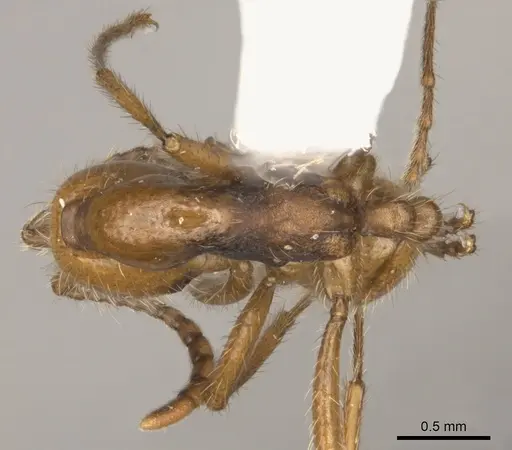
科学文献
正在加载分布地图...正在加载商品...