
Carebara bihornata
- 学名
- Carebara bihornata
- 族
- Crematogastrini
- 亚科
- Myrmicinae
- 命名者
- Xu, 2003
- 地理分布
- 分布于 0 个国家/地区
物种引言
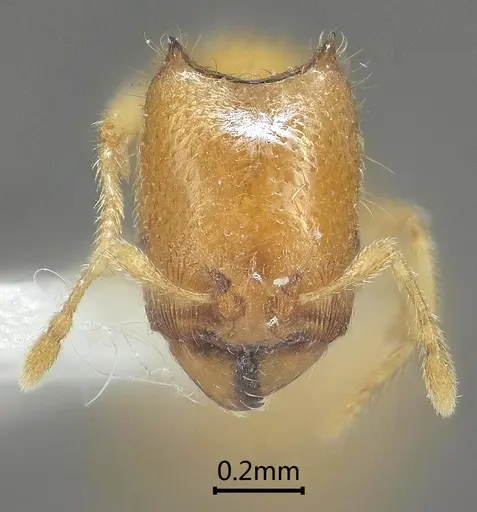
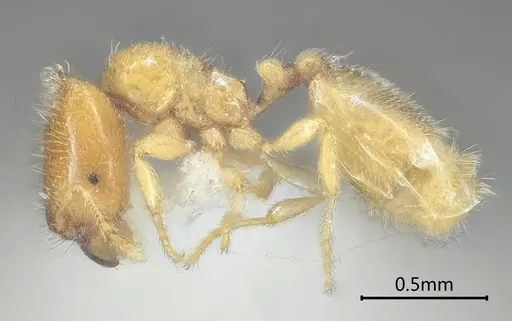
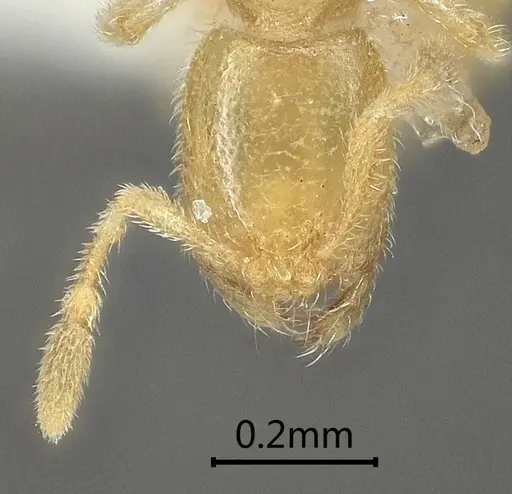
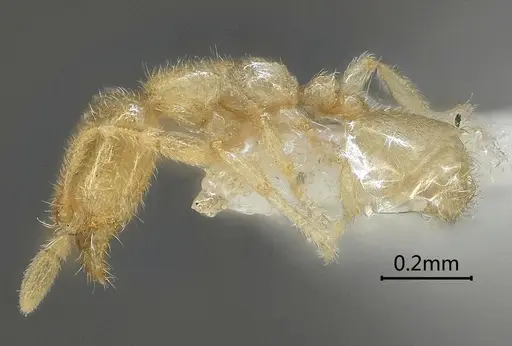
Carebara bihornata is a tiny yellow ant native to Yunnan Province, China. The species gets its name from the distinctive pair of horns on the heads of major workers (soldiers) - these horns are connected by a transverse ridge across the back of the head. Minor workers are much smaller at 1.1-1.2mm total length and lack horns, while major workers range from 2.1-3.1mm total length [AntWiki]. They were originally described in 2003 from the Gaoligongshan mountains at around 1000m elevation, collected from valley alsium shrub vegetation [AntWiki]. This is a poorly studied species with limited published information on its biology and captive care requirements.
Quick Summary
- Difficulty: Unknown, likely Moderate due to small size and limited data
- Origin & Habitat: Yunnan Province, China. Found in the Gaoligong Shan mountains at approximately 1000m elevation in valley alsium shrub tussock habitats [1][2].
- Colony Type: Unconfirmed colony structure. Carebara species typically form small colonies, but the specific colony type for C. bihornata has not been documented.
- Size & Growth:
- Queen: Size data unavailable, queen morphology has not been described in available literature
- Worker: Minor workers: 1.1-1.2mm total length, Major workers (soldiers): 2.1-3.1mm total length [1]
- Colony: Unknown, likely small based on typical Carebara patterns
- Growth: Unknown
- Development: Unconfirmed, no specific development data exists for this species (Estimates based on related Carebara species patterns may be unreliable given limited data.)
- Antkeeping:
- Temperature: Unconfirmed, suggest starting around 20-24°C based on the temperate to subtropical mountain habitat of this species [2].
- Humidity: Unconfirmed, likely prefers moderate to slightly humid conditions given the valley shrub habitat [1]. Start with moderately damp substrate.
- Diapause: Unknown, the 1000m elevation location in Yunnan experiences cool winters, so a winter rest period may be beneficial but this is unconfirmed.
- Nesting: Natural nesting: valley shrub tussock/vegetation. In captivity, likely needs a small nest with fine substrate or test tube setup scaled to their tiny size. The very small worker size (1.1mm) means escape prevention must be excellent.
- Behavior: Undocumented in captivity. Based on typical Carebara behavior, they may be nocturnal or crepuscular foragers. Major workers with their distinctive horns may serve as soldiers or food processors. Their tiny size makes them vulnerable and escape prevention is critical. They likely form small colonies and may be shy or non-aggressive.
- Common Issues: tiny worker size (1.1mm) makes escape likely without fine mesh barriers, no published captive care information means trial and error required, colony size unknown, may be naturally small making them harder to establish, humidity and temperature requirements unconfirmed require careful observation, limited availability in the antkeeping hobby
Appearance and Identification
Carebara bihornata is one of the smallest ant species in the world, with minor workers measuring just 1.1-1.2mm total length and major workers (soldiers) reaching 2.1-3.1mm total length [1]. The species is easily identified by the distinctive pair of horns on the head of major workers, these horns are connected by a well-developed transverse ridge across the occipital region [3]. Minor workers lack these horns and have a simpler rectangular head. Both castes are yellow in color, with soldiers having slightly darker coloration. The antenna has 9 segments with a 2-segmented club [1]. Soldiers have small eyes with 4 facets, while minor workers lack eyes entirely, a common trait in dimorphic Carebara species where minor workers are blind and specialize in colony tasks.
Natural Habitat and Distribution
This species is known only from Yunnan Province, China, specifically the Gaoligong Shan mountains at approximately 1000m elevation [1][2]. The type specimens were collected from valley alsium shrub tussock, indicating they nest in ground-level vegetation or leaf litter in mountainous shrubland habitats [1]. The Gaoligongshan region has a subtropical to temperate climate with distinct seasons. Summer temperatures are warm while winters can be cool at higher elevations. This suggests the species is adapted to moderate temperatures with seasonal variation. No other countries or regions have documented populations of C. bihornata.
Housing and Escape Prevention
Due to their extremely small size (minor workers are only 1.1mm), excellent escape prevention is essential. Standard test tube setups may work but must have tightly fitting plugs. Foraging areas should be enclosed with fine mesh, these ants can easily squeeze through gaps that would hold back larger species. A small formicarium or test tube nest with chambers scaled to their tiny size works best. Avoid tall, open spaces that could cause them to get lost or stranded. Given their natural habitat in valley shrub vegetation, a naturalistic setup with some plant material or leaf litter might be appreciated, though this is speculative. Keep nesting areas dark and quiet as they likely prefer hidden, protected spaces.
Feeding and Diet
No specific dietary information exists for C. bihornata. Based on typical Carebara species, they likely are omnivorous and will accept small protein sources like micro-arthropods, springtails, or small insects. Their tiny size means prey items must be appropriately sized, fruit flies, pinhead crickets, or other small insects work well. Sugar sources like honey water or sugar water may be accepted, though this is unconfirmed. Feed small amounts initially and observe acceptance. Given their likely ground-nesting habits, they may forage primarily on the substrate surface. Remove uneaten food promptly to prevent mold in the humid nest environment.
Temperature and Seasonal Care
No specific temperature data exists for this species. The Yunnan mountain habitat at 1000m elevation suggests adaptation to moderate temperatures, think low-to-mid 20s°C in summer with cooler winter conditions. Start with a range of 20-24°C and observe colony behavior. If workers are sluggish, slightly warmer, if they avoid the heated area, slightly cooler. The elevation and location suggest they may experience a winter rest period. If your colony shows reduced activity in winter (late fall through early spring), a cool period around 10-15°C for 2-3 months may be beneficial, but this is an estimate rather than a confirmed requirement. [1]
Colony Structure and Development
Carebara bihornata exhibits polymorphism with distinct minor workers and major workers (soldiers). The major workers have distinctive head horns, which may serve defensive functions or help process large food items [3]. No information exists on queen size, colony founding behavior, or typical colony size. Based on related Carebara species, colonies are likely small. Development time from egg to worker is unconfirmed for this species. The species was originally described in 2003 and remains poorly studied, so much of captive care will require observation and adaptation.
Frequently Asked Questions
How long does it take for Carebara bihornata to produce first workers?
The egg-to-worker timeline is unconfirmed for this species. No specific development data exists for C. bihornata.
What do Carebara bihornata ants eat?
No specific dietary studies exist for this species. Based on related Carebara ants, they likely accept small protein sources like fruit flies, micro-arthropods, or small insects. Sugar sources like honey water may also be accepted. Feed small amounts and remove uneaten food promptly.
What temperature should I keep Carebara bihornata at?
Temperature requirements are unconfirmed. Based on their mountain habitat in Yunnan at 1000m elevation, start around 20-24°C and adjust based on colony activity. They may benefit from a winter rest period but this is not confirmed.
How big do Carebara bihornata colonies get?
Maximum colony size is unknown. Based on typical Carebara species, colonies likely remain small. The species is known only from a few specimens collected in China.
Do Carebara bihornata ants sting?
Stinging behavior has not been documented for this species. Given their tiny size (1.1mm workers), any sting would likely be imperceptible to humans. Most Carebara species are non-aggressive and docile.
Is Carebara bihornata a good species for beginners?
This species is not recommended for beginners due to limited available care information and their extremely small size requiring excellent escape prevention. The lack of documented captive care means keepers must be prepared for experimentation and careful observation.
How do I identify Carebara bihornata?
Major workers (soldiers) have distinctive paired horns on the head connected by a transverse ridge [3]. Minor workers are much smaller (1.1-1.2mm total length) and lack horns. Both castes are yellow colored with 9-segmented antennae featuring a 2-segmented club [1].
Where is Carebara bihornata found in the wild?
This species is known only from Yunnan Province, China, specifically the Gaoligong Shan mountains at approximately 1000m elevation. They were collected from valley alsium shrub tussock vegetation [1][2].
Do Carebara bihornata queens have wings?
Queen morphology has not been described in available literature. Based on typical Myrmicinae, queens would be larger than soldiers and winged for nuptial flights, but this is not confirmed for this specific species.
Why are the major workers called 'bihornata'?
The species name 'bihornata' comes from Latin and means 'two-horned', referring to the distinctive pair of horns on the heads of major workers (soldiers). This is the most recognizable feature of the species [3].
Report an Issue
The current care sheet is based fully on literature. See inconsistencies, or something that's incorrect? Please , it will be resolved after review from an admin. Contributing to the blogs tab also helps providing information, to make us be able to further improve the caresheets. Thank you for your support!
References

此饲养指南授权协议为 CC BY-SA 4.0 .
社区博客
ANTWEB1060554
在 AntWeb 上查看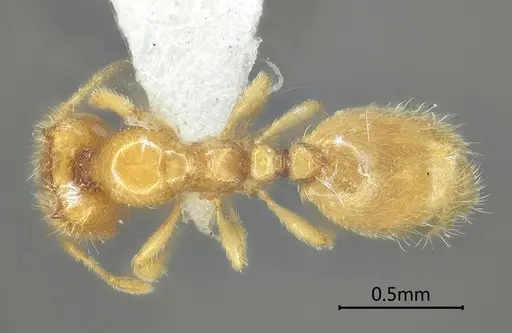
ANTWEB1060555
在 AntWeb 上查看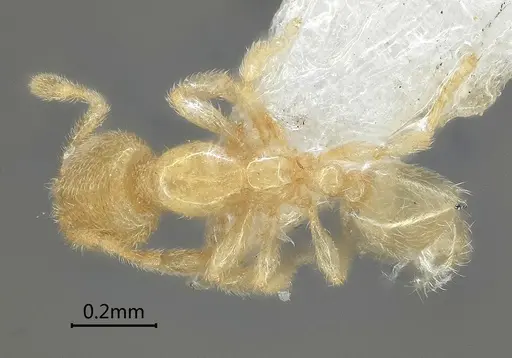
科学文献
正在加载分布地图...正在加载商品...