
Peronomyrmex greavesi
- Bilimsel Adı
- Peronomyrmex greavesi
- Oymak (Tribe)
- Crematogastrini
- Alt Familya
- Myrmicinae
- Yazar (Tanımlayan)
- Shattuck, 2006
- Dağılım
- 0 ülkede bulundu
Giriş
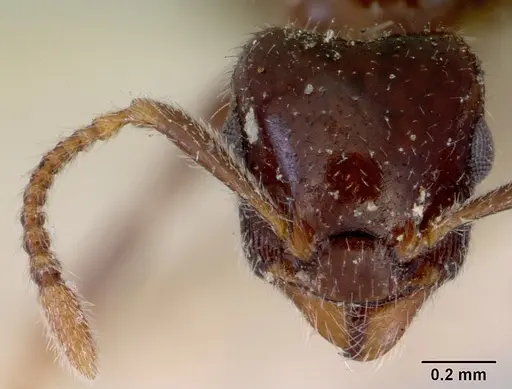
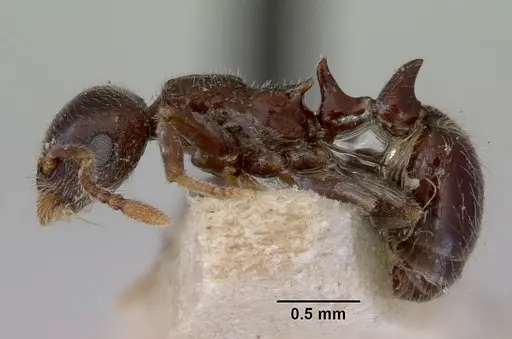
Peronomyrmex greavesi is one of the rarest ants in the world. Only one worker has ever been found, collected in 1937 near Clohesy River, Queensland, Australia . Workers are 3.4 mm long and chestnut-brown . The genus is arboreal and nocturnal, which is why they're so hard to find . This species is the northernmost in the genus . What makes this species special is its extreme rarity and unique features like a smooth head and concave postpetiole . No colonies have been seen since 1937 .
Quick Summary
- Difficulty: Expert
- Origin & Habitat: Northern Queensland, Australia, Clohesy River near Mareeba. Arboreal and nocturnal in tropical forests [1].
- Colony Type: Unknown, only one worker has been documented.
- Size & Growth:
- Antkeeping:
- Temperature: Based on tropical location, likely warm (24-28°C), but no direct data [1].
- Humidity: Arboreal habits suggest moderate to high humidity, but no specific data [1].
- Diapause: Unknown, tropical species may not require hibernation.
- Nesting: Arboreal habits suggest nesting in hollow twigs or under bark, but no data [1].
- Behavior: Extremely poorly known. The genus is arboreal and nocturnal, suggesting these ants are likely secretive and may be nocturnal foragers [1]. No aggression data exists. Escape prevention should be excellent given the 3.4 mm worker size. Defense mechanism is smear, with a modified stinger, as typical for Myrmicinae/Crematogastrini.
- Common Issues: this species has never been kept in captivity, no established care protocols exist., only one specimen has been found since 1937,making acquisition essentially impossible., no information exists on founding behavior, colony structure, or diet., arboreal and nocturnal habits make them difficult to find and observe., any care recommendations would be entirely speculative based on genus-level inference.
Why This Species Is Exceptional
Peronomyrmex greavesi presents a unique challenge in antkeeping: it is possibly the least-known ant species that could potentially be kept in captivity. Since its discovery in 1937,despite numerous collecting expeditions in northern Queensland, no additional specimens have been found [2]. The entire genus Peronomyrmex is known from only four specimens spanning over 2000 km of Australia [2]. This means that any information about their biology, care requirements, or colony structure is either inferred from the single worker specimen or borrowed from related species in the Crematogastrini tribe. For practical purposes, this species should be considered a 'holy grail' for myrmecologists rather than a viable species for captive keeping.
Identification and Morphology
The worker of Peronomyrmex greavesi measures 3.4 mm in total length, making it a small to medium-sized Myrmicine ant [1]. The head capsule is shiny with very fine microsculpture, while the mesosoma has weak longitudinal rugae that are more abundant on the sides but absent centrally [1]. The petiole and postpetiole show a mix of smooth and weakly sculptured areas, and the gaster is smooth and shiny with microreticulate sculpturing [1]. The entire body is covered with suberect hairs that are bluntly pointed, though those on the gaster are more narrowly pointed [1]. The coloration is chestnut-brown, with dorsal areas slightly darker than the lateral areas [1]. Key diagnostic features include the antennal scrobes being shallow troughs without rugae along the margins, a broadly concave posterior face of the postpetiole, and a flat area between the humeral angles of the pronotum [1].
Habitat and Distribution
Peronomyrmex greavesi is known only from the type locality near Clohesy River, close to Mareeba in northern Queensland, Australia [1]. This represents the northernmost extent of the genus Peronomyrmex [1]. The species was collected on June 15,1937,by Tom Greaves, hence the species name 'greavesi' honoring the collector [1]. The arboreal and nocturnal habits of the genus explain why these ants have proven so elusive, they likely live in the forest canopy and forage at night, making them extremely difficult to collect using standard ant collection methods [1]. The tropical Queensland environment suggests warm temperatures year-round with moderate to high humidity.
Keeping Considerations
It must be emphasized that Peronomyrmex greavesi cannot be recommended for captive keeping because no specimens are available and no captive husbandry information exists. The species exists only as a single specimen in a museum collection [2]. However, for theoretical interest, arboreal Myrmicines typically prefer humid conditions and may nest in hollow twigs, under bark, or in similar elevated microhabitats. If a colony were ever discovered, care would likely resemble that of other tropical arboreal Myrmicines: high humidity, warm temperatures (24-28°C), and small prey items. The worker size of 3.4 mm suggests they would accept small insects. Escape prevention should be excellent given their small size. Any actual keeping recommendations would require first discovering living colonies, which has eluded ant collectors for over 85 years.
Frequently Asked Questions
Can I keep Peronomyrmex greavesi as a pet ant?
No. This species has never been kept in captivity and no specimens are available. Only a single worker has ever been found since its discovery in 1937,making it one of the rarest ants in the world.
Where does Peronomyrmex greavesi live?
Only known from northern Queensland, Australia, near Clohesy River close to Mareeba. It is the northernmost species in the genus Peronomyrmex.
How big are Peronomyrmex greavesi ants?
Workers measure 3.4 mm in total length. No queens have ever been collected or described.
What do Peronomyrmex greavesi ants eat?
Unknown. As arboreal Myrmicines, they likely forage for small insects and honeydew, but no direct observations of their diet exist.
Do Peronomyrmex greavesi ants sting?
Unknown. Most Myrmicines have stingers, but whether this species can sting and its effect on humans has never been studied.
Are Peronomyrmex greavesi dangerous?
Unknown. Given their extreme rarity and small size (3.4 mm), they would pose minimal danger even if they could sting.
How long do Peronomyrmex greavesi colonies live?
Unknown. No colony has ever been observed. The entire genus is known from only four specimens collected over decades.
Do Peronomyrmex greavesi need hibernation?
Unknown. As a tropical species, they likely do not require true hibernation but may have reduced activity during cooler months.
Why is Peronomyrmex greavesi so rare?
The genus is arboreal and nocturnal, making these ants extremely difficult to find through standard collecting methods. Despite extensive efforts in northern Queensland since 1937,no additional specimens have been located.
Can I find Peronomyrmex greavesi in the wild?
Extremely unlikely. Despite being one of the most sought-after Australian ants, no specimens have been found since 1937 despite numerous collecting expeditions. The species appears to be either exceptionally rare or possibly extinct in the wild.
Report an Issue
The current care sheet is based fully on literature. See inconsistencies, or something that's incorrect? Please , it will be resolved after review from an admin. Contributing to the blogs tab also helps providing information, to make us be able to further improve the caresheets. Thank you for your support!
References

Bu bakım rehberi şu lisans altındadır: CC BY-SA 4.0 .
Topluluk Blogları
CASENT0172264
AntWeb'de Görüntüle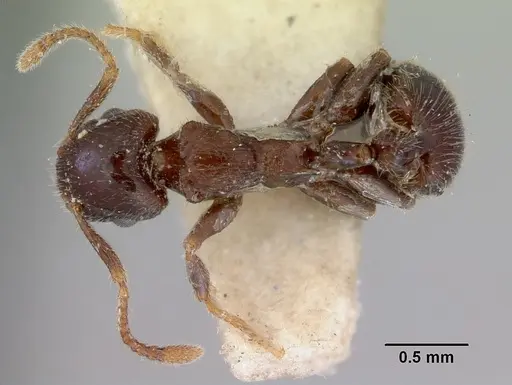
Literatür
Dağılım haritası yükleniyor...Ürünler yükleniyor...