
Melophorus teretinotus
- Bilimsel Adı
- Melophorus teretinotus
- Oymak (Tribe)
- Melophorini
- Alt Familya
- Formicinae
- Yazar (Tanımlayan)
- Heterick <i>et al.</i>, 2017
- Dağılım
- 0 ülkede bulundu
Giriş
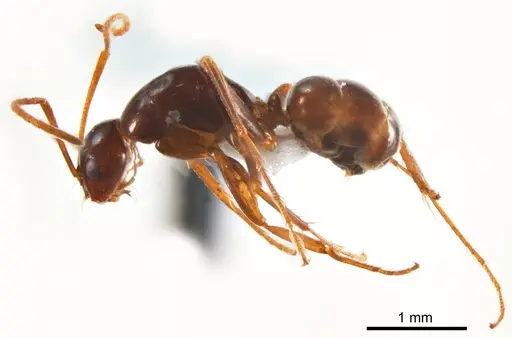
Melophorus teretinotus is a small Australian ant species belonging to the Melophorini tribe within the Formicinae subfamily. Only the minor worker caste has been described - no major workers or queens have been documented yet. They are found exclusively in Western Australia, particularly in the Kimberley and Pilbara regions, with records also from Barrow Island and likely the Northern Territory. The species is part of the Melophorus aeneovirens species group and is distinguished by its uniquely shaped mesosoma - strongly arched and smooth with the mesonotum and propodeum flowing together in a curve reminiscent of a snail shell, and notably lacking a metanotal groove entirely. The name 'teretinotus' comes from Latin meaning 'cylindrical and tapering back'. Size data for this species is unavailable as only fragmentary measurements exist in the original description.
Quick Summary
- Difficulty: Unknown
- Origin & Habitat: Western Australia (Kimberley and Pilbara regions), Barrow Island, and likely Northern Territory. Found in monsoonal tropical habitats [1][2].
- Colony Type: Unconfirmed, only minor workers have been described. No queen or major worker castes have been documented. The species may belong to colonies with ergatoid (wingless) replacement queens typical of some Melophorus species, but this is unconfirmed.
- Size & Growth:
- Queen: Unknown, queen caste has not been described [2]
- Worker: Size data unavailable, only fragmentary measurements (head width and mesosoma length) exist in the original description [2]
- Colony: Unknown, only minor workers documented, no colony size data available
- Growth: Unknown
- Development: Unknown, no development data exists for this species (Development timeline has not been studied.)
- Antkeeping:
- Temperature: Unknown, no specific temperature data exists. Based on the Kimberley and Pilbara distribution in Western Australia, they likely prefer warm conditions, but this is unconfirmed.
- Humidity: Unknown, no humidity data exists. Based on the Pilbara and Kimberley distribution, they likely prefer semiarid to tropical savanna conditions, but this is unconfirmed.
- Diapause: Unknown, no seasonal data exists. Australian Melophorus species in similar climates may reduce activity during dry seasons rather than true hibernation.
- Nesting: Unknown, natural nesting behavior has not been documented. Based on related species in the aeneovirens group, they likely nest in soil or under stones in ground cavities. For captivity, a small test tube setup or Y-tong nest with narrow chambers scaled to their tiny size would be appropriate.
- Behavior: Behavior is completely unstudied. Based on genus-level patterns, Melophorus species are typically generalist foragers that search for sugary liquids and small prey. Their small size means escape prevention must be excellent, they can squeeze through extremely small gaps. No information on aggression levels or defensive behaviors exists for this species.
- Common Issues: biology is completely unstudied, no care information exists for this species, only minor workers known, no queen or major worker to establish a functioning colony, tiny size makes escape prevention critical, use fine mesh and tight-fitting lids, no development data means you cannot predict growth timelines, wild-caught colonies may be impossible to establish since queen is unknown
Species Discovery and Taxonomy
Melophorus teretinotus was only recently described in 2017 by Heterick, Castalanelli, and Shattuck as part of a major revision of the genus Melophorus. The species belongs to the Melophorus aeneovirens species group and the aeneovirens species complex. What makes this species particularly interesting is that only the minor worker caste has ever been documented, no major workers, queens, or males have been collected or described. This is unusual in ant taxonomy as the minor worker is typically the most abundant caste. Recent genetic analysis has revealed that what was previously identified as M. teretinotus may actually consist of two very similar species (ter1 and ter2) that are nearly indistinguishable morphologically. These two species have overlapping distributions in the Northern Territory and northeastern Western Australia, with additional unsourced specimens from northwestern Queensland [1].
Identification and Morphology
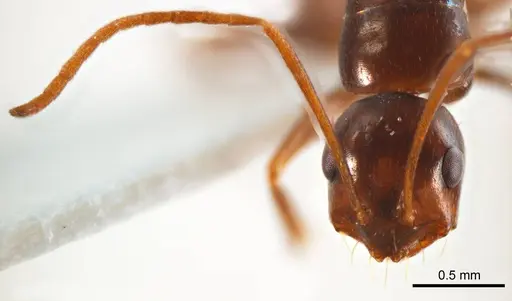
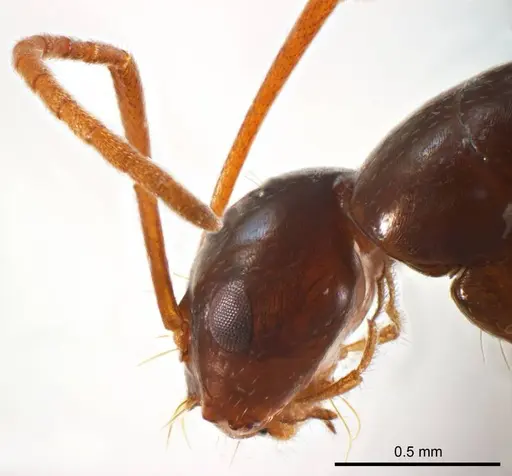
Melophorus teretinotus cannot be confused with any other Melophorus species due to its distinctive morphology. The most striking feature is the complete absence of a metanotal groove, the indentation normally found between the mesonotum and propodeum on an ant's thorax. Instead, the mesosoma forms a smooth, continuously arched curve similar to a snail shell. The mesosoma is strongly arched, smooth, and glabrous (lacking hairs). The pronotum and mesonotum are broadly expansive and shining. The head is square-shaped with a convex posterior margin, and the clypeus has a distinct notch at its midpoint. The eyes are moderate and set above the midline of the head capsule [2].
Distribution and Habitat
All confirmed records of Melophorus teretinotus come from Western Australia, specifically the Kimberley and Pilbara regions on the mainland, as well as Barrow Island off the coast. The species is also expected to occur in the Northern Territory based on the distribution of similar specimens. The 102 pinned specimens in the Darwin collection attributed to this species suggest it is not extremely rare within its range, but it appears occasionally rather than commonly in collections. The region features a monsoonal tropical climate with distinct wet and dry seasons, and semiarid to savanna conditions in the Pilbara. The recent discovery of two very similar species (ter1 and ter2) within what was identified as M. teretinotus means the exact distribution of the true M. teretinotus remains unclear [1][2].
Current State of Knowledge
It must be emphasized that absolutely nothing is known about the biology of Melophorus teretinotus. This includes colony structure, founding behavior, diet, nuptial flight timing, development time, overwintering requirements, and any behavioral traits. The species has never been observed in captivity, and no ecological studies have been conducted on it. This makes it impossible to provide reliable care recommendations. Even the basic colony structure (monogyne vs polygyne) is unknown. What we know about this species is limited to physical measurements of preserved minor workers and their geographic collection points. For antkeepers, this means M. teretinotus is essentially an unknown species in terms of husbandry, there is no established care protocol, no documented success in captivity, and no way to know if the species can be kept in formicaria. Attempting to keep this species would be entirely experimental [2].
Melophorus Genus Context
While M. teretinotus-specific information is lacking, we can look at the broader Melophorus genus for context. Melophorus is an Australian endemic genus with over 200 described species, making it one of the most diverse ant genera in Australia. They belong to the Formicinae subfamily and the Melophorini tribe. Most Melophorus species are generalist foragers that scavenge for sugary liquids and small arthropods. The genus shows considerable variation in colony structure, with some species being monogyne (single queen) and others polygyne (multiple queens). Some Melophorus species are known to have ergatoid (wingless) queens that can serve as replacement reproductives. However, without specific study of M. teretinotus, we cannot assume it shares any of these traits [2].
Frequently Asked Questions
Can I keep Melophorus teretinotus as a pet ant?
No, this species cannot be kept in captivity because only minor workers have ever been documented. Without queens or major workers, there is no way to establish a functioning colony. Even if you found minor workers in the wild, they cannot found a new colony on their own. The biology of this species is completely unknown, so no established care protocol exists.
What do Melophorus teretinotus ants eat?
This is completely unknown. No feeding observations or diet studies have been conducted on this species. Related Melophorus species are generalist foragers that consume sugary liquids and small arthropods, but we cannot confirm M. teretinotus shares this diet.
How big do Melophorus teretinotus colonies get?
Unknown, no colony size data exists for this species. Even the maximum colony size of related species in the aeneovirens group has not been documented.
What temperature should I keep Melophorus teretinotus at?
No specific temperature data exists for this species. Based on the Kimberley and Pilbara distribution in Western Australia, they likely prefer warm conditions, but this is unconfirmed.
How long does it take for Melophorus teretinotus to develop from egg to worker?
This is completely unknown, no development studies have been conducted on this species.
Do Melophorus teretinotus need hibernation?
Unknown, no seasonal activity data exists. The Kimberley and Pilbara regions have mild winters, so if hibernation occurs it would likely be minimal or just reduced activity during the dry season.
Where does Melophorus teretinotus live in the wild?
They are found in Western Australia's Kimberley and Pilbara regions, plus Barrow Island, and likely the Northern Territory. The habitat is semiarid to tropical savanna with monsoonal climate.
Are Melophorus teretinotus good for beginners?
No, this species is not suitable for antkeeping at any level. The biology is completely unstudied, only minor workers exist, and no one has successfully kept this species in captivity. There is no care information to follow.
Can I find Melophorus teretinotus queens to start a colony?
No, queen castes have never been documented for this species. The original description only mentions minor workers, and no subsequent studies have found queens or major workers. It is unknown whether ergatoid (wingless) queens exist or if the species reproduces through some other mechanism.
Report an Issue
The current care sheet is based fully on literature. See inconsistencies, or something that's incorrect? Please , it will be resolved after review from an admin. Contributing to the blogs tab also helps providing information, to make us be able to further improve the caresheets. Thank you for your support!
References

Bu bakım rehberi şu lisans altındadır: CC BY-SA 4.0 .
Topluluk Blogları
ANTWEB1008665
AntWeb'de Görüntüle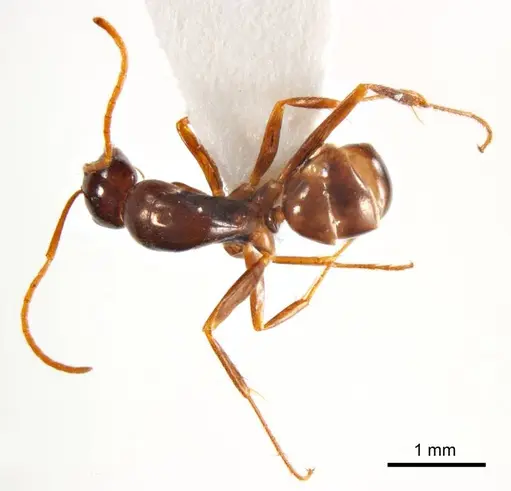
Literatür
Dağılım haritası yükleniyor...Ürünler yükleniyor...