
Centromyrmex praedator
- Bilimsel Adı
- Centromyrmex praedator
- Oymak (Tribe)
- Ponerini
- Alt Familya
- Ponerinae
- Yazar (Tanımlayan)
- Bolton & Fisher, 2008
- Dağılım
- 0 ülkede bulundu
Giriş
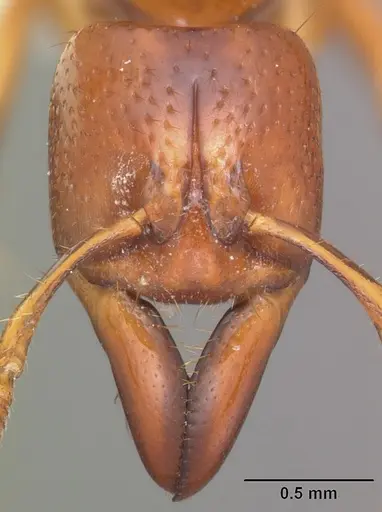
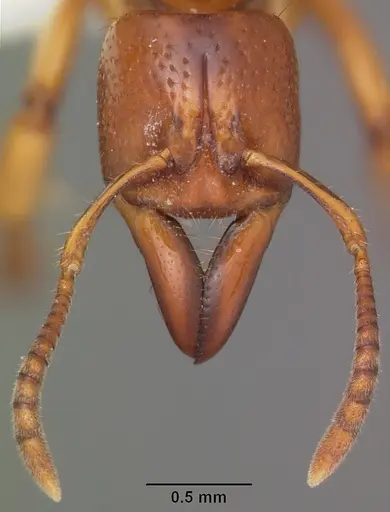
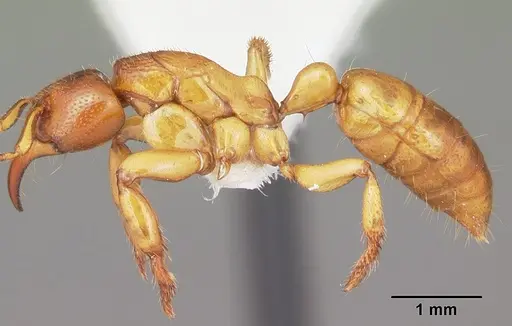
Centromyrmex praedator is a large ponerine ant measuring 6.4mm in total length, with a yellow to light brownish yellow coloration . The head capsule is longer than broad with almost straight, parallel sides. The mandibles are smooth with small punctures and have teeth that are almost entirely worn down or effaced - researchers cannot determine whether this is a normal trait or wear from use . The petiole node is unusually long and narrow, distinguishing this species from most others in the feae group which have broad, transverse petiole shapes . This species is endemic to the Democratic Republic of Congo, known only from a single specimen collected in Kinzambi Forest, Bandundu region in 1985 . The closest relative is Centromyrmex fugator, which shares the elongated petiole node trait .
Quick Summary
- Difficulty: Unknown, biology completely unstudied
- Origin & Habitat: Democratic Republic of Congo, tropical forest habitat in the Bandundu region [1][3]
- Colony Type: Unconfirmed, only a single worker has ever been collected, queen, male, and colony structure are entirely unknown [1]
- Size & Growth:
- Antkeeping:
- Temperature: Unknown, no biological data exists. Based on the tropical forest habitat in DRC, they would likely prefer warm conditions in the mid-to-high 20s°C, but this is entirely speculative.
- Humidity: Unknown, no biological data exists. Based on the tropical forest habitat in DRC, expect high humidity requirements, but this cannot be confirmed.
- Diapause: Unknown, no seasonal data exists [1]
- Nesting: Unknown, no nesting observations exist. The single specimen was collected in forest, but specific nest location is unrecorded [1].
- Behavior: Unknown, the behavior of this species has never been studied. Based on genus-level patterns, Centromyrmex ants are typically predators, likely hunting termites and other small invertebrates. As a member of the Ponerinae subfamily, they possess a functional stinger with potent venom. Specific hunting behavior, aggression levels, and activity patterns for C. praedator are unconfirmed [1].
- Common Issues: this species is essentially impossible to keep, only a single worker specimen has ever been collected and no biological data exists, no established care guidelines exist for this species, queens have never been found or described, making captive establishment impossible, the natural history is completely unknown, including diet, nesting preferences, and reproductive behavior
Species Status and Availability
Centromyrmex praedator is one of the most poorly known ant species in the world. It was described in 2008 by Bolton and Fisher based on a single damaged worker collected in 1985 from Kinzambi Forest in the Democratic Republic of Congo [1]. The specimen is missing its left midleg and right hindleg, and the mandible teeth are so worn down that researchers cannot determine whether this is a normal trait or simply wear from age [1]. No queens, males, or complete colonies have ever been found or described. This species exists in museum collections but has never been observed alive by researchers. There are no established captive populations, no care guides, and no biological studies beyond the original species description. The AntWiki explicitly states that nothing is known about the biology of this species [4]. For all practical purposes, Centromyrmex praedator cannot be kept in captivity because no one has ever collected or described a queen or established a colony.
Taxonomy and Identification
Centromyrmex praedator belongs to the feae species group within the genus Centromyrmex, making it a member of the subfamily Ponerinae, tribe Ponerini [1]. The species was formally described in 2008 by Barry Bolton and Brian Fisher in their revision of African Ponerinae genera [1]. The most distinctive identification features are the unusually long petiole node (longer than broad, narrow anteriorly and broader posteriorly) and the mandibles with almost completely effaced teeth [1][2]. The closest relative is Centromyrmex fugator, which shares the elongated petiole node trait that contrasts with the usual broad, transverse petiole shape seen in other feae group species [1]. The worker measures 6.4mm in total length, making it a moderately large ant, and has a yellow to light brownish yellow coloration [1]. Accurate identification would require examination of the petiole shape and mandible structure under magnification.
Why This Species Cannot Be Kept
There are several fundamental reasons why Centromyrmex praedator cannot be maintained in captivity. First, no one has ever collected or described a queen, so there is no source from which to obtain a founding colony [1]. Second, even if queens were to be discovered, there is no information about their founding behavior, temperature requirements, humidity preferences, or diet, the basic pillars of ant keeping. Third, the single known specimen was collected decades ago in a remote region of the Democratic Republic of Congo, and there have been no additional records or observations since [1][3]. This species represents a complete information void in ant keeping. Unlike most ant species where gaps in knowledge can be filled with genus-level or related-species data, even the genus-level understanding of Centromyrmex is limited. Attempting to keep this species would be speculative and almost certainly unsuccessful. Antkeepers interested in Centromyrmex species would be better served by seeking other, better-documented species in the genus where at least basic care information exists.
Related Species and What We Might Expect
While Centromyrmex praedator specifically is unknown, the genus Centromyrmex as a whole provides some general context that illustrates what this species might be like if ever studied. The genus is known from African tropical regions, with species typically found in forest habitats. Workers are generally large and robust, with powerful stingers. Based on related ponerine ants, Centromyrmex species are typically predatory, hunting termites and other small invertebrates. They have painful stings as a defense mechanism, though specific sting potency for C. praedator is unknown. The genus name Centromyrmex translates to something like 'central ant' and members are known for their relatively large size compared to many tropical ants. However, these are guesses at best, the specific biology, behavior, and care requirements of C. praedator remain entirely unknown and can only be confirmed through dedicated field research and specimen collection. [1]
Frequently Asked Questions
Can I keep Centromyrmex praedator ants?
No. This species cannot be kept because only a single worker has ever been collected and described. No queens, males, or colonies have ever been found. There is no established source for obtaining this species and no biological information exists to guide captive care.
Where does Centromyrmex praedator live?
It is known only from Kinzambi Forest in the Bandundu region of the Democratic Republic of Congo. This is a tropical forest habitat in central Africa. Only a single specimen has ever been collected from this location.
How big is Centromyrmex praedator?
The only known specimen (a worker) measures 6.4mm in total length. The queen size is unknown as no queens have ever been described.
What do Centromyrmex praedator ants eat?
Unknown. No feeding observations or diet studies exist for this species. Based on genus-level patterns, they are likely predatory like other Centromyrmex species, but this cannot be confirmed.
What is the colony structure of Centromyrmex praedator?
Unknown. No colony has ever been observed. The colony type (single queen vs. multiple queen) is entirely unconfirmed. Only a single worker specimen exists in museum collections.
What temperature do Centromyrmex praedator ants need?
Unknown. No biological data exists for this species. Based on the tropical forest location in DRC, they would likely prefer warm conditions, but this is purely speculative.
Does Centromyrmex praedator need hibernation?
Unknown. No seasonal data or dormancy observations exist. Given the tropical location in DRC, hibernation would be unlikely if the species follows typical tropical ant patterns.
How long do Centromyrmex praedator ants live?
Unknown. No lifespan data exists for this species. Development time from egg to adult is completely unstudied.
Is Centromyrmex praedator endangered?
Unknown. The conservation status has not been assessed. Only a single specimen has been collected from one location, suggesting either extreme rarity or simply very limited sampling.
Can I find Centromyrmex praedator in the wild?
Extremely unlikely. Only a single specimen has ever been collected, despite extensive ant collecting efforts in Africa. The species has not been recorded since its original collection in 1985, and no additional specimens or observations exist.
Are there similar ants that are easier to keep?
Yes. Other Centromyrmex species may have more documented biology. Additionally, many other Ponerine ants from Africa (such as Diacamma, Pachycondyla, or Myrmica species) have established care guidelines in the ant-keeping hobby. These would be far more practical choices for keepers interested in predatory ponerine ants.
Report an Issue
The current care sheet is based fully on literature. See inconsistencies, or something that's incorrect? Please , it will be resolved after review from an admin. Contributing to the blogs tab also helps providing information, to make us be able to further improve the caresheets. Thank you for your support!
References

Bu bakım rehberi şu lisans altındadır: CC BY-SA 4.0 .
Topluluk Blogları
CASENT0102928
AntWeb'de Görüntüle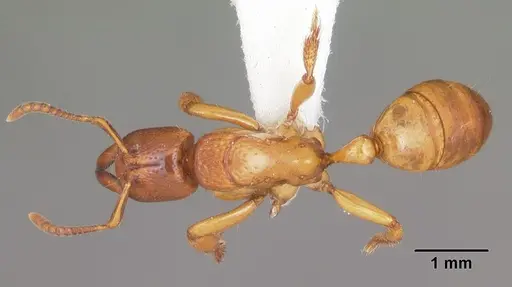
Literatür
Dağılım haritası yükleniyor...Ürünler yükleniyor...