
Cardiocondyla compressa
- Bilimsel Adı
- Cardiocondyla compressa
- Oymak (Tribe)
- Crematogastrini
- Alt Familya
- Myrmicinae
- Yazar (Tanımlayan)
- Seifert, 2017
- Dağılım
- 0 ülkede bulundu
Giriş
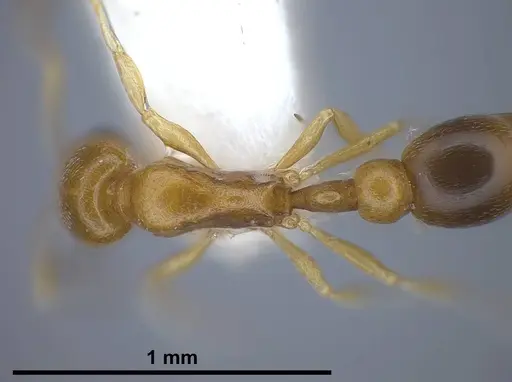
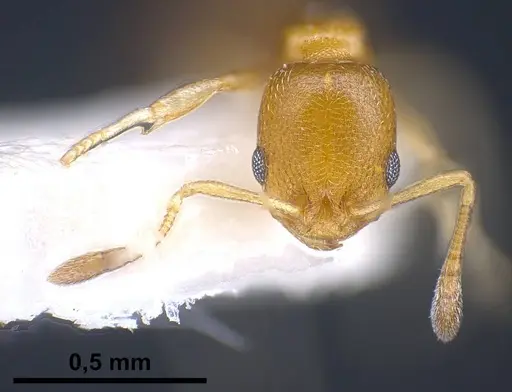
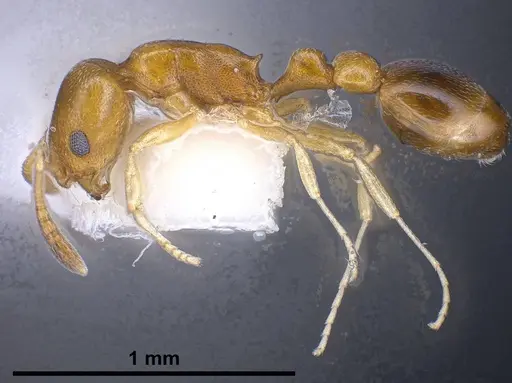
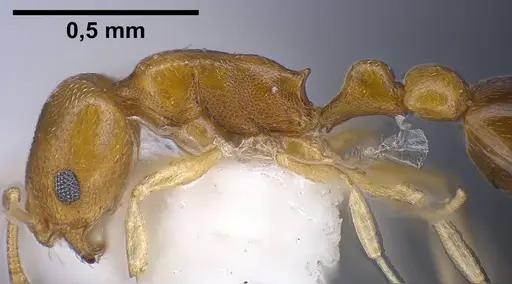
Cardiocondyla compressa is an exceptionally tiny ant species in the Cardiocondyla nuda group, known only from two worker specimens collected on Hammond Island in the Torres Strait between Australia and Papua New Guinea . The species gets its name from its most distinctive feature - an extremely narrow petiole (the 'waist' segment between the thorax and abdomen), which is proportionally the narrowest of any species in the group . Workers have a yellowish head, mesosoma, waist, and appendages, while the abdomen (gaster) is noticeably darker . The sculpture on the head, mesosoma, and waist is much weaker than typical for the nuda group, giving these ants a relatively smooth and shiny appearance . This species is one of the rarest ants in existence, known from only a single remote island location .
Quick Summary
- Difficulty: Expert, species is virtually unavailable and extremely poorly known
- Origin & Habitat: Hammond Island, Torres Strait, Queensland, Australia, a tropical island environment between Australia and Papua New Guinea at approximately 10.33°S, 142.12°E [1][2]
- Colony Type: Unknown, only two workers have ever been documented. No queen specimens have been described.
- Size & Growth:
- Queen: Unknown, no queen specimens have been described [1]
- Worker: ~1.5-2mm, inferred from Cardiocondyla genus patterns (head size CS 410 μm reported in original description) [1][2]
- Colony: Unknown, only two workers known from the original description [1]
- Growth: Unknown, no developmental data exists for this species
- Development: Unknown, no direct data exists for this species (No developmental studies exist for this species.)
- Antkeeping:
- Temperature: Keep at 24-28°C, these are tropical island ants from the Torres Strait region.
- Humidity: Moderate to high humidity (60-80%). The Torres Strait has a humid tropical climate.
- Diapause: Unlikely, Hammond Island is near the equator with minimal seasonal temperature variation. No diapause expected.
- Nesting: In nature, Cardiocondyla typically nest in soil, under stones, or in rotting wood. For captivity, a small test tube setup or Y-tong nest with appropriately scaled chambers works well.
- Behavior: Cardiocondyla are generally calm, non-aggressive ants. Workers are tiny and slow-moving. They are not known for stinging, their stingers are too small to penetrate human skin. They are scavengers and likely feed on small insects, honeydew, and sugar sources. Their tiny size makes escape prevention critical.
- Common Issues: escape prevention is critical due to their tiny size, use fine mesh barriers and tight-fitting lids, no biological data exists for this species, all care recommendations are inferred from genus patterns, finding appropriately-sized prey may be challenging, they need very small insects, wild-caught colonies are essentially impossible since the species is only known from a single remote island location, this species is not available in the antkeeping hobby, only two museum specimens exist
Species Discovery and Rarity
Cardiocondyla compressa was described in 2017 by Bernhard Seifert, Ichiro Okita, and Jürgen Heinze through a taxonomic revision of the Cardiocondyla nuda group [1]. The entire scientific knowledge of this species comes from just two worker specimens, the holotype and one paratype, both collected from Hammond Island in the Torres Strait between July 4-8,1974 [1][2]. This means there is essentially no biological data available for this species. The species was identified primarily through detailed morphometric measurements, as the nuda group is notoriously difficult to separate taxonomically [1]. The extremely narrow petiole is the most distinctive feature that sets this species apart from its relatives [1].
Size and Identification
This is an exceptionally tiny ant, the original description reports a cephalic size (CS) of 410 μm, making C. compressa the smallest species in the Cardiocondyla nuda group [1][2]. Based on typical Cardiocondyla genus proportions, workers are estimated at approximately 1.5-2mm in total body length. The head is elongated (CL/CW ratio of 1.200), and the eyes are relatively small [1]. The most diagnostic feature is the extremely narrow petiole width, this is proportionally the narrowest petiole in the entire group and is where the species gets its name 'compressa' meaning 'compressed' [1][2]. Workers are yellowish-brown on the head, mesosoma, waist, and legs, while the abdomen (gaster) is significantly darker [1]. The surface sculpture is notably reduced compared to other nuda group species, giving them a smoother, shinier appearance [1].
Natural Habitat and Distribution
Cardiocondyla compressa is known only from Hammond Island in the Torres Strait, located at approximately 10.33°S, 142.12°E, essentially at Australia's northern border with Papua New Guinea [1][2]. This is a tropical island environment with year-round warm temperatures and high humidity. The Torres Strait islands lie between the Cape York Peninsula of Queensland and the southern coast of Papua New Guinea, creating a unique transitional environment. The original specimens were collected in July 1974, which is the dry season in this region. Nothing is known about this species' natural history, nesting preferences, or colony size in the wild, they have never been observed alive by researchers.
Housing and Care Recommendations
Since this species has never been kept in captivity and no biological data exists, care recommendations must be based on what is known about related Cardiocondyla species. These ants are extremely small, so housing must be appropriately scaled. Temperature should be kept in the 24-28°C range, reflecting their tropical island origin. Humidity should be moderate to high (60-80%). Escape prevention is critical, these ants are so small they can squeeze through gaps that other ants cannot. Use fine mesh barriers and ensure all connections are sealed. Feed small prey items like fruit fly pieces or small live prey like springtails. Sugar water or honey can be offered occasionally. Given how rare this species is in the wild, it is extremely unlikely that live colonies are available in the antkeeping hobby.
Feeding and Diet
Based on general Cardiocondyla feeding patterns, these ants are likely omnivorous scavengers that consume small insects, honeydew from aphids, and sugar sources. In captivity, offer very small prey items, fruit flies, small mealworm pieces, or tiny live prey like springtails are appropriate. Sugar water, honey water, or small drops of honey can be offered as carbohydrate sources. Because of their tiny size, prey items must be appropriately scaled. Feed small amounts every few days and remove any uneaten prey to prevent mold.
Legal and Ethical Considerations
Cardiocondyla compressa is endemic to Hammond Island in the Torres Strait, which is Australian territory. There are no known established populations in captivity anywhere in the world. It is extremely unlikely that this species is available in the antkeeping hobby, as only two museum specimens have ever been documented. If somehow available, keeping this species would require careful consideration of Australian wildlife export regulations. Never release any ant species into non-native areas, even if you somehow obtained this species, releasing it could cause ecological damage. This species should be considered a 'museum species' that exists primarily in scientific literature rather than in antkeeping collections. [1][2]
Frequently Asked Questions
How big are Cardiocondyla compressa workers?
Workers are extremely small. The original description reports a cephalic size (CS) of 410 μm, and based on typical Cardiocondyla genus proportions, total body length is estimated at approximately 1.5-2mm [1][2].
Where does Cardiocondyla compressa live?
This species is only known from Hammond Island in the Torres Strait between Australia and Papua New Guinea. It has never been found anywhere else in the world [1][2].
Is Cardiocondyla compressa available in the antkeeping hobby?
No. This species is only known from two museum specimens collected in 1974. It has never been observed alive by modern researchers and is not available in the antkeeping hobby.
How do I care for Cardiocondyla compressa?
Since no biological data exists for this species, care must be inferred from related Cardiocondyla. Keep at 24-28°C with 60-80% humidity. Housing must be appropriately scaled for their tiny size. Escape prevention is critical.
What makes Cardiocondyla compressa different from other Cardiocondyla?
The species is named for its extremely narrow petiole (the 'waist' segment), which is proportionally the narrowest in the nuda group. It also has reduced surface sculpture and is the smallest species in its group [1][2].
Do Cardiocondyla compressa ants sting?
Cardiocondyla ants have stingers but they are too small to penetrate human skin. These ants are completely harmless to humans.
When was Cardiocondyla compressa discovered?
This species was described in 2017 by Bernhard Seifert, Ichiro Okita, and Jürgen Heinze through a taxonomic revision of the Cardiocondyla nuda group [1].
How many Cardiocondyla compressa specimens exist?
Only two worker specimens are known to science, the holotype and one paratype, both collected in 1974 [1][2].
Do I need to hibernate Cardiocondyla compressa?
No. Hammond Island is near the equator with minimal seasonal temperature variation. These tropical ants do not require a diapause period.
Can I keep multiple queens together?
This is unknown for this species. Colony structure has never been documented. Most Cardiocondyla are single-queen colonies, but some species can have multiple queens.
Report an Issue
The current care sheet is based fully on literature. See inconsistencies, or something that's incorrect? Please , it will be resolved after review from an admin. Contributing to the blogs tab also helps providing information, to make us be able to further improve the caresheets. Thank you for your support!
References

Bu bakım rehberi şu lisans altındadır: CC BY-SA 4.0 .
Topluluk Blogları
ANTWEB1038016
AntWeb'de Görüntüle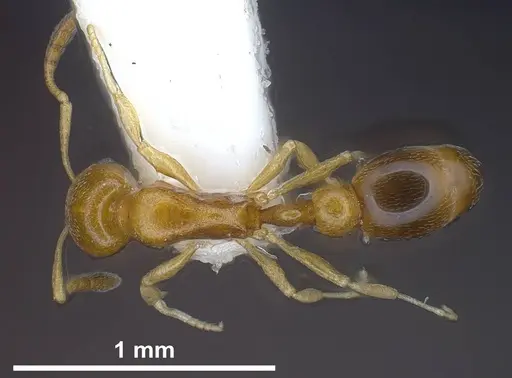
Literatür
Dağılım haritası yükleniyor...Ürünler yükleniyor...