
Axinidris palligastrion
- Bilimsel Adı
- Axinidris palligastrion
- Oymak (Tribe)
- Tapinomini
- Alt Familya
- Dolichoderinae
- Yazar (Tanımlayan)
- Shattuck, 1991
- Dağılım
- 0 ülkede bulundu
Giriş
Axinidris palligastrion is a tiny tree-dwelling ant from Ghana with a striking two-tone appearance - a reddish-brown head and thorax contrasting with a noticeably lighter yellowish-red abdomen . Workers are minute ants that have only been collected from tree trunks where they were sharing foraging trails with Crematogaster clariventris ants . To date, scientists have never documented queens or males of this species - only workers are known to exist in museum collections, making this one of the most mysterious ants in the world .
Quick Summary
- Difficulty: Expert
- Origin & Habitat: Ghana, West Africa. Arboreal, found foraging on tree trunks in Afrotropical forests [2].
- Colony Type: Unknown, only the worker caste has ever been collected [2].
- Size & Growth:
- Antkeeping:
- Temperature: Likely requires warm conditions around 24-28°C based on the Ghanaian tropical origin, but specific requirements remain unconfirmed.
- Humidity: Likely moderate to high, consistent with forest tree trunk habitats. Keep nest materials lightly moist.
- Diapause: Likely not required, appears to be a tropical species [2].
- Nesting: Arboreal, vertical wood or bark setups with very small chambers appropriate for their tiny size.
- Behavior: Likely fast-moving and agile given their arboreal habits and small size. Escape prevention must be excellent due to their minute size.
- Common Issues: queens have never been collected, making captive colony founding currently impossible., extreme rarity, only four specimens exist in museums (one holotype and three paratypes), making acquisition practically impossible., dietary requirements are completely unknown., tiny size means they can escape through extremely small gaps.
Natural History and Distribution
Axinidris palligastrion is known only from Ghana in West Africa, specifically collected at Nswam (Nsawam) in March 1970 [2]. The species appears to be strictly arboreal, the type series was collected from tree trunks where workers were sharing foraging trails with Crematogaster clariventris ants [2]. This association suggests they may be part of the arboreal ant community in West African forests, though whether this trail-sharing indicates mutual tolerance, competition, or mere coincidence remains unknown. The extreme rarity of collections suggests either genuinely low population density, cryptic nesting habits, or simply lack of targeted sampling in their specific microhabitat.
Identification and Appearance
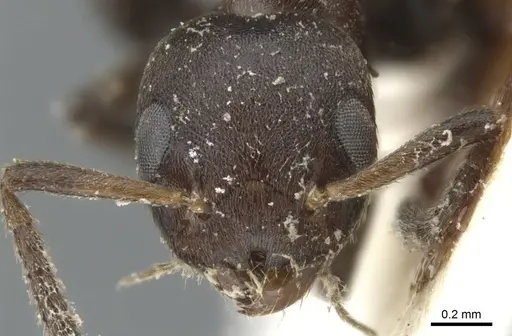
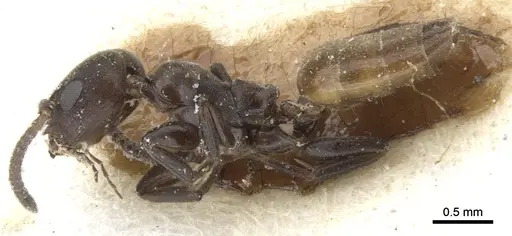
These are tiny ants with a distinctive color pattern that separates them from similar species. Workers have a reddish-brown head and thorax that contrasts sharply with their yellowish-red abdomen [1]. Key identifying features include erect hairs present on the pronotum (the upper surface of the first thoracic segment), a smooth and shiny pronotum surface, and the absence of erect hairs on the antennal scapes [1]. They differ from the similar Axinidris nigripes by their smaller size and shallower clypeal notch, and from Axinidris mlalu by having erect pronotal hairs and a less distinctly two-toned abdomen [1].
Housing and Nest Setup
Since these ants live on tree trunks in nature, you should provide a vertical arboreal setup rather than a horizontal soil nest. Use wood, cork bark, or Y-tong (aerated concrete) arranged vertically to mimic tree trunk conditions. Chambers and tunnels must be extremely small, standard ant nest chambers will be far too large and open for these tiny ants. Tight, narrow spaces are essential. Because of their minute size, escape prevention must be exceptional, use fine mesh (300 micron or smaller) for ventilation, tight-fitting lids, and Fluon or PTFE barriers on all access points. [2]
Feeding and Diet
The specific diet of Axinidris palligastrion is unknown. As members of the subfamily Dolichoderinae, they likely feed primarily on honeydew from sap-sucking insects like aphids and scale insects, supplemented with small prey items and plant exudates. If you somehow obtained workers, you could experiment with sugar water, honey, and tiny live prey such as springtails or fruit flies. However, without knowing the queen's founding requirements or whether this species has any specialized dietary needs, maintaining a colony would be pure speculation. [2]
Temperature and Environmental Care
Given their origin in Ghana, these ants likely require warm, stable temperatures typical of tropical forest conditions. Start with temperatures around 24-28°C and observe any activity patterns. They probably do not require hibernation or diapause given their tropical origin. Humidity should likely be moderate to high, matching the moist but not waterlogged conditions of forest tree bark. Provide a moisture gradient in the nest so the ants can choose their preferred humidity level, but avoid letting the setup dry out completely. [2]
Why This Species Is Currently Unkeepable
You cannot currently keep Axinidris palligastrion as a pet ant. Only four specimens exist in the entire world, one holotype and three paratypes housed at the Natural History Museum in London [2]. No queens have ever been collected, meaning we do not know how colonies are founded, how large they grow, or even what the reproductive individuals look like. Without queens, you cannot start a colony. Furthermore, the species has never entered the ant trade and is not available from any dealers. Any caresheet for this species is purely theoretical until additional specimens are collected and their biology is studied.
Frequently Asked Questions
Can I keep Axinidris palligastrion in a test tube?
Unknown, no captive keeping methods have ever been documented for this species. Given their arboreal nature, a vertical setup would likely be more appropriate than a horizontal test tube, but this is speculation.
How long does Axinidris palligastrion take from egg to worker?
Unknown, development time has never been documented. Queens have never been collected, so founding behavior and development timelines remain completely unstudied.
Can I keep multiple Axinidris palligastrion queens together?
Unknown, queens have never been collected for this species. Whether they are single-queen or multi-queen colonies is impossible to determine from the available data.
What do Axinidris palligastrion eat?
Their specific diet is unknown. Based on their subfamily (Dolichoderinae), they likely consume honeydew from sap-sucking insects and small prey, but this has not been observed in the wild.
Are Axinidris palligastrion good for beginners?
No, this species is unsuitable for any keeper. Only four specimens exist in museums, no queens are known, and their biology is completely unstudied. This is a species for researchers, not hobbyists.
Do Axinidris palligastrion need hibernation?
Likely not, they appear to be a tropical species from Ghana where temperatures remain warm year-round. However, this has not been confirmed through observation.
How big do Axinidris palligastrion colonies get?
Unknown, colony size has never been documented. Only four worker specimens have ever been collected, providing no data on population size or colony structure.
Where can I buy Axinidris palligastrion?
You cannot buy this species. It is not available in the ant trade and exists only as four museum specimens collected in 1970. The species has never been kept in captivity.
Report an Issue
The current care sheet is based fully on literature. See inconsistencies, or something that's incorrect? Please , it will be resolved after review from an admin. Contributing to the blogs tab also helps providing information, to make us be able to further improve the caresheets. Thank you for your support!
References

Bu bakım rehberi şu lisans altındadır: CC BY-SA 4.0 .
Topluluk Blogları
CASENT0902935
AntWeb'de Görüntüle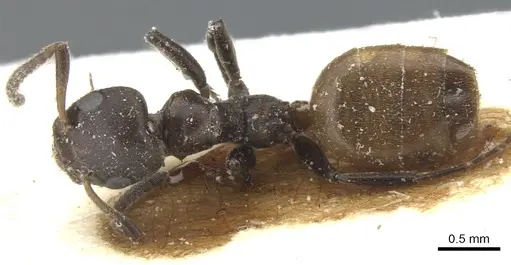
Literatür
Dağılım haritası yükleniyor...Ürünler yükleniyor...