
Aenictus brevinodus
- Bilimsel Adı
- Aenictus brevinodus
- Alt Familya
- Dorylinae
- Yazar (Tanımlayan)
- Jaitrong & Yamane, 2011
- Dağılım
- 0 ülkede bulundu
Giriş
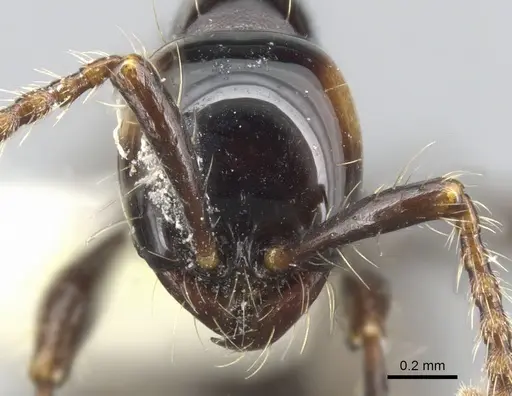
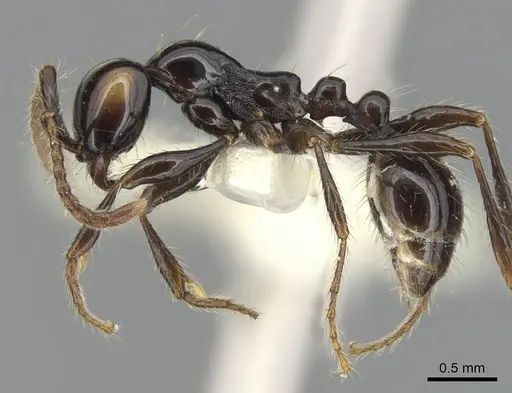
Aenictus brevinodus is a tiny army ant found in the forests of Sulawesi, Indonesia and China's Yunnan Province . Workers measure 3.65-3.75 mm in total length and have entirely smooth, shiny legs with fewer than ten standing hairs on their mesosomal dorsum . The body is dark reddish-brown . This species belongs to the Aenictus laeviceps species group . Only worker ants have ever been collected - no queens or males have been described, making this one of the most poorly known army ant species . In the wild, workers raid along low vegetation and roads to hunt prey .
Quick Summary
- Difficulty: Expert
- Origin & Habitat: Sulawesi (Indonesia) and Yunnan Province (China), in lowland and highland forests [1][2]
- Colony Type: Unknown, only worker ants have ever been found [4]
- Size & Growth:
- Queen: Size data unavailable, no queens have ever been described [4]
- Worker: 3.65-3.75 mm [1]
- Colony: Likely thousands of workers, typical for army ants, but specific data for this species does not exist
- Growth: Unknown
- Development: Unknown (Development timing is unstudied because queens have never been found.)
- Antkeeping:
- Temperature: Likely 24-28°C based on tropical Sulawesi habitat, but unconfirmed
- Humidity: Likely moderate to high based on forest habitat, but specific needs are unknown
- Diapause: No, tropical and subtropical species do not hibernate [1][2]
- Nesting: Unknown in nature. Army ants typically form temporary bivouacs (living clusters of ants) rather than permanent nests.
- Behavior: Active raiders that hunt along low vegetation and roads [1][4]. Their very small size means they can escape through the tiniest gaps. Army ants are nomadic and frequently move their entire colony.
- Common Issues: no queens are known, making colony founding impossible., wild-caught colonies would require massive enclosures and enormous daily amounts of live prey., small size (under 4 mm) means escape prevention is extremely difficult, use fluon on all edges., nomadic army ant behavior is nearly impossible to replicate in standard formicaria., this species is not available in the ant trade due to lack of described queens.
Natural History and Distribution
This species lives in the forests of Sulawesi, Indonesia and has also been recorded from China's Yunnan Province [1][2]. Workers forage as army ants, raiding along low vegetation and roads to hunt prey [1][4]. They belong to the Aenictus laeviceps species group, which is characterized by smooth bodies and specific hair patterns [3]. Only worker ants have ever been collected, researchers have not found any queens or males [4]. This means we know almost nothing about how colonies start, how large they grow, or how they reproduce.
Why These Ants Are Not Suitable for Standard Keeping
You cannot keep Aenictus brevinodus like a typical pet ant. Since no queens have been described, you cannot start a colony from a single foundress [4]. Wild colonies would likely contain thousands of workers and require massive amounts of live prey daily. Their nomadic lifestyle means they frequently move their entire colony, which is nearly impossible to manage in a standard formicarium. These factors make them suitable only for specialized research facilities, if at all.
Housing and Escape Prevention
If you somehow obtained a wild colony, you would need an enormous enclosure with excellent escape prevention. At 3.65-3.75 mm, workers can squeeze through the tiniest gaps [1]. Army ants require space to form bivouacs, temporary living structures made of the ants' own bodies. You would need a large, open area with substrate for them to cluster. Apply fluon or similar barrier to all enclosure edges to prevent escape. However, no captive housing methods have been developed for this specific species.
Feeding and Diet
In the wild, they raid for prey along vegetation and roads [1][4]. As army ants, they eat whatever small insects and arthropods they can overpower. In captivity, they would need constant access to live prey such as termites, small crickets, or other insects. Sugar sources like honey or sugar water may not be accepted, as army ants are specialized predators.
Frequently Asked Questions
Can I keep Aenictus brevinodus in a test tube?
No. Test tubes are suitable for founding queens, but no queens of this species have been found. Wild colonies are massive and nomadic, requiring huge enclosures [4][1].
How do I found an Aenictus brevinodus colony?
You cannot. Scientists have never described a queen of this species, so there is no way to start a colony [4].
What do Aenictus brevinodus eat?
They are army ants that raid for prey along low vegetation and roads. They likely eat small insects and other arthropods, but specific prey preferences are unstudied [1].
Do Aenictus brevinodus need hibernation?
No. They come from tropical Sulawesi and subtropical China, so they do not require a winter rest period [1][2].
How big do Aenictus brevinodus colonies get?
Colony size is unknown. Army ants typically form large colonies with thousands of workers, but specific data for this species does not exist [4].
Are Aenictus brevinodus dangerous?
They are very small ants (under 4 mm) and unlikely to harm humans, but army ants can be aggressive defenders when raiding. Handle with care [1].
Where can I buy Aenictus brevinodus?
You cannot. This species is not available in the ant trade due to the lack of described queens and the difficulty of keeping army ants [4].
How long until Aenictus brevinodus get their first workers?
This is unknown. Development time has never been studied because queens have never been found [4].
Report an Issue
The current care sheet is based fully on literature. See inconsistencies, or something that's incorrect? Please , it will be resolved after review from an admin. Contributing to the blogs tab also helps providing information, to make us be able to further improve the caresheets. Thank you for your support!
References

Bu bakım rehberi şu lisans altındadır: CC BY-SA 4.0 .
Topluluk Blogları
CASENT0903684
AntWeb'de Görüntüle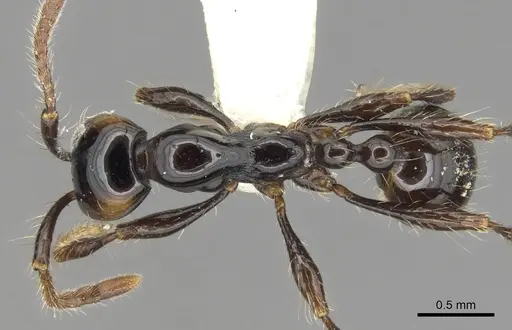
Literatür
Dağılım haritası yükleniyor...Ürünler yükleniyor...