
Vombisidris harpeza
- Sci. Name
- Vombisidris harpeza
- Tribe
- Crematogastrini
- Subfamily
- Myrmicinae
- Author
- Bolton, 1991
- Distribution
- Found in 1 countries
Introduction
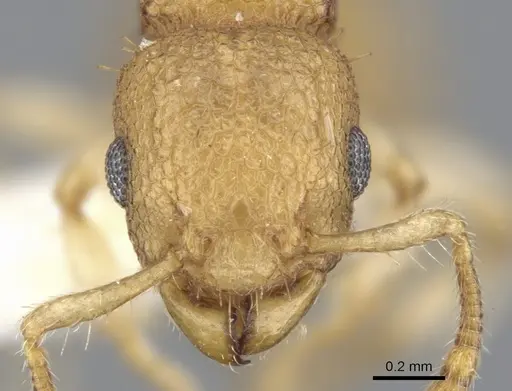
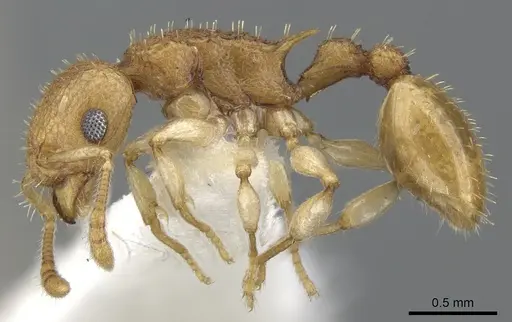
Vombisidris harpeza is a tiny, bright yellow arboreal ant from the Myrmicinae subfamily. Workers measure about 3.5 mm in total length and have short, blunt, erect hairs on the head and gaster, with sparse hairs on the mesosoma . It belongs to the australis species group and is distinguished by a weakly impressed metanotal groove and a petiole node that separates from the peduncle at an obtuse angle . The species was first described from Sarawak, Borneo, and has since been recorded in Brunei, Indonesia, and the Philippines (Palawan Island) . These ants live in lowland dipterocarp rainforests and secondary forests, where they forage on tree bark and in the canopy .
Quick Summary
- Difficulty: Medium
- Origin & Habitat: Native to the Indomalaya region: Borneo (Sarawak), Brunei, Indonesia, and the Philippines. Found in lowland dipterocarp rainforests and secondary forests, foraging on tree bark and in the canopy [2][3].
- Colony Type: Unknown, only workers have been collected, colony structure and queen number are unconfirmed.
- Size & Growth:
- Queen: Unknown (queen has not been described)
- Worker: ~3.5 mm [1]
- Colony: Unknown, only individual workers have been collected, no large colonies reported
- Growth: Unknown, insufficient data
- Development: Unknown, specific data not available (As a tropical species, development likely depends on stable warm temperatures, but no exact timeline is known)
- Antkeeping:
- Temperature: Based on its tropical lowland rainforest habitat, maintain stable warm temperatures around 25°C. Avoid cold drafts or temperatures below 20°C [3].
- Humidity: High humidity, keep the nest substrate moist but not waterlogged. The natural habitat is humid rainforest, so occasional misting is beneficial.
- Diapause: No, as a tropical species from Southeast Asia, it does not require hibernation. Keep conditions stable year-round [3].
- Nesting: Arboreal, prefers small, vertical spaces. A Y-tong (AAC) or plaster nest with tiny chambers works well, along with climbing surfaces like cork bark or twigs in the outworld [4].
- Behavior: Uses a spatulate stinger to wipe venom onto enemies (smear defense), rather than a typical piercing sting. These ants are generally docile and tend to retreat when disturbed. Their small size (3.5 mm) makes escape prevention critical, use fine mesh (≤0.5 mm) on all openings. Activity patterns are unknown but likely nocturnal or crepuscular, given their canopy habitat.
- Common Issues: escape prevention is critical due to their tiny size, they can squeeze through gaps as small as 0.5 mm, unknown specific requirements make care challenging, wild-caught colonies may struggle in captivity, high humidity needs can lead to mold if ventilation is poor, arboreal nature means they need climbing structures, not just flat surfaces, no published data on founding or colony growth, so keepers must rely on trial and error
Housing and Nest Setup
In nature, Vombisidris harpeza forages on tree bark and in the canopy [4][3]. For a captive colony, provide a nest with small, scale-appropriate chambers, such as a Y-tong (AAC) or plaster nest. Since they are arboreal, include vertical climbing surfaces like cork bark, twigs, or artificial plants in the outworld. Keep the nest substrate consistently damp, these are rainforest ants, but avoid waterlogging. A small water source (test tube or cotton ball) should always be available.
Feeding and Diet
Specific dietary data for V. harpeza is lacking, but based on the genus, they are likely omnivorous. Offer a constant supply of sugar water or honey for energy, and small protein sources 2-3 times per week, such as fruit flies, pinhead crickets, or tiny mealworms. Remove uneaten prey after 24-48 hours to prevent mold. Their small size means prey must be very small, anything larger than their head may be ignored.
Temperature and Humidity
As a tropical lowland rainforest species, V. harpeza needs warm, humid conditions. Aim for a temperature around 25°C, avoiding extremes below 20°C or above 32°C [3]. Humidity should be high, the nest should be kept moist but not wet. Occasional misting and a covered water source help maintain humidity. Avoid direct sunlight or drafts from air conditioning.
Colony Founding and Growth
The founding behavior of V. harpeza is unknown. No queens have been described, and no captive colonies have been reported. Keepers should be prepared to experiment with typical Myrmicinae conditions: a test tube setup with a water reservoir, kept dark and warm. The first workers likely appear after several weeks, but this is pure speculation. Patience is essential.
Behavior and Temperament
Vombisidris harpeza belongs to the Myrmicinae tribe Crematogastrini, which uses a specialized spatulate stinger to smear venom onto threats (smear defense). The workers are not aggressive and will flee when disturbed. Their small size (3.5 mm) makes them excellent climbers, so escape-proofing is mandatory. Activity patterns are unclear, but they are probably active at night or in dim light, given their canopy habitat [3].
Seasonal Care
This is a tropical species with no known diapause requirement. Maintain stable warm and humid conditions year-round. Avoid significant temperature drops, if your home cools in winter, use a small heating mat with a thermostat to keep the colony around 25°C. Consistency is more important than matching any specific seasonal cycle. [3]
Frequently Asked Questions
How long does it take for Vombisidris harpeza to have first workers?
There is no published data for V. harpeza. Based on related Myrmicinae, if the queen founds claustrally (unconfirmed), first workers might appear in 6-8 weeks at warm temperatures, but this is an estimate.
What do Vombisidris harpeza ants eat?
They are likely omnivorous. Provide sugar water or honey constantly, and small protein sources like fruit flies or pinhead crickets 2-3 times per week. Remove leftover prey after 24-48 hours.
Can I keep Vombisidris harpeza in a test tube?
A test tube with a water reservoir is a good temporary setup for a founding queen (if you have one), but since the queen is undescribed and founding unknown, this is speculative. For established colonies, a Y-tong or plaster nest with small chambers is better.
Do Vombisidris harpeza ants sting?
They have a spatulate stinger, but it is used to wipe venom onto enemies rather than pierce skin. They are not considered dangerous to humans and will flee rather than attack.
What temperature do Vombisidris harpeza ants need?
Aim for a stable temperature around 25°C, typical of tropical lowland rainforests. Avoid drops below 20°C [3].
How big do Vombisidris harpeza colonies get?
Colony size is unknown. Only individual workers have been collected in the field, no large colonies have been documented.
Are Vombisidris harpeza good for beginners?
This species is not recommended for beginners. Its small size makes escape prevention difficult, and its specific care requirements are unknown. It is best suited for experienced keepers willing to experiment.
Do Vombisidris harpeza need hibernation?
No, as a tropical species from Southeast Asia, they do not require hibernation. Keep temperatures stable year-round [3].
Why are my Vombisidris harpeza escaping?
Workers are only 3.5 mm long and can squeeze through holes smaller than 0.5 mm. Use very fine mesh on all ventilation, seal all joints, and check for cracks. Escape prevention is the top priority for this species.
When should I move Vombisidris harpeza to a formicarium?
Since no captive colonies have been reported, there is no standard timeline. If you have a colony, move them when the test tube becomes crowded (30-50 workers) to a small Y-tong or plaster nest with climbing structures.
Report an Issue
The current care sheet is based fully on literature. See inconsistencies, or something that's incorrect? Please , it will be resolved after review from an admin. Contributing to the blogs tab also helps providing information, to make us be able to further improve the caresheets. Thank you for your support!
References

This caresheet is licensed under CC BY-SA 4.0 .
Community Blogs
CASENT0901989
View on AntWeb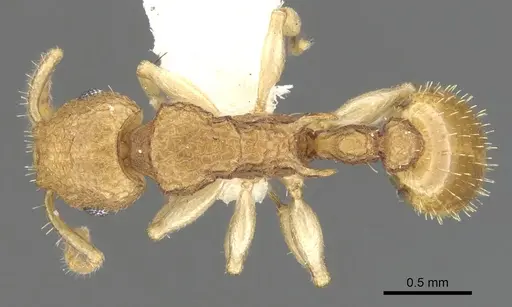
Literature
Loading distribution map...Loading products...