
Vicinopone conciliatrix
- Sci. Name
- Vicinopone conciliatrix
- Subfamily
- Dorylinae
- Author
- Brown, 1975
- Distribution
- Found in 2 countries
Introduction
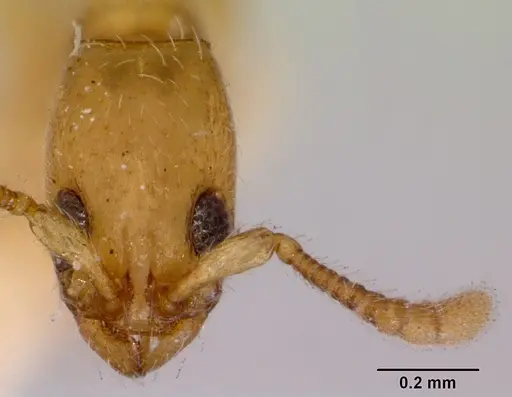
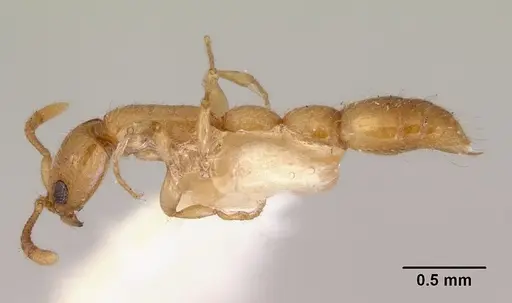
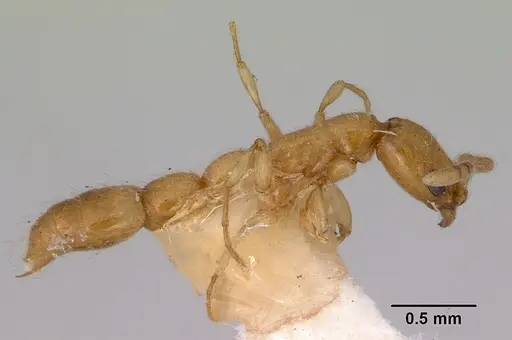
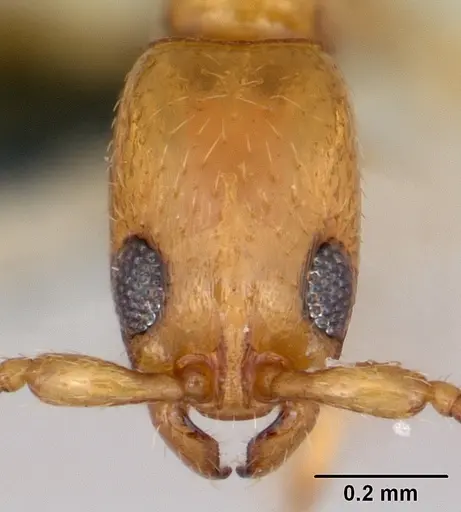
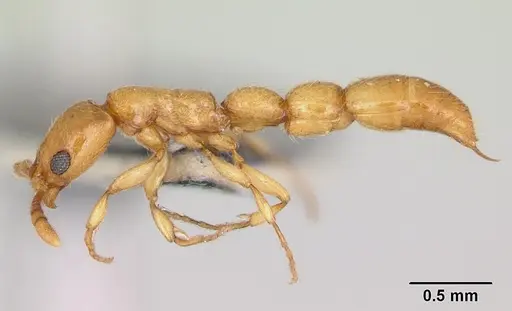
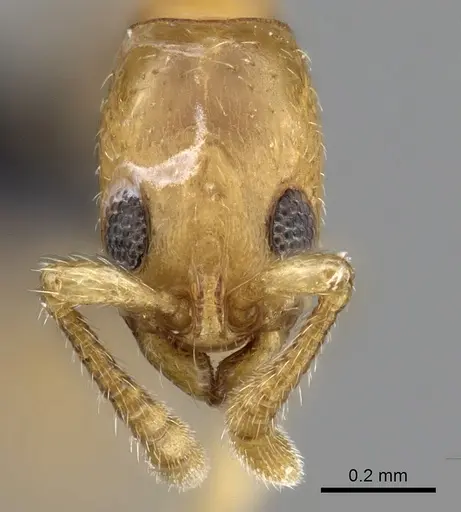
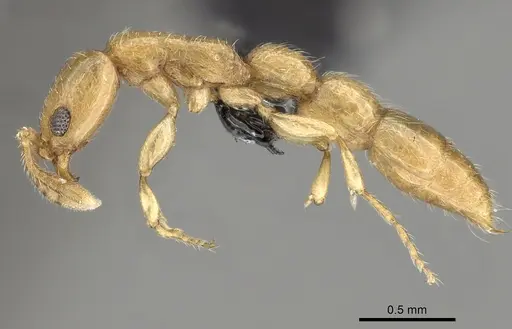
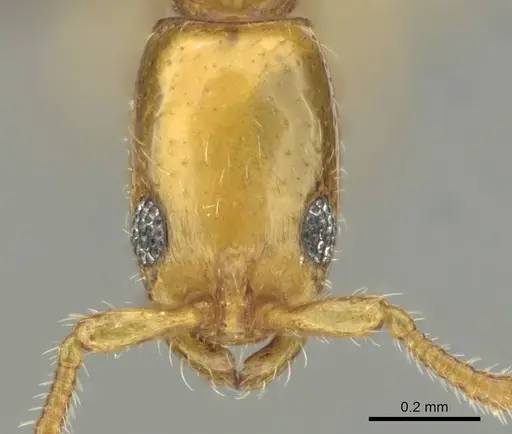
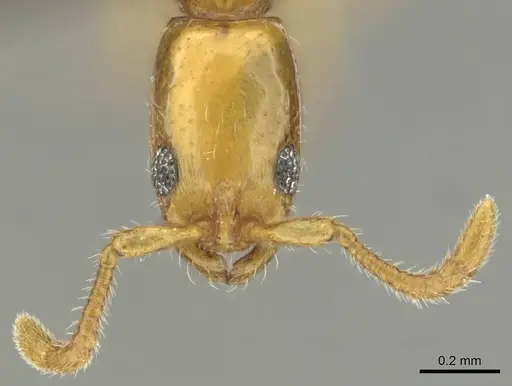
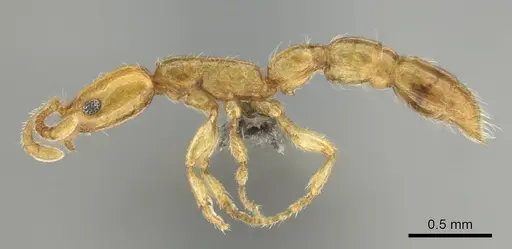
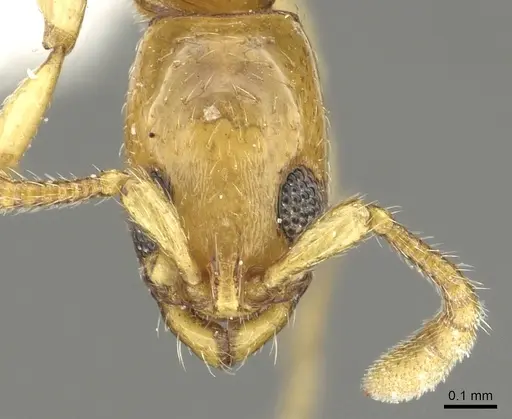
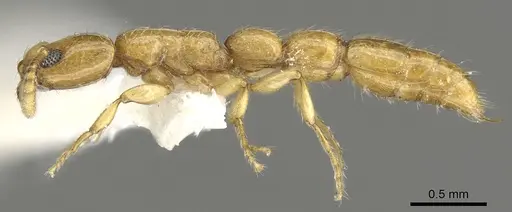
Vicinopone conciliatrix is a rare, unusual arboreal ant from the Dorylinae subfamily, the group that includes army ants. Workers are small, slender ants measuring 2.4-3.4 mm, with a distinctive yellow body and eyes placed far forward on the head . This is the only species in the genus Vicinopone, making it one of the most distinct and least-studied ants. It is found across the Afrotropical region: Ghana, Democratic Republic of Congo, Gabon, and Tanzania, where it nests high in trees rather than on the ground . The type nest was discovered in a hollow cocoa twig about 2 m above ground, containing 103 workers and 2 dealate queens .
Quick Summary
- Difficulty: Expert
- Origin & Habitat: Afrotropical region, Ghana, DRC, Gabon, Tanzania. Nests in hollow twigs and small branches in trees, typically 2 m or more above ground in shaded forest canopies [1][3].
- Colony Type: Small colonies with multiple queens, the only known wild nest contained 103 workers and 2 dealate queens [1]. Colony structure beyond this is not documented.
- Size & Growth:
- Queen: ~3.6 mm (dealate queen) [1]
- Worker: 2.4-3.4 mm [1]
- Colony: Up to ~100 workers, based on the type nest [1]
- Growth: Unknown, no captive breeding documented
- Development: Unknown, no captive data available (Development timeline has not been studied. As a Dorylinae ant, development may follow patterns similar to related predatory species, but specific data is lacking.)
- Antkeeping:
- Temperature: Based on its Afrotropical distribution, these ants likely require warm conditions in the mid-to-high 20s °C. No specific studies exist on temperature preferences.
- Humidity: As an arboreal rainforest ant, it likely requires moderate to high humidity. The cocoa-tree nesting suggests humid, shaded conditions.
- Diapause: Unknown, no data on overwintering. Given their tropical distribution, they likely do not require diapause.
- Nesting: Natural nesting occurs in hollow twigs and small branches in trees. In captivity, this would require an arboreal setup with small-diameter tubes or branches. Standard test tubes are unsuitable.
- Behavior: Classified as an ‘insinuator’ species, they infiltrate existing arboreal cavities rather than building their own nests [3][4]. As Dorylinae, they are predatory on small invertebrates. Workers are size‑variable (polymorphic), with larger workers having relatively larger eyes [1]. They rarely come down to the ground. Escape risk is moderate given their small size and arboreal habits, vertical containment is essential.
- Common Issues: no captive husbandry information exists, this species has never been documented in the antkeeping hobby, arboreal lifestyle requires specialized setups not commonly used in antkeeping, predatory diet may be difficult to meet with standard feeder insects, extreme rarity in the wild makes collection impractical and potentially harmful to wild populations, queen number and colony structure in captivity are completely unknown
Why This Species Is Extremely Challenging
Vicinopone conciliatrix is one of the most difficult ants to keep in captivity, perhaps the most difficult non‑parasitic species. There is zero documented captive husbandry information. It has never been observed in the antkeeping hobby, and no one has published any successful keeping data. The reasons are clear: they live exclusively in tree canopies, nest in tiny hollow twigs, and are found only in a handful of wild locations across central Africa. They are not ground‑nesting ants. Combined with their predatory diet and specific arboreal requirements, this species should be considered a hands‑off species for anyone without access to wild‑caught specimens from specific African locations and the ability to provide highly specialised care. Even then, success would be uncertain. [1][3][4]
Natural History and Distribution
Vicinopone conciliatrix is known from only a handful of locations in the Afrotropical region. The type locality is in Ghana at the Cocoa Research Institute, where the original nest was found in a hollow twig of a small cocoa tree about 2 m above ground [1]. Additional specimens have been recorded from the Democratic Republic of Congo, Gabon, and Tanzania. In Gabon they were nesting in forest canopy trees, confirming a strictly arboreal lifestyle [3][4]. They are classified as ‘insinuator’ species, they exploit pre‑existing cavities in trees rather than excavating their own nests. The species is considered rare, but this may be partly because researchers rarely search for ants in tree canopies where they live.
Morphology and Identification
This is the sole species in the genus Vicinopone, making identification straightforward if you ever encounter one. Workers are 2.4-3.4 mm, yellow, with a slender cylindrical body [1]. Their most striking feature is the extremely forward‑placed eyes, positioned very close to the mandibles, which distinguishes them from related genera like Simopone. They have 12‑segmented antennae (unusual among close relatives, which typically have 11), and a barrel‑shaped petiole that is elongate rather than flattened. Workers are polymorphic, with larger individuals having relatively larger eyes. Queens are slightly larger at about 3.6 mm and are dealate (wingless) in known specimens. Founding behavior is unconfirmed.
Taxonomy and Relationships
Vicinopone was originally described as Vicinopone conciliatrix but was elevated to its own genus by Bolton and Fisher in 2012,based on significant morphological differences [1]. Phylogenetic analyses confirmed it is not closely related to Simopone and instead belongs to the Dorylinae subfamily, the same group that includes army ants. It was considered a ‘wildcard’ taxon in phylogenetic studies, with its position varying depending on the analytical method, but it is now firmly established as a distinct genus [5][6]. This ant is part of a group of specialised predatory ants that hunt small invertebrates in the forest canopy.
If You Somehow Obtain Specimens
If you somehow obtain live specimens of this species (which would require fieldwork in Ghana, DRC, Gabon, or Tanzania), captive care would require careful consideration. Based on natural history, you would need an arboreal setup with small‑diameter tubes or hollow twigs, temperatures in the mid‑20s °C, high humidity, and a diet of small live prey (likely micro‑arthropods like springtails). Standard test tube setups would be inappropriate for an arboreal species. However, there is absolutely no guarantee this would work, no one has documented success. Given the extreme difficulty and the species’ rarity in the wild, it is far better to appreciate this ant from scientific literature and photographs rather than attempt to keep it. Many well‑established ant species in the hobby make excellent alternatives. [1][3][4]
Frequently Asked Questions
Can I keep Vicinopone conciliatrix in a test tube?
No. This is an arboreal species that nests in hollow twigs in trees, not in ground cavities. A test tube setup would be completely inappropriate. They would need an arboreal‑style enclosure with small‑diameter tubes or branches.
Has anyone kept Vicinopone conciliatrix in captivity?
No. There is zero documented captive husbandry information for this species. It has never been observed in the antkeeping hobby and no care guides exist. This is one of the least‑documented ant species in existence.
What do Vicinopone conciliatrix ants eat?
As a Dorylinae ant (army‑ant relative), they are predatory on small invertebrates. The specific prey is not documented, but based on their small size and arboreal lifestyle, they likely hunt micro‑arthropods in tree canopies. Captive feeding would require small live prey.
Where does Vicinopone conciliatrix live?
They live exclusively in tree canopies across the Afrotropical region, Ghana, Democratic Republic of Congo, Gabon, and Tanzania. They nest in hollow twigs and small branches, typically 2 m or more above ground, and rarely if ever come down to the ground.
How big do Vicinopone conciliatrix colonies get?
The largest known wild nest contained 103 workers with 2 dealate queens. This appears to be near the upper end of colony size for this species. Colonies are relatively small compared to many other ant species.
Do Vicinopone conciliatrix ants sting?
Yes, they have a sting. The original description mentions ‘the stout sting issues from the true apex.’ However, given their tiny size (2.4-3.4 mm), any sting would be negligible to humans.
Are Vicinopone conciliatrix good for beginners?
Absolutely not. This species is not recommended for anyone, including experts. There is no captive husbandry information, they require highly specialised arboreal setups, and they are extremely rare in the wild. There are many better‑documented species available in the antkeeping hobby.
Do Vicinopone conciliatrix need hibernation?
Unknown. Given their tropical African distribution, they likely do not require a diapause period. However, no specific studies on their seasonal requirements exist.
How many queens does Vicinopone conciliatrix have?
The type nest contained 2 dealate queens, suggesting polygynous (multiple queen) colonies. However, colony structure is not well documented, and it is unknown whether this is typical or represents a founding cluster.
Why is Vicinopone conciliatrix so rare?
They are not necessarily rare in absolute terms, but they are difficult to find because they live exclusively in tree canopies, where researchers rarely search. Most ant surveys focus on ground‑nesting species. Their arboreal lifestyle makes them naturally uncommon in standard sampling methods.
Report an Issue
The current care sheet is based fully on literature. See inconsistencies, or something that's incorrect? Please , it will be resolved after review from an admin. Contributing to the blogs tab also helps providing information, to make us be able to further improve the caresheets. Thank you for your support!
References

This caresheet is licensed under CC BY-SA 4.0 .
Community Blogs
CASENT0172320
View on AntWeb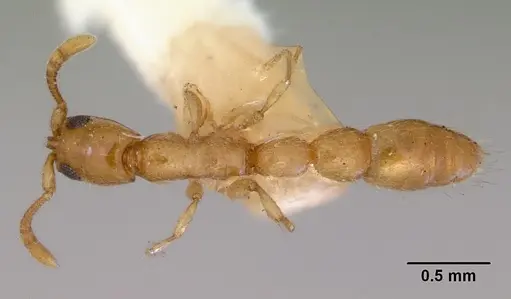
CASENT0172777
View on AntWeb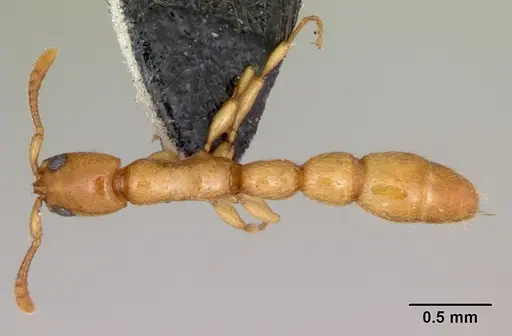
CASENT0249323
View on AntWeb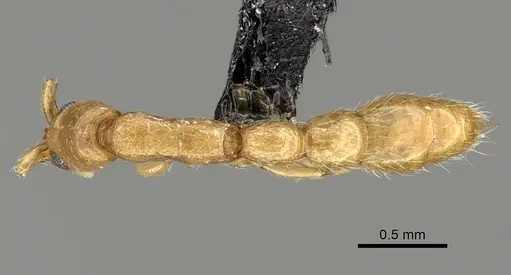
CASENT0249622
View on AntWeb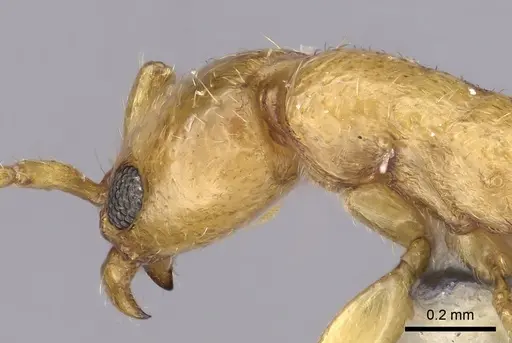
CASENT0813008
View on AntWeb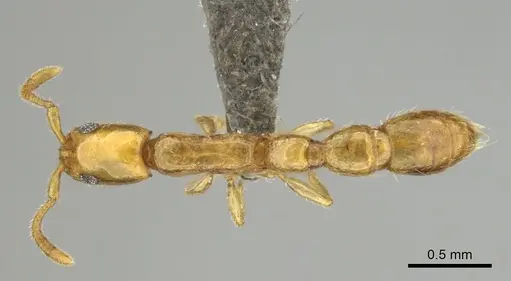
CASENT0902700
View on AntWeb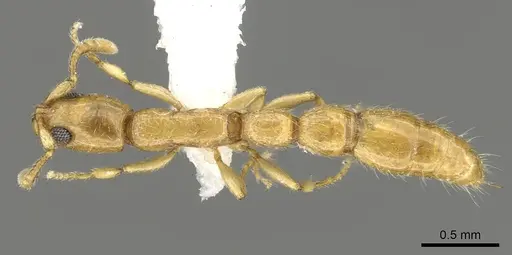
Literature
Loading distribution map...Loading products...