
Tetraponera connectens
- Sci. Name
- Tetraponera connectens
- Tribe
- Pseudomyrmecini
- Subfamily
- Pseudomyrmecinae
- Author
- Ward, 2001
- Distribution
- Found in 1 countries
Introduction
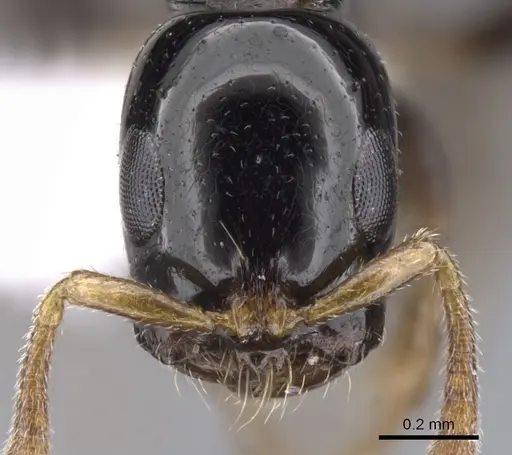
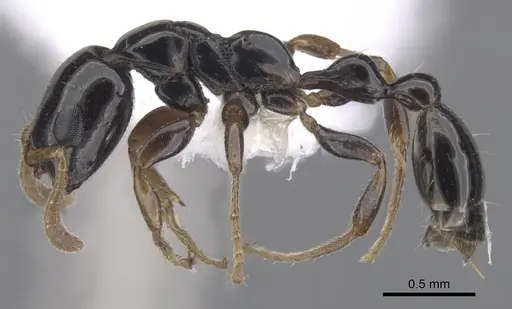
Tetraponera connectens is a tiny black ant from Thailand, belonging to the Pseudomyrmecinae subfamily and the Tetraponera allaborans species group . Described by Ward in 2001,it is known only from its type locality in Khao Lak National Park, where it was collected via canopy fogging in semi-primary dipterocarp hilltop forest at 300 meters elevation . This ant is small and slender with disproportionately small eyes, short antenna scapes, and broad femurs; its body is black to dark brownish-black with lighter brown antennae, mandibles, and legs . As an arboreal species, it likely nests in hollow plant stems or crevices in trees, though direct observations are lacking .
Quick Summary
- Difficulty: Medium
- Origin & Habitat: Thailand: Khao Lak National Park, Thone Chong Fa Fall,300m elevation. Semi-primary dipterocarp hilltop forest, a tropical environment with high humidity and warm temperatures year-round [1][2].
- Colony Type: Unconfirmed. Colony structure has not been documented for this species.
- Size & Growth:
- Queen: Unknown, not described in available literature.
- Worker: Body length (total length) not available, only head measurements exist (head width ~0.58-0.63 mm, head length ~0.77-0.84 mm) [1][2]. These are not full body size.
- Colony: Unknown, no colony size data available.
- Growth: Unknown, no development data available.
- Development: Unknown, no direct measurements or estimates exist for this species. (No specific development data exists for T. connectens. Tropical ants typically develop faster than temperate species, but exact timelines are speculative.)
- Antkeeping:
- Temperature: Keep warm, around 24-28°C. Use a heat mat on the side of the nest to create a gradient. Avoid prolonged temperatures below 20°C.
- Humidity: High humidity needed, keep nest substrate consistently moist but not waterlogged. Provide good ventilation to prevent mold.
- Diapause: No, this tropical species does not require hibernation. Keep warm year-round.
- Nesting: Arboreal, provide vertical climbing structures and narrow chambers that mimic hollow stems. Y-tong (AAC) or 3D-printed nests with small chambers work well.
- Behavior: Active and agile climbers, typical of arboreal Pseudomyrmecinae. They have a functional sting and may use it if threatened, but they are more likely to flee than attack. Their small size makes escape prevention critical. They are likely omnivorous, feeding on nectar, honeydew, and small insects. Workers are slender and fast-moving.
- Common Issues: escape prevention is critical due to their tiny size, use fine mesh (≤0.5mm) and tight seals on all connections., unknown care parameters mean you must experiment with conditions, small changes can cause stress., humidity management is tricky, too dry kills, too wet causes mold, balance with good ventilation., founding queens are sensitive to disturbance, minimize inspections until first workers appear.
Housing and Nest Setup
Choose nesting that suits their arboreal nature. Y-tong (AAC) blocks with narrow chambers or 3D-printed nests with tight vertical spaces work well. Avoid large open chambers, these tiny ants prefer snug quarters where they feel secure. Connect a small outworld for foraging. For founding queens, a test tube setup with a water reservoir (cotton plug) and a dark cover is ideal. Cover all ventilation holes with fine mesh (0.5mm or smaller) to prevent escapes. Provide climbing structures like sticks or artificial plants in the outworld. Place the nest in a quiet, dim area to reduce stress.
Temperature Requirements
As a tropical species from Thailand, T. connectens needs consistent warmth. Maintain nest temperatures around 24-28°C. Use a heat mat on the side or top of the nest to avoid drying out the substrate. Provide a temperature gradient so workers can choose. Room temperature may work if your home stays warm, but a heating source is safer. Avoid temperatures below 20°C for extended periods, cold can kill the colony quickly.
Humidity and Water
Keep the nest substrate moist but not waterlogged. Squeeze the substrate, it should hold together and feel damp, but no water should drip. For test tube setups, maintain a good water reservoir with a cotton plug. Mist the outworld lightly if needed, but avoid puddles. Good ventilation is essential to prevent mold. If you see condensation on nest walls, humidity is likely fine. Adjust by covering part of the nest to retain moisture or increasing airflow.
Feeding and Diet
Offer a mix of sugars and proteins. For carbohydrates, provide honey water or sugar water continuously via a small container or soaked cotton ball. For protein, offer small insects like fruit flies, springtails, or pinhead crickets 2-3 times per week. Prey should be appropriately sized, these tiny ants cannot handle large prey. Remove uneaten food after 24 hours to prevent mold and pests. Feed sparingly, overfeeding wastes food and attracts problems.
Colony Development
Development data is absent for this species. Expect slow growth, especially during founding. The queen may take months to produce the first nanitic workers. Once the colony reaches a few workers, growth may accelerate, but maximum colony size is unknown. Be patient and disturb the nest as little as possible. Wild-caught colonies may have parasites, quarantine them initially.
Escape Prevention
Their tiny size makes escape prevention non-negotiable. Workers can squeeze through gaps as thin as a credit card edge. Use very fine mesh (0.5mm or less) on all ventilation points. Apply fluon or PTFE to the upper edges of the outworld. Check all connections between nest and outworld for tiny cracks. When feeding, work in a contained area (like a tray) to catch escapees. A single escaped worker can be extremely difficult to recapture, caution is key.
Frequently Asked Questions
How long does it take for Tetraponera connectens to produce first workers?
Unknown, no development data exists for this species. General Pseudomyrmecinae patterns suggest 4-8 weeks under warm conditions, but this is speculative. Be patient and minimize disturbances during founding.
Can I keep Tetraponera connectens in a test tube?
Yes. Use a test tube with a water reservoir (cotton plug) and wrap it in foil to keep it dark. This works well for founding colonies. Move to a small Y-tong or 3D-printed nest once the colony outgrows the tube (e.g.,20-30 workers). Make the transition gradual by connecting the tube to the new nest.
Do Tetraponera connectens ants sting?
Like many Pseudomyrmecinae, they have a functional sting. However, they are not dangerous to humans. Their sting is mild and rarely used unless the ant is cornered. They prefer to flee. No specific studies detail their sting behavior.
What temperature do Tetraponera connectens need?
Keep them at 24-28°C year-round. They are tropical and cannot handle cold. Use a heat mat on the side of the nest. Avoid temperatures below 20°C.
Are Tetraponera connectens good for beginners?
Rated medium difficulty. The lack of species-specific data means you'll need to troubleshoot conditions yourself. Their tiny size and escape risk add challenge. Beginners may want to gain experience with hardier species first.
How big do Tetraponera connectens colonies get?
Colony size is unknown. Related Tetraponera species may reach several hundred workers, but no data exists for T. connectens. Growth is likely slow at first.
Do Tetraponera connectens need hibernation?
No, as a tropical species they do not hibernate. Keep warm temperatures stable all year. Simulating winter can stress or kill them.
What do Tetraponera connectens eat?
Offer sugar water (carbohydrates) and small insects like fruit flies, springtails, or pinhead crickets (protein). Feed protein 2-3 times per week, sugar continuously. Remove uneaten food after 24 hours.
Why are my Tetraponera connectens dying?
Common causes: temperatures too cold (below 20°C), humidity too low or too high (mold), stress from disturbance, or parasites from wild colonies. Check each condition and adjust gradually. If founding, give the queen undisturbed time.
Can I keep multiple Tetraponera connectens queens together?
Colony structure is unknown. Most Tetraponera are monogyne (single queen), but polygyny occurs in some. Without specific data, do not combine unrelated queens unless you are experienced and prepared to separate them if aggression occurs.
When should I move Tetraponera connectens to a formicarium?
Move from a test tube to a proper nest when the colony reaches 20-30 workers or when mold/waste buildup occurs. Use a small nest with narrow chambers. Connect the tube to the new nest and let them move at their own pace.
Is Tetraponera connectens invasive anywhere?
No, this species is known only from Thailand and has not been reported elsewhere. Never release captive colonies into the wild.
Report an Issue
The current care sheet is based fully on literature. See inconsistencies, or something that's incorrect? Please , it will be resolved after review from an admin. Contributing to the blogs tab also helps providing information, to make us be able to further improve the caresheets. Thank you for your support!
References

This caresheet is licensed under CC BY-SA 4.0 .
Community Blogs
CASENT0902826
View on AntWeb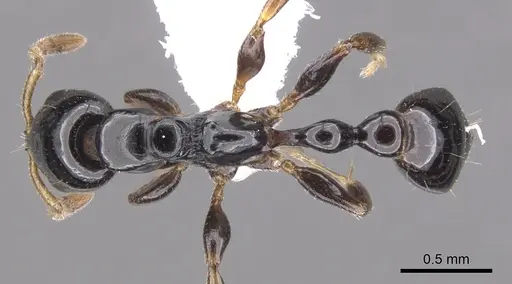
Literature
Loading distribution map...Loading products...