
Tetramorium polymorphum
- Sci. Name
- Tetramorium polymorphum
- Tribe
- Crematogastrini
- Subfamily
- Myrmicinae
- Author
- Yamane & Jaitrong, 2011
- Distribution
- Found in 2 countries
Introduction
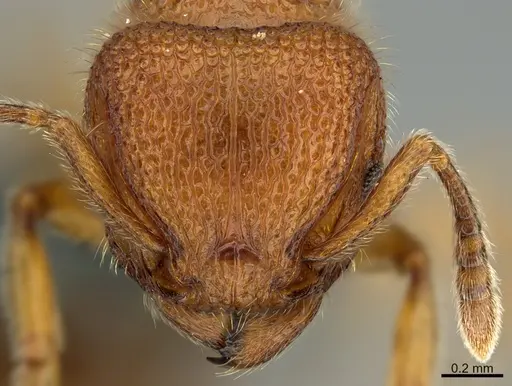
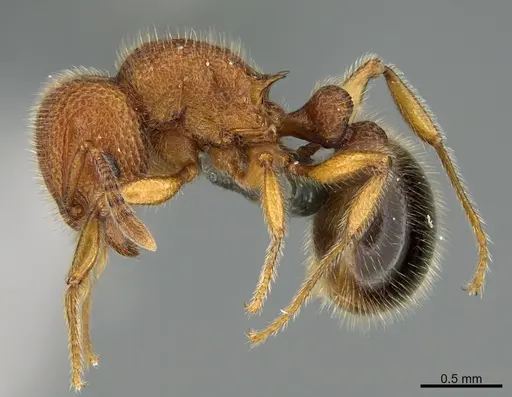
Tetramorium polymorphum is a small ant native to Southeast Asia, specifically Laos, Thailand, and southern China (Yunnan province). It is the first known Tetramorium species with a polymorphic worker caste, producing three distinct worker sizes: minor, media, and major workers, distinguished by head width. The major workers have larger heads and more eye facets, and they show aggressive behavior when the colony is disturbed, likely serving a defensive role . The queen is exceptionally large among Asian Tetramorium species . These ants are brown to reddish brown with dense branched hairs on the body, and they inhabit primary evergreen forests and dry dipterocarp forests at elevations of 300-680 meters .
Quick Summary
- Difficulty: Medium
- Origin & Habitat: Native to Laos, Thailand, and Yunnan province, China. This species is a habitat specialist restricted to primary/undisturbed evergreen rain forests and dry dipterocarp forests at 300-680m elevation [2][3][4]. The type colony was found nesting under a relatively large stone in a dry evergreen forest in Vientiane Province, Laos [1].
- Colony Type: Unknown, the type series contained one queen, but colony structure has not been studied in the field. Based on limited data, it may be monogyne, but this is unconfirmed.
- Size & Growth:
- Queen: Size data unavailable, only head measurements are recorded in the literature (head width ~1.10 mm) [1].
- Worker: Size data unavailable, only head widths are documented: minor 0.58-0.75 mm, media 0.80-0.90 mm, major 1.03-1.10 mm (head width) [1][2].
- Colony: Up to 60 workers observed in a wild colony [1], maximum colony size unknown.
- Growth: Moderate
- Development: Estimated 6-8 weeks based on related Tetramorium species, species-specific data unavailable. (Development time is inferred from genus-level data since direct studies are lacking.)
- Antkeeping:
- Temperature: Keep at 22-26°C, as this species comes from tropical forests. Use a heating cable to create a gentle gradient if needed [2].
- Humidity: Moderate to high, they inhabit evergreen forests. Keep the nest substrate consistently moist but not waterlogged, providing drainage [1].
- Diapause: Minimal or none, being tropical, they likely do not require hibernation. A slight cooling period (18-20°C) in winter may be beneficial but is not required [2].
- Nesting: In nature, they nest under stones in shallow soil [1][2]. In captivity, use a Y-tong (AAC) nest with tight chambers, or a naturalistic setup with soil and flat stones.
- Behavior: This species is comparatively aggressive, with major workers showing defensive behavior when the colony is disturbed [2][3]. They use a modified stinger to smear venom, rather than injecting it. Escape prevention is important due to their small size. Workers are active foragers. Major workers likely serve as soldiers.
- Common Issues: primary forest specialist, this species is sensitive to suboptimal conditions and may not thrive in artificial setups [4][3]., aggressive defense, major workers will smear venom when threatened, handle with care., escape risk, tiny workers can squeeze through very small gaps, use fine mesh and tight lids., humidity control, needs consistent moisture but can develop mold if too wet, provide ventilation.
Housing and Nest Setup
Tetramorium polymorphum nests under stones in shallow soil in the wild. For captivity, a Y-tong (AAC) nest with tight chambers works well, or you can use a naturalistic setup with a soil layer and flat stones on top to mimic their natural nesting sites [1]. The chambers should be appropriately scaled to the tiny size of the workers. A test tube setup can work for founding colonies, but you may need to move them to a more spacious formicarium as the colony grows. Since they come from primary forest habitats, they seem to prefer more natural conditions than some other Tetramorium species [2]. Use a water tube for humidity but avoid flooding the nest area.
Feeding and Diet
No specific diet data is available for this species. Based on typical Tetramorium feeding patterns, they are likely omnivorous and will accept small insects like fruit flies, micro crickets, and mealworms, as well as sugar water or honey. Offer protein sources regularly and remove uneaten food to prevent mold. The type colony was collected from under a stone, suggesting they forage in the soil layer and may be opportunistic feeders [1].
Temperature and Seasonal Care
Being native to Laos, Thailand, and southern China, this species prefers warm conditions. Keep the nest at 22-26°C, with a slight gradient if possible. A heating cable placed on one side of the nest can help maintain appropriate temperatures, but avoid direct heat that could dry out the nest too quickly [2]. Since they come from elevations of 300-680 m in tropical forests, they likely do not require a true hibernation diapause. However, slightly cooler temperatures during winter months (around 18-20°C) may be appropriate and simulate natural seasonal changes [3].
Understanding the Polymorphic Worker Caste
This is the first documented Tetramorium species with three distinct worker castes, making it particularly interesting for antkeepers [2][1]. The minor workers are the most common and handle most day-to-day tasks. Media workers are intermediate in size. Major workers have significantly larger heads, more ommatidia in their eyes, and shorter antennae relative to their head size [1]. Major workers show aggressive behavior when the colony is disturbed and likely serve as defenders [2]. In minor and media workers, most body hairs are branched (trifid), while major workers have mostly simple (unbranched) hairs [1]. This polymorphism is a fascinating example of division of labor in ant societies.
Behavior and Temperament
Tetramorium polymorphum is described as comparatively aggressive compared to other Tetramorium species [2][3]. When their nest is disturbed, major workers will readily defend the colony. They use a modified stinger to smear venom, rather than injecting a typical sting. Workers are active foragers. The species is a habitat specialist restricted to primary/undisturbed forests, this suggests they may be more sensitive to environmental conditions than more adaptable species [4][3]. They do not thrive in secondary forests or disturbed areas, so aim to provide conditions that mimic their natural evergreen forest habitat.
Frequently Asked Questions
How long does it take for Tetramorium polymorphum to produce first workers?
Based on typical Tetramorium development patterns, expect 6-8 weeks from egg to first worker at optimal temperature (around 24°C). The exact timeline for this species has not been studied, so this is an estimate based on related species.
Can I keep multiple queens together in one colony?
This is not recommended. The colony structure is unconfirmed, but no evidence suggests polygyny. Combining unrelated queens could result in fighting.
Do Tetramorium polymorphum ants sting?
No, they cannot sting in the typical sense. As a myrmicine ant, they use a modified stinger to smear venom onto enemies rather than injecting it. This means the defense is more of a topical irritant.
Are Tetramorium polymorphum good for beginners?
This species is rated as medium difficulty. While not the hardest ant to keep, it is a rarely kept species with limited captive breeding information. Being a habitat specialist that requires primary forest conditions, it may be more challenging than hardy beginner species like Lasius or Camponotus.
What size formicarium do I need for Tetramorium polymorphum?
Start with a test tube setup for the founding queen. Once the colony grows, you can move them to a small Y-tong nest or naturalistic setup with chambers scaled to the tiny size of the workers.
Why are my Tetramorium polymorphum dying?
This species is a habitat specialist restricted to primary forests. Common issues include: improper humidity (too dry or too wet), temperatures outside the 22-26°C range, poor nutrition, or stress from disturbance. They may also struggle in setups that don't mimic their natural conditions. Ensure good escape prevention since they are small ants.
Do Tetramorium polymorphum need hibernation?
Probably not. Being a tropical species from Southeast Asia, they likely do not require a true hibernation period. A slight temperature reduction during winter months (to around 18-20°C) may be beneficial but is not required.
How big do Tetramorium polymorphum colonies get?
The wild type series had approximately 60 workers, but this may not represent a full colony. The maximum colony size for this species is not well documented. Based on related Tetramorium species, colonies may reach several hundred workers over time.
Report an Issue
The current care sheet is based fully on literature. See inconsistencies, or something that's incorrect? Please , it will be resolved after review from an admin. Contributing to the blogs tab also helps providing information, to make us be able to further improve the caresheets. Thank you for your support!
References

This caresheet is licensed under CC BY-SA 4.0 .
Community Blogs
CASENT0284479
View on AntWeb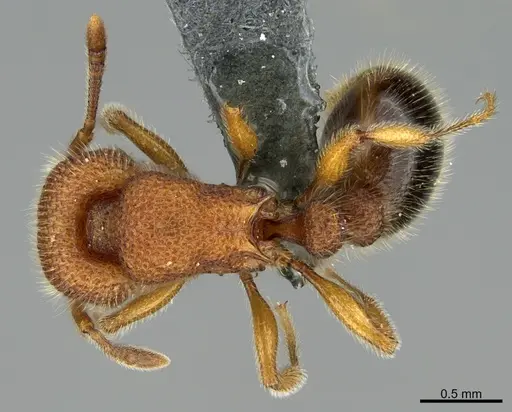
Literature
Loading distribution map...Loading products...