
Tetramorium elf
- Sci. Name
- Tetramorium elf
- Tribe
- Crematogastrini
- Subfamily
- Myrmicinae
- Author
- Hita Garcia & Fisher, 2012
- Distribution
- Found in 2 countries
Introduction
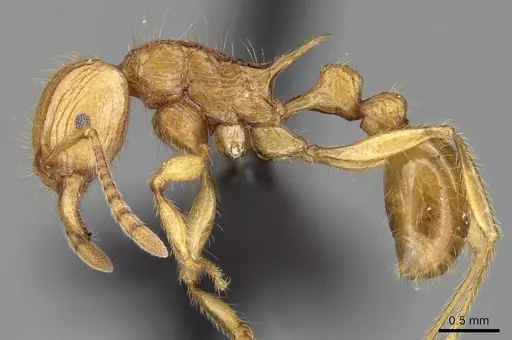
Tetramorium elf is a tiny, yellowish ant from the Tetramorium tortuosum species group, native to the rainforests of northern Madagascar. Its uniform yellow body and extremely long propodeal spines (the spikes on its back) make it easy to tell apart from similar species, like the dark brown T. electrum . The name comes from Old Norse myths, referencing its elusive nature . So far, only 12 specimens have ever been collected from four locations, making it one of the rarest Tetramorium species known . Because it’s barely been kept or studied, almost everything about its captive care is guesswork based on related species and its rainforest home. It belongs to the subfamily Myrmicinae and tribe Crematogastrini, meaning it likely defends itself by smearing venom with a modified stinger rather than stinging. If you want to try keeping it, you'll be working with a species that has no documented husbandry, so be prepared to experiment and learn as you go.
Quick Summary
- Difficulty: Expert, no captive care data exists and the species is extremely rare
- Origin & Habitat: Northern Madagascar rainforests at elevations 625-900 m, found in Makirovana, Marojejy, Antalaha, and Ambalagoavy [1][2]. The type locality is Parc National de Marojejy, Manantenina River [1].
- Colony Type: Colony structure is unconfirmed. Based on typical Tetramorium patterns, likely monogyne (single queen). No data on whether multiple queens can coexist.
- Size & Growth:
- Queen: Size data unavailable
- Worker: Size data unavailable
- Colony: Unknown, maximum colony size not documented
- Growth: Unknown, likely moderate based on genus patterns
- Development: No data exists for this species. Based on related Tetramorium, an estimate is 6-8 weeks at suitable temperature. (All timing is inferred from genus patterns, not observed for T. elf.)
- Antkeeping:
- Temperature: Keep nest temperature around 22-26 °C (low to mid 20s). This matches its rainforest habitat at moderate elevation. Use a heating cable on one side to create a gentle gradient if room temp falls below 22 °C.
- Humidity: High humidity, think damp rainforest floor. Keep nest substrate consistently moist but not waterlogged. Provide a water tube. Mist the outworld occasionally, but avoid standing water.
- Diapause: Unknown, likely no true diapause given its tropical origin. May show reduced activity during cooler periods, but does not need hibernation.
- Nesting: Based on collection from leaf litter and ground samples, likely nests in soil or under leaf litter in the wild. For captivity, use Y‑tong (AAC), plaster, or a naturalistic soil setup with small chambers suited to their tiny size. Avoid acrylic nests.
- Behavior: No direct studies exist. Based on genus patterns, these are ground‑foraging ants that probably eat small insects and honeydew. Their tiny size (exact length unknown, but head length ~1 mm) means escape prevention is critical, they can slip through standard barriers. As a member of Crematogastrini, they likely use a smear venom defense rather than a piercing sting. Not known to be aggressive.
- Common Issues: escape prevention is extremely challenging due to tiny size, use fine mesh and tight seals., no captive husbandry data exists, all care is based on inference, making colony failure likely., humidity management is hard to get right: too wet causes mold, too dry leads to decline., unknown dietary preferences may cause starvation if offered only the wrong foods., wild‑caught colonies may carry parasites or diseases that kill them in captivity.
Natural History and Distribution
Tetramorium elf is endemic to northern Madagascar, known from only four locations: Makirovana, Marojejy, Antalaha, and Ambalagoavy [1]. All sites are rainforest at elevations 625-900 m, making it a montane species that experiences cooler, more humid conditions than lowland rainforests [1]. The type locality is Parc National de Marojejy, where the holotype was collected from sifted leaf litter in November 2003 [1].
Despite being found at multiple sites, the entire known material is just 12 specimens [2]. They were collected using leaf litter sifting, ground foraging, and pan traps, suggesting they forage on the ground and within the leaf litter layer [2]. The species was formally described in 2012 by Hita Garcia and Fisher as part of a revision of the Tetramorium tortuosum group [1]. The name 'elf' refers to supernatural beings from Norse mythology, reflecting how rarely this ant is seen [2].
Identification and Morphology
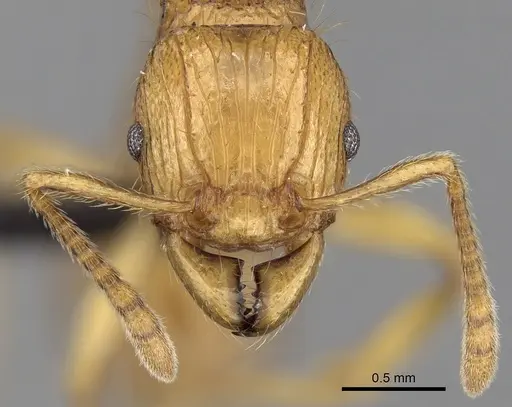
Tetramorium elf is easy to recognize within its species group. Its most obvious feature is the extremely long propodeal spines, among the longest in the whole group [1]. The body is a uniform yellowish colour, unlike the very dark brown or black of its relatives T. electrum and T. isoelectrum [2]. The mandibles are smooth and shiny (unsculptured), which separates it from T. isoelectrum (which has sculptured mandibles) [2].
No total body length (TL) has been given in research, so the actual worker size is unknown. The head length is 0.97-1.13 mm, but that does not represent total body size [1]. Eyes are small, and antennal scapes are short [1]. The petiolar node is about 1.2 times higher than long, giving it a distinctive shape [1].
Housing and Nest Setup
Because T. elf has never been kept in captivity, all setup advice is based on its natural habitat and related species. Given it was collected from leaf litter and ground samples, a naturalistic setup with moist substrate is most appropriate.
For nesting, use Y‑tong (AAC), plaster, or a 3D‑printed nest with very small chambers (workers are tiny, exact size unknown). A soil or coconut‑fibre substrate can also work, letting the ants dig their own tunnels. Do not use acrylic nests. The outworld should include a water tube and a small foraging area. Escape prevention is critical, use fine mesh and fluon barriers since even standard test tube setups may leak.
Maintain high humidity in the nest by keeping the substrate consistently moist but not waterlogged. The outworld can be slightly drier. Temperature should be 22-26 °C, use a heating cable on one side to create a gradient.
Feeding and Diet
No dietary studies exist for this species. Based on typical Tetramorium habits, they are likely generalist omnivores that forage for small arthropods and honeydew. Since workers are tiny (head length ~1 mm), prey must be very small: fruit flies, springtails, micro crickets, or other tiny insects. Offer a sugar source such as diluted honey or sugar water, though acceptance may vary.
Feed small amounts every 2-3 days and remove uneaten prey after 24 hours to prevent mold. Provide constant drinking water. Because no keeper data exists, be prepared to experiment with different foods. Some rarely kept species can be picky.
Colony Establishment and Growth
Establishing a colony of T. elf is a major challenge. No one has documented a captive colony. Your only options would be a wild‑caught queen (if you can find one during an unknown nuptial flight) or a complete wild colony.
Based on genus patterns, founding is likely claustral, the queen seals herself in a chamber and raises the first brood from stored reserves. The first workers (nanitics) may emerge after about 6-8 weeks at optimal temperature. But this is pure guesswork, no data exists for this species. Colony growth is probably slow to moderate, with maximum size unknown. Be patient and expect setbacks.
Seasonal Care and Overwintering
Seasonal care is unknown. T. elf comes from a tropical montane rainforest that likely has mild seasonal variation. Madagascar’s highland rainforests have a wet season (November-April) and a dry season (May-October), but temperatures remain moderate year‑round.
A true winter diapause is probably not needed. The colony should stay active at room temperature (20-22 °C) all year. Avoid dropping below 18 °C or above 30 °C. During the dry season months, you could slightly reduce misting frequency, but never let the nest dry out. If your room gets cooler in winter, use a gentle heat source to keep conditions stable.
Frequently Asked Questions
How long does it take for Tetramorium elf to raise their first workers?
The egg‑to‑worker timeline is unknown. Based on related Tetramorium, estimate 6-8 weeks at around 24-26 °C. The first workers will likely be smaller than normal.
What do Tetramorium elf ants eat?
No specific data exists, but they likely accept very small live prey (fruit flies, springtails) and sugar water. Prey must be tiny because the workers are tiny.
Are Tetramorium elf ants suitable for beginners?
Absolutely not, this is an expert‑level species. No one has successfully kept them in captivity, and almost nothing is known about their care. They are also extremely rare in the wild.
Do Tetramorium elf ants need hibernation?
Probably not. As a tropical rainforest species, it likely doesn't require a true hibernation. It may slow down in cooler periods but should stay active at room temperature year‑round.
How big do Tetramorium elf colonies get?
Maximum colony size is unconfirmed. Only 12 wild specimens have ever been collected, suggesting colonies are small, but no hard data exists.
Can I keep multiple Tetramorium elf queens together?
Colony structure is unconfirmed. Most Tetramorium are monogyne (single queen), so keeping multiple together is not recommended and has never been tested.
What temperature do Tetramorium elf ants need?
Keep the nest at 22-26 °C (low to mid 20s). This matches their montane rainforest home. Provide a gradient with a heating cable if needed.
Do Tetramorium elf ants sting?
As a member of Crematogastrini, T. elf likely uses a modified stinger to smear venom onto enemies rather than piercing the skin. The defensive capabilities of this specific species are not documented, but typical smear venom is not a painful sting.
What makes Tetramorium elf different from other Tetramorium?
It has extremely long propodeal spines (PSLI 59-64), a uniform yellow body, and is one of the rarest Tetramorium species, known from only 12 specimens in Madagascar [1].
Where is Tetramorium elf found in the wild?
It is endemic to northern Madagascar, in rainforests at 625-900 m elevation. Known locations: Makirovana, Marojejy, Antalaha, and Ambalagoavy [1][2].
Why is Tetramorium elf so rarely collected?
Only 12 specimens are known, possibly because the ants are so tiny they're easily overlooked, or because their populations are genuinely very low [2].
How do I set up a nest for tiny Tetramorium ants?
Use a Y‑tong, plaster, or 3D‑printed nest with very small chambers. Maintain high humidity and ensure escape‑proof barriers (fine mesh, fluon). Avoid acrylic nests.
Report an Issue
The current care sheet is based fully on literature. See inconsistencies, or something that's incorrect? Please , it will be resolved after review from an admin. Contributing to the blogs tab also helps providing information, to make us be able to further improve the caresheets. Thank you for your support!
References

This caresheet is licensed under CC BY-SA 4.0 .
Community Blogs
CASENT0045788
View on AntWeb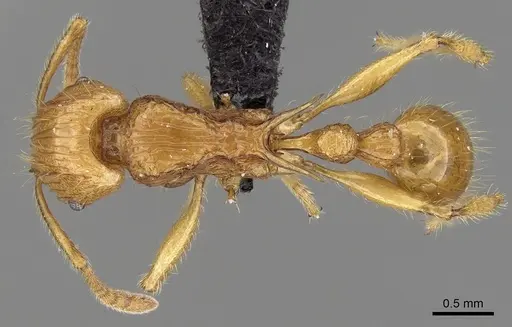
Literature
Loading distribution map...Loading products...