
Tetramorium calinum
- Sci. Name
- Tetramorium calinum
- Tribe
- Crematogastrini
- Subfamily
- Myrmicinae
- Author
- Bolton, 1980
- Distribution
- Found in 4 countries
Introduction
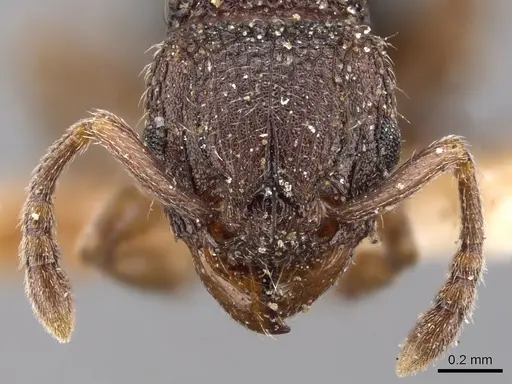
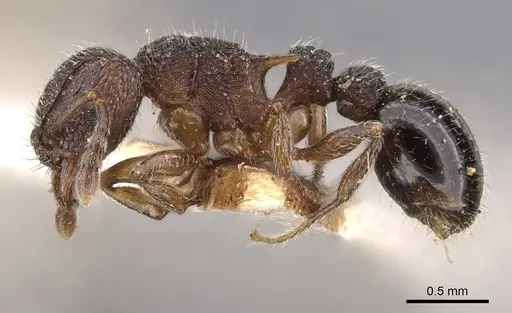
Tetramorium calinum is a small West African ant found in Ghana, Ivory Coast, and Nigeria . Workers are 3.5mm total length with a dark brown body and black gaster. Their surface has a dense, coarse texture of tiny pits and ridges . They belong to the Tetramorium angulinode species group and are closely related to Tetramorium legone . These ants are a tramp species - they spread through human activity and do well in modified habitats . They nest in open places with dry sandy soils . Their defense mechanism uses a modified flattened stinger to smear venom onto enemies rather than piercing them.
Quick Summary
- Difficulty: Easy
- Origin & Habitat: West Africa (Ghana, Ivory Coast, Nigeria), open places with dry sandy soils [1][2]
- Colony Type: Unconfirmed, likely monogyne (single queen) based on typical Tetramorium patterns, but not directly documented for this species.
- Size & Growth:
- Queen: Unknown, no measurements available.
- Worker: 3.5mm total length [1]
- Colony: Unknown, likely several hundred workers (inferred from related Tetramorium species).
- Growth: Moderate (inferred from genus).
- Development: Estimated 6-8 weeks (inferred from genus). (Direct development data not available for this species.)
- Antkeeping:
- Temperature: 22-26°C (inferred from tropical origin).
- Humidity: Low to moderate, they naturally nest in dry sandy soils, so keep the nest substrate mostly dry with a small moist area [2].
- Diapause: No, tropical West African species, unlikely to require hibernation.
- Nesting: Dry, well-drained Y-tong (AAC) or plaster nests with tight chambers scaled to 3.5mm workers. Test tubes work for founding.
- Behavior: Documented as a tramp species, adaptable to human environments [3]. They use a smear defense: a modified stinger wipes venom onto threats. Generally peaceful, but escape risk is high due to tiny 3.5mm size.
- Common Issues: escape prevention is critical due to 3.5mm workers, use fine mesh and tight seals., too much humidity can cause problems since they naturally nest in dry sandy soils., small prey required, fruit flies or pinhead crickets are ideal., limited information available, many care details are estimated based on genus patterns., tramp species, ensure no escapes to avoid potential establishment in non-native areas.
Housing and Nest Setup
Tetramorium calinum nests in open places with dry sandy soils [2]. In captivity, use Y-tong (AAC) or plaster nests with a dry substrate. Chambers should be tight and scaled to the 3.5mm workers, avoid tall spaces. Test tubes work well for founding colonies, with a dry foraging area. Because of their tiny size, escape prevention is essential, use fine mesh (0.5mm or smaller) on all openings and ensure lid seals are tight.
Feeding and Diet
Generalist feeders. Offer small protein sources like fruit flies, tiny crickets, or small pieces of mealworm. Provide constant access to sugar water or honey. Prey items must be small enough for 3.5mm workers to handle. Remove uneaten food after 24 hours to prevent mold.
Temperature and Humidity
Keep colonies at 22-26°C, which mimics their tropical West African environment. They prefer dry conditions matching their natural sandy soil habitat [2]. Provide a humidity gradient: keep the nest substrate mostly dry with a small moist area. Avoid constant dampness typical for rainforest species.
Colony Development
Founding details are unconfirmed for this species. Based on typical Tetramorium patterns, queens are likely claustral (sealing themselves in a chamber and raising the first workers without feeding). Expect 6-8 weeks from egg to first worker at optimal temperature, and colony growth is moderate. The ultimate colony size is unknown but likely several hundred workers.
Behavior and Temperament
Tetramorium calinum is a tramp species, meaning it adapts well to human environments [3]. Its primary defense is smearing venom via a modified, flattened stinger. Workers are active foragers and generally not aggressive towards humans. Their tiny 3.5mm size makes them excellent escape artists, so secure the setup thoroughly.
Frequently Asked Questions
How long does it take for Tetramorium calinum to get their first workers?
Based on typical Tetramorium development, expect 6-8 weeks from egg to first worker at 22-26°C. This is an estimate since this species hasn't been studied in captivity.
Can I keep Tetramorium calinum in a test tube setup?
Yes, test tubes work well for founding. Keep the water reservoir moderate-sized and pack the cotton tight, these tiny ants can slip through gaps. Move to a proper nest (Y-tong or plaster) once the colony has around 20-30 workers.
Do Tetramorium calinum ants sting?
They have a modified, flattened stinger used to smear venom rather than pierce. The venom is mild and unlikely to cause more than minor irritation to humans.
What temperature do Tetramorium calinum need?
Keep them at 22-26°C. They come from tropical West Africa and prefer warmth, but they also naturally live in dry sandy soils, so they don't need high humidity [2].
Are Tetramorium calinum good for beginners?
Yes, they are an easy species to keep. They are resilient and adaptable (tramp species) [3]. The main challenge is their tiny size requiring good escape prevention.
How big do Tetramorium calinum colonies get?
Not well-documented. Based on related species, likely several hundred workers.
Do Tetramorium calinum need hibernation?
No. As a tropical West African species, they don't experience cold winters and won't enter full diapause. They may slow down slightly in cooler months but don't need a cooling period.
What do Tetramorium calinum eat?
Generalist feeders. Offer small insects (fruit flies, pinhead crickets) and constant access to sugar water or honey. All prey must be small enough for 3.5mm workers.
Why are my Tetramorium calinum escaping?
Their 3.5mm size lets them squeeze through tiny gaps. Check all openings, use fine mesh (0.5mm or smaller), and seal lids tightly.
Can I keep multiple Tetramorium calinum queens together?
Not documented. Based on typical Tetramorium behavior, they likely form single-queen colonies. Combining queens would probably result in fighting.
Report an Issue
The current care sheet is based fully on literature. See inconsistencies, or something that's incorrect? Please , it will be resolved after review from an admin. Contributing to the blogs tab also helps providing information, to make us be able to further improve the caresheets. Thank you for your support!
References

This caresheet is licensed under CC BY-SA 4.0 .
Community Blogs
CASENT0901164
View on AntWeb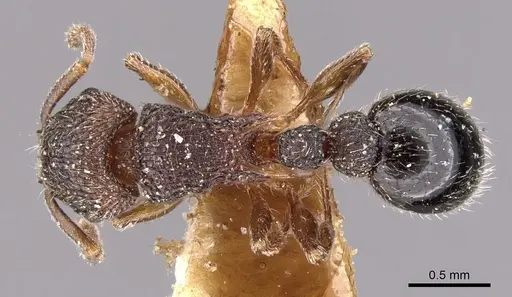
Literature
Loading distribution map...Loading products...