
Temnothorax schmittii
- Sci. Name
- Temnothorax schmittii
- Tribe
- Crematogastrini
- Subfamily
- Myrmicinae
- Author
- Wheeler, 1903
- Distribution
- Found in 1 countries
Introduction
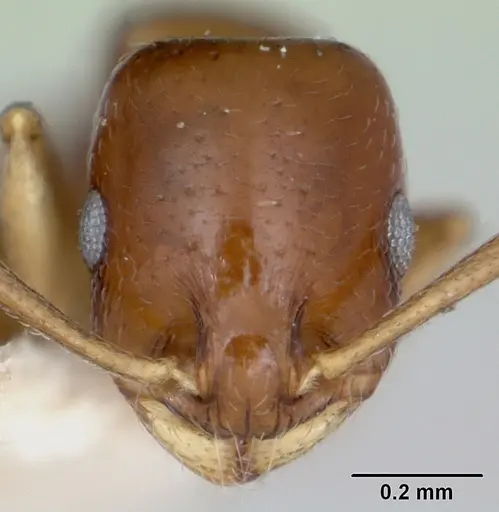
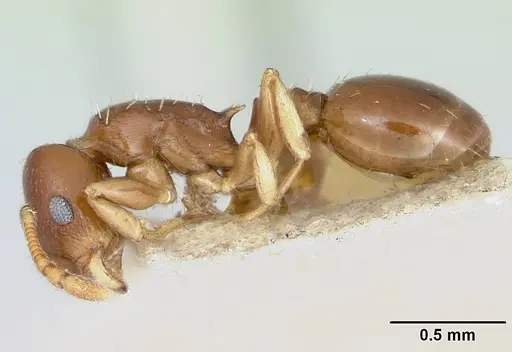
Temnothorax schmittii is a tiny ant known only from a handful of type specimens collected in Colorado (Canyon City) and Mexico (Hidalgo) . Workers measure 2-2.25mm, making them one of the smaller North American ants . They have a distinctive appearance: the head and mesosoma are very smooth and shining, body color is dark brown to almost black, and the mandibles, neck, funiculus, and legs are yellow . The pronotum has sharp, square-shouldered humeral angles with a carina that forms a transverse ridge, and the propodeal spines are well-developed . The head is narrow with parallel sides, and erect hairs are white, moderately abundant, and clavate (club-tipped) . Virtually nothing is known about its biology in the wild. The species belongs to the sallei-clade within Temnothorax and is considered extremely rare - it has not been collected in recent decades . Like other Temnothorax, it likely nests in pre-existing cavities such as hollow stems, under stones, or in rotting wood, but this is inferred from genus patterns.
Quick Summary
- Difficulty: Hard
- Origin & Habitat: Known only from Colorado (Fremont County, Canyon City) and Hidalgo, Mexico [1][2]. The species likely inhabits mountainous or semi-arid habitats in the southwestern US and central Mexico, but specific habitat data is lacking [4].
- Colony Type: Colony structure is unconfirmed. Based on typical Temnothorax patterns, it is likely monogyne (single queen), but this has not been studied directly.
- Size & Growth:
- Queen: Unknown, no queen specimens have been described or measured [3].
- Worker: 2-2.25mm (total length) [1][3].
- Colony: Unknown, no colony size estimates exist. Typical Temnothorax colonies are small, usually under 100 workers, but this is inferred.
- Growth: Slow, based on typical small-colony Temnothorax patterns.
- Development: Estimated 6-10 weeks at optimal temperature based on typical Temnothorax development [3] (Development time is estimated from related species in the genus, specific data for T. schmittii does not exist.)
- Antkeeping:
- Temperature: Temperature requirements are unknown. Based on its temperate origins (Colorado/Mexico), provide moderate room temperature (roughly 20-24°C) during the active season, with a gradient so ants can self-regulate. Avoid extremes below 10°C or above 30°C [4].
- Humidity: Humidity needs are unknown. For typical Temnothorax, provide a moisture gradient, keep one area of the nest (e.g., test tube reservoir) damp, and let the rest dry out. Avoid waterlogging. Base substrate moisture on natural habitat (semi-arid to temperate).
- Diapause: Yes, based on temperate origin, likely requires a winter rest period. Reduce temperature to roughly 10-15°C for 2-3 months during winter (November to February in the Northern Hemisphere). Reduce feeding during this time.
- Nesting: Temnothorax ants prefer tight, enclosed spaces. Test tubes with cotton water reservoirs work well for founding. For established colonies, use small Y-tong (AAC) or plaster nests with small chambers. Avoid large, open spaces, they feel safest in snug cavities scaled to their tiny size. Naturalistic setups with hollow stems or acorns can also work.
- Behavior: Temperament is unconfirmed but likely docile based on typical Temnothorax patterns. Workers are tiny (2mm) and non-aggressive. Their primary defense is a modified stinger that smears venom rather than piercing skin, but they are harmless to keepers. Escape prevention is critical due to their size, fine mesh (0.5mm or finer) or fluon barriers are essential. They likely forage individually for small prey and honeydew.
- Common Issues: extreme rarity means wild-caught colonies are almost impossible to obtain, no captive colonies are documented, very limited research means all care advice is based on inference from related species, not on species-specific studies, tiny size (2mm) makes escape prevention challenging, standard cotton plugs and mesh may be insufficient without reinforcement, slow colony growth and small colony size may disappoint keepers expecting rapid development, unknown founding behavior means queens may not be claustral, if caught, they must be handled with extreme care
Housing and Nest Setup
Because the species has never been kept in captivity, all setup advice is based on typical Temnothorax patterns. For a founding queen (if one were caught), a test tube setup is recommended: use a small test tube (1.5cm diameter or smaller) with a cotton ball creating a water reservoir at one end, and plug the open end with another cotton ball. Wrap the tube in dark material to simulate a confined, dark cavity. For an established colony, small Y-tong (AAC) or plaster nests with narrow chambers work well. The foraging area (outworld) should be connected via tubing with a very small diameter to prevent escapes. All ventilation must use mesh of 0.5mm or tighter, workers are only 2mm and can squeeze through standard mesh. A fluon barrier on the rim of the outworld adds security. [3]
Feeding and Diet
Diet has not been studied. By genus inference, Temnothorax are omnivorous. Offer tiny protein sources such as fruit flies (Drosophila), pinhead crickets, or very small pieces of mealworm. Sugar water (1:4 sugar:water) or honey can be provided on a small piece of cotton. Feed protein 2-3 times per week, remove uneaten food after 24 hours to prevent mold. Because workers are 2mm, prey items must be appropriately small, crushed or pre-killed may be necessary. A constant sugar source is recommended for energy. [3]
Temperature and Seasonal Care
Specific temperature requirements for T. schmittii are unknown. The species occurs in temperate Colorado and Mexico, so it likely requires moderate temperatures and a seasonal cycle. Aim for 20-24°C during the active season (spring through fall), with a cooler area in the nest to allow temperature choice. A heating cable on one side of a Y-tong nest can create a gradient. For diapause, reduce temperature to 10-15°C for 2-3 months in winter (roughly November-February). During diapause, reduce feeding to minimal sugar water and keep the nest slightly drier. Avoid sudden temperature changes. Resumption of normal temperatures and feeding in spring should stimulate brood production. [4]
Colony Establishment and Growth
Because founding behavior has never been reported for this species, the following is inferred from typical Temnothorax. If a queen is captured after mating, she likely searches for a pre-existing cavity (e.g., hollow stem, under stone) and seals herself in to raise the first brood without foraging. This is the typical claustral pattern for Temnothorax. The first workers (nanitics) will be very small. Do not disturb the queen during this founding period. Once workers appear (estimated 6-10 weeks after sealing), slowly introduce small food items. Colony growth is slow, expect only a few dozen workers after a year. Colony size is unknown but likely remains under 100 workers. Patience is essential. [3]
Handling and Observation
Temnothorax schmittii is likely docile and safe to observe. Workers are tiny (2mm) but visible with the naked eye. Their primary defense is a modified stinger that smears venom onto attackers rather than piercing skin, this is harmless to humans. Do not rely on them being defenseless, they can still react if crushed. Observation is best through the clear walls of a nest. Avoid frequent vibrations or bright light directly on the nest. When cleaning the outworld, use a soft brush and inspect the area for any escaped workers, their small size makes them hard to spot. Use a shallow water moat around the foraging area as an additional escape barrier. [3]
Frequently Asked Questions
How long does it take for Temnothorax schmittii to raise first workers?
The specific development time for this species is unknown. Based on typical Temnothorax development at 20-24°C, the time from egg to first worker is estimated at 6-10 weeks. The queen likely raises the first brood alone without foraging (claustral founding) [3].
What do Temnothorax schmittii ants eat?
Their diet has not been studied. By inference from related Temnothorax, they are omnivorous. Offer tiny protein sources like fruit flies (Drosophila), pinhead crickets, or very small mealworm pieces, along with sugar water or honey. Keep prey items very small (under 2mm) to match worker size [3].
Do Temnothorax schmittii ants sting?
They have a stinger, but it is modified for smearing venom rather than piercing. As members of the Crematogastrini tribe, they use a spatulate stinger to wipe venom onto enemies, so they cannot deliver a painful sting to humans. They are harmless but may release a faint odor if threatened.
What temperature do Temnothorax schmittii need?
Specific temperature data does not exist. Based on their temperate origin, maintain moderate room temperature (roughly 20-24°C) during the active season. Provide a temperature gradient so ants can choose. In winter, provide a cool diapause period at 10-15°C for 2-3 months. Avoid temperatures below 10°C or above 30°C [4].
How big do Temnothorax schmittii colonies get?
Colony size has never been documented. Based on typical small-colony Temnothorax patterns, colonies likely number under 100 workers at most. Growth is very slow, expect only a few dozen workers after a year of careful care [3].
Can I keep Temnothorax schmittii in a test tube?
Yes, test tubes are recommended for founding colonies, by inference from typical Temnothorax. Use a small test tube (1.5cm diameter) with a cotton water reservoir at one end and a dark cover to simulate a natural cavity. Once the colony reaches 20+ workers, you can move them to a small Y-tong or plaster nest for better observation [3].
Do Temnothorax schmittii need hibernation?
Yes, based on their temperate origin, they require a winter diapause. Reduce temperature to 10-15°C for 2-3 months (roughly November to February). Reduce feeding during this period. This seasonal cooling supports colony health and reproductive potential [4].
Are Temnothorax schmittii good for beginners?
No. This species is rated Hard because: it is extremely rare in the wild (only known from a handful of type specimens), practically nothing is known about its biology, all care advice is inference, founding queens may be impossible to obtain, and escape prevention due to tiny size is very challenging. Only experienced keepers with patience should attempt this species [3].
Why is Temnothorax schmittii so rare in the wild?
This species is known only from a handful of type specimens collected in the early 1900s in Colorado and Mexico. It may be genuinely rare, have very localized distribution, or occupy microhabitats that are difficult to sample. It has not been observed in nature in recent decades [1][2].
How do I prevent Temnothorax schmittii from escaping?
Escape prevention is critical due to their tiny 2mm size. Use fine mesh (0.5mm or tighter) on all ventilation and connection points. Apply fluon (insect barrier) to the rim of the foraging area. Ensure all seals between nest and outworld are airtight. Check for gaps daily, especially after feeding. A shallow water moat around the outworld provides additional security. Good luck recovering an escaped worker, they are nearly invisible on most surfaces [3].
Report an Issue
The current care sheet is based fully on literature. See inconsistencies, or something that's incorrect? Please , it will be resolved after review from an admin. Contributing to the blogs tab also helps providing information, to make us be able to further improve the caresheets. Thank you for your support!
References

This caresheet is licensed under CC BY-SA 4.0 .
Community Blogs
CASENT0172996
View on AntWeb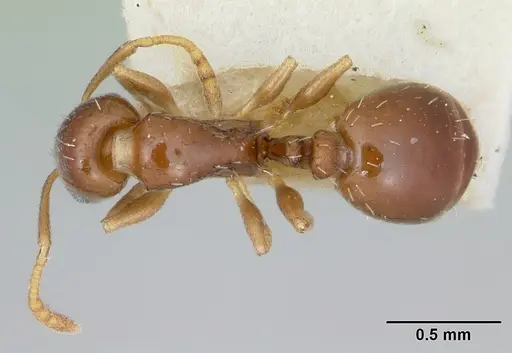
Literature
Loading distribution map...Loading products...