
Tapinoma geei
- Sci. Name
- Tapinoma geei
- Tribe
- Tapinomini
- Subfamily
- Dolichoderinae
- Author
- Wheeler, 1927
- Distribution
- Found in 1 countries
Introduction
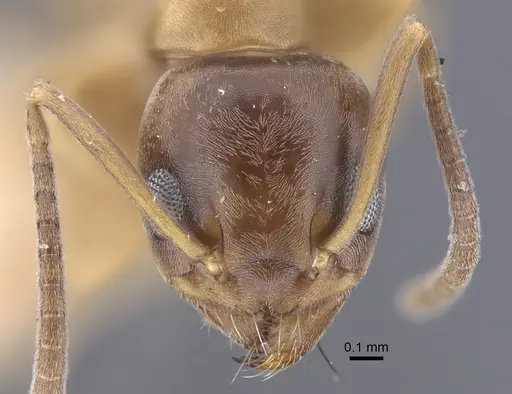
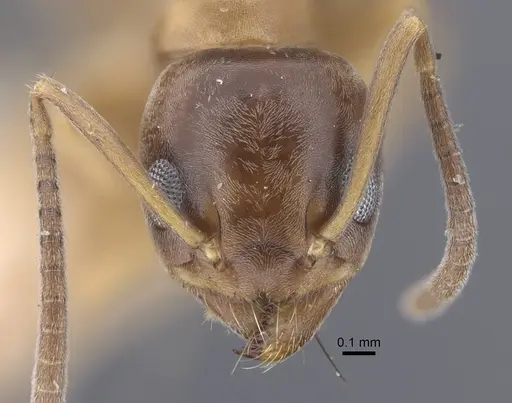
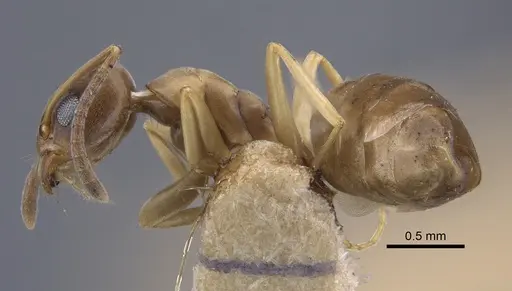
Tapinoma geei is a tiny ant native to China and the Republic of Korea . Workers measure just 2.3–2.8 mm, with a brown to blackish-brown body and yellowish-brown mandibles, antennae, legs, and mesosoma . The head is nearly rectangular, and the body is shiny with fine, dense punctures . This species is a habitat specialist found mainly in rubber plantations, not in primary or secondary forests, and nests in soil, under stones, or on the ground surface at elevations from 574 to 1,770 meters . It is also recorded in conifer-broadleaf forest, semi-evergreen broadleaf forest, walnut forest, and Masson pine forest, showing moderate ecological adaptation . Endemic to the Liupan Mountains ant region of China, it is considered a restricted-range species .
Quick Summary
- Difficulty: Medium
- Origin & Habitat: Native to China (Beijing, Hebei, Sichuan, Hubei, Yunnan, northern Shaanxi) and the Republic of Korea [1][2][6][7]. Found in rubber plantations and various forest types at 574–1,770 m elevation [3][4]. Nests in soil, under stones, or on the ground surface [3].
- Colony Type: Colony structure is unconfirmed. Only the worker caste has been formally described [1], queen number and social organization have not been documented.
- Size & Growth:
- Queen: Unconfirmed – queen size has not been documented in available literature
- Worker: 2.3–2.8 mm [2]
- Colony: Unknown – maximum colony size has not been documented in research
- Growth: Moderate (estimated based on typical Tapinoma patterns)
- Development: 6–8 weeks (estimated – based on related Tapinoma at warm room temperatures) (Exact development time for this species has not been studied. The estimate assumes steady warmth (22–26 °C).)
- Antkeeping:
- Temperature: Keep at 20–26 °C. Their elevation range (574–1,770 m) and distribution in temperate to subtropical China suggest they tolerate a range of conditions, with room temperature suitable [3].
- Humidity: Moderate. They nest in soil and under stones, so the nest substrate should be lightly moist but not waterlogged. Provide a drier area for the colony to self-regulate.
- Diapause: Likely yes. Their native range includes temperate regions of China and Korea, so a winter dormant period of 2–3 months at 10–15 °C probably benefits colony health. Monitor activity – clusters and reduced foraging signal entering dormancy.
- Nesting: Use a naturalistic setup: a small Y-tong, plaster, or soil nest with finely scaled chambers. Given their tiny size, ensure chambers are appropriately sized and all connections are escape-proof.
- Behavior: Fast-moving, active foragers on both ground and low vegetation. Non-aggressive – will flee when disturbed. As a Dolichoderinae, they lack a stinger and instead exude a sticky, foul-smelling defensive compound from their anal glands when threatened. Their small size (2.3–2.8 mm) makes escape prevention critical – they can slip through tiny gaps and require fine mesh and tight seals.
- Common Issues: escape prevention is critical due to their very small size – use fine mesh (, colony establishment data is absent, founding queens are unstudied, so patience and careful observation are needed, as a habitat specialist, they may have specific substrate preferences – offer soil or fine-grained material for nesting, winter dormancy needs are not fully understood – watch for natural activity slowdown and provide a cool period if feasible, captive-bred colonies are rare, any obtained specimens likely come from wild collection, so check local laws
Housing and Nest Setup
Because Tapinoma geei is only 2.3–2.8 mm, every part of the setup must be scaled down. In the wild, they nest in soil, under stones, or directly on the ground surface [3]. A Y-tong (AAC), plaster, or soil nest with fine‑grained chambers works well. The nest chambers should be small enough that the ants feel secure – think gaps just a couple millimeters wide. Keep the substrate lightly moist (not wet) by adding water to a corner or using a test‑tube water reservoir. Escape prevention is the most critical factor: use fine metal or nylon mesh (less than 1 mm openings) on all ventilation, seal lid edges with fluon or tape, and double‑check every connection. An outworld can be a simple plastic container with a thin layer of sand or plaster. Add a small water feeder and feeding area.
Feeding and Diet
Tapinoma geei is almost certainly omnivorous, like most Tapinoma. In nature, they collect honeydew from aphids and scale insects and scavenge small arthropods [2]. In captivity, offer a constant supply of sugar water (1:4 sugar‑to‑water ratio) or a honey‑water mix. For protein, provide tiny prey such as fruit flies (Drosophila), pinhead crickets, or small pieces of mealworm. Prey items must be no larger than the ants can carry – they are tiny workers. Scatter food in the outworld or place it on a small dish. Remove uneaten protein after 24 hours to avoid mold. A varied diet helps brood production, especially once the colony has more than a few workers.
Temperature and Seasonal Care
Tapinoma geei occurs across a broad elevation range (574–1,770 m) in temperate and subtropical China, so it tolerates moderate temperature swings [3]. For daily care, keep the nest at 20–26 °C. Room temperature (22–24 °C) is usually fine. If you want to speed development, you can warm one end of the nest to 26–28 °C with a heat cable, but avoid overheating the entire nest. During winter, your colony may naturally slow down. Based on native climate, a 2‑ to 3‑month cool period at 10–15 °C likely benefits long‑term health. If you see workers clustering and food intake decreasing, that’s a sign to start cooling. Resume normal temperature gradually after the cool period.
Behavior and Temperament
These are fast, active ants that forage both on the ground and on low plants. They are not aggressive – they prefer to run and hide when disturbed. Like all Dolichoderinae, they lack a functional stinger. Their main defense is to eject a sticky, foul‑smelling fluid from an anal gland (cyclopentanoid monoterpenes). You may notice a strong smell if you disturb the nest, but it’s harmless to humans. Because of their tiny size, they are supreme escape artists: any gap over about 0.5 mm is a potential exit. Always use fine mesh (0.5 mm openings or smaller) and seal all joints. They can also climb smooth surfaces, so apply fluon or a similar barrier to the outworld walls. They are peaceful enough to be kept in a mixed‑species setup with similarly non‑aggressive ants, but this is not recommended for beginners. [2]
Colony Establishment
Founding biology of Tapinoma geei is completely undocumented – we don’t know if queens found claustrally (sealed in), semi‑claustrally, or in another way. Most Tapinoma species are claustral, so that’s the most likely pattern, but it’s an inference. If you obtain a queen, place her in a clean test‑tube setup with a water reservoir at the bottom and a cotton plug. Keep it completely dark and quiet at room temperature (22–24 °C). Do not disturb her for at least 3‑4 weeks. If she is claustral, she will not need food until her first workers emerge. Once you see nanitics (first tiny workers), start offering a drop of sugar water and a small fruit fly. Move to a small nest formicarium only when the colony has at least 10–15 workers. Record any observations – every bit of captive data helps the whole antkeeping community.
Frequently Asked Questions
How long does it take for Tapinoma geei to develop from egg to worker?
The exact time hasn’t been documented for this species. Based on related Tapinoma, at 22–26 °C you can expect roughly 6–8 weeks from egg to first workers. Development may be slower at cooler temperatures.
What size do Tapinoma geei workers grow to?
Workers are very small: 2.3–2.8 mm [2]. Queen size is unknown.
Can I keep multiple queens together?
No data exists on whether Tapinoma geei is monogyne or polygyne. Until research clarifies this, do not attempt to keep multiple unrelated queens together. They might fight and kill each other.
What do Tapinoma geei eat?
They likely eat both sweet liquids (honeydew, sugar water) and small insects. Offer a 1:4 sugar‑water solution or honey‑water, plus tiny prey like fruit flies, pinhead crickets, or small pieces of mealworm. Remove uneaten protein within a day.
Do Tapinoma geei need hibernation?
Probably yes. Their native range includes temperate China and Korea, so a winter dormant period of 2–3 months at 10–15 °C is recommended. Watch for reduced activity and clustering – then start cooling. Resume normal temperature gradually in spring.
Are Tapinoma geei good for beginners?
Not the easiest starter ant. While the ants are tolerant of normal room temperatures, their tiny size demands meticulous escape‑proofing, and almost nothing is known about their founding and colony growth. Better for an experienced keeper who enjoys working with small species.
Where is Tapinoma geei found in the wild?
In China (Beijing, Hebei, Sichuan, Hubei, Yunnan, northern Shaanxi) and the Republic of Korea [1][2][6][7]. They inhabit rubber plantations and several forest types at 574–1,770 m elevation [3][4].
How big do Tapinoma geei colonies get?
The maximum colony size is unknown – no published data exists. Based on their small worker size and typical Tapinoma patterns, colonies might reach a few hundred workers, but this is pure speculation.
What temperature should I keep Tapinoma geei at?
Aim for 20–26 °C. Room temperature (22–24 °C) is fine. A heat cable can warm one side of the nest to 26–28 °C, but don’t overheat the whole nest. They come from a range of elevations and climates, so they’re not picky [3].
When should I move my colony to a formicarium?
Wait until the colony has at least 10–15 workers. Because the ants are so small, use a nest with very fine chambers and test all escape routes before moving them. A test‑tube setup works well for the first few months.
Why are my Tapinoma geei escaping?
Workers are only 2.3–2.8 mm – they can slip through any gap larger than about 0.5 mm. Check all lid seals, ventilation holes, and tubing connections. Use fine metal mesh (
Report an Issue
The current care sheet is based fully on literature. See inconsistencies, or something that's incorrect? Please , it will be resolved after review from an admin. Contributing to the blogs tab also helps providing information, to make us be able to further improve the caresheets. Thank you for your support!
References

This caresheet is licensed under CC BY-SA 4.0 .
Community Blogs
CASENT0917263
View on AntWeb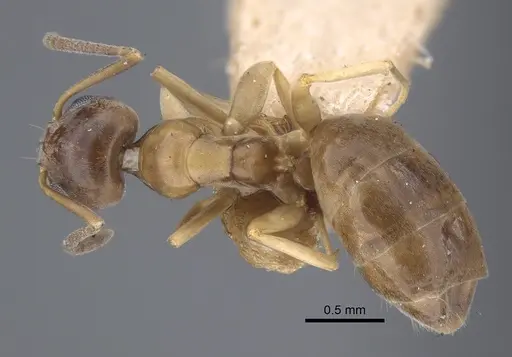
Literature
Loading distribution map...Loading products...