
Strumigenys korahyla
- Sci. Name
- Strumigenys korahyla
- Tribe
- Attini
- Subfamily
- Myrmicinae
- Author
- Bolton, 1983
- Distribution
- Found in 2 countries
Introduction
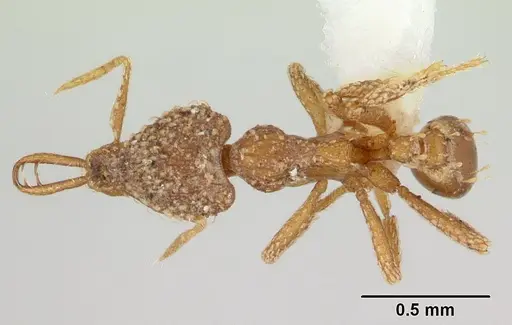
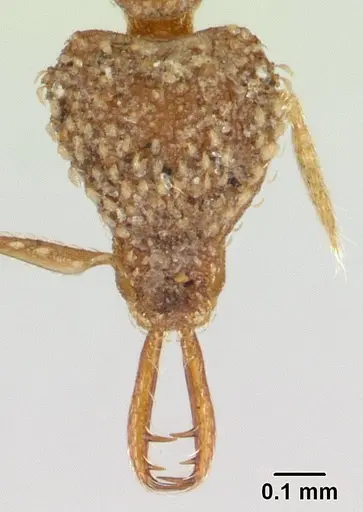
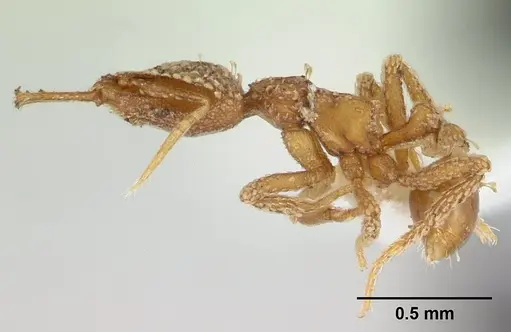
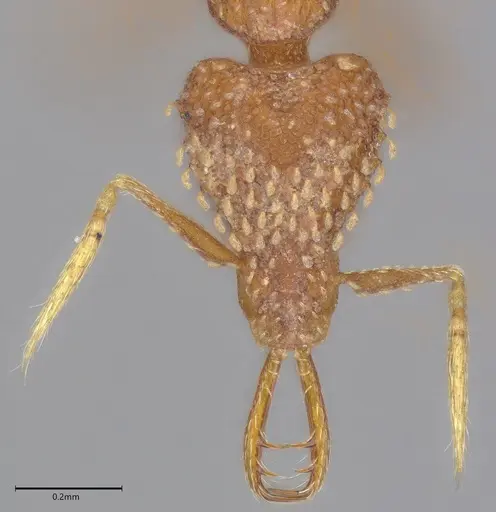
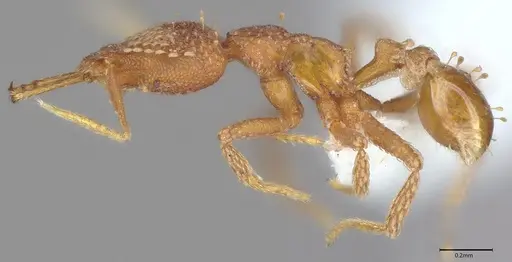
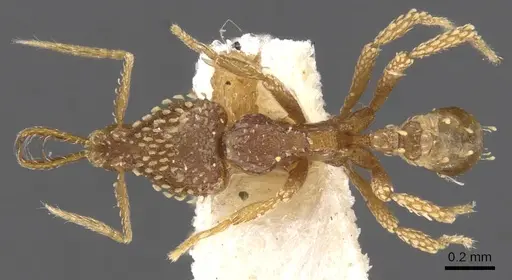
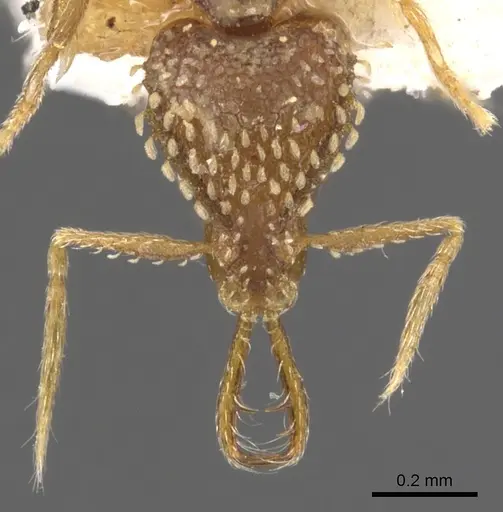
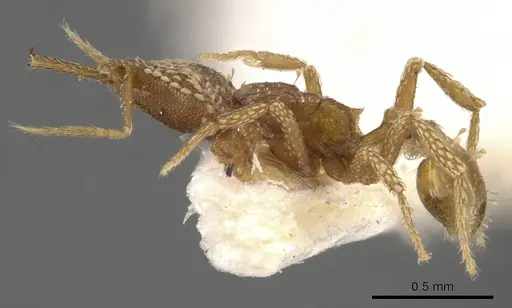
Strumigenys korahyla is a tiny, specialized predatory ant found in wet forests of central and East Africa. Workers measure 2.2-2.3 mm in total length and are brownish yellow . They have elongated mandibles with two preapical teeth, slender antennae, and very small eyes (only 4-5 ommatidia) . This species belongs to the Strumigenys arnoldi group, havilandi complex . Its range includes Cameroon, Gabon, Ghana, Kenya, and Uganda, where it is always collected from leaf litter in moist forest habitats . One record places it at 640 m elevation in Gabon . Like other members of its genus, it preys on tiny soil arthropods using a rapid mandible snap.
Quick Summary
- Difficulty: Hard
- Origin & Habitat: Wet forests of the Afrotropical region: Cameroon, Gabon, Ghana, Kenya, Uganda. Found in leaf litter at elevations around 640 m [2][1].
- Colony Type: Unknown, no data available on queen number or social structure.
- Size & Growth:
- Queen: Queen not described, size unknown.
- Worker: 2.2-2.3 mm total length [1]
- Colony: Unknown, litter‑dwelling Strumigenys typically have very small colonies (likely under 100 workers), but no specific data exists.
- Growth: Unknown, likely slow, but no direct data.
- Development: No data available for this species. (Based on related small myrmicine predators, development is probably extended (many weeks).)
- Antkeeping:
- Temperature: As a tropical wet‑forest species, it likely needs warm, stable temperatures around 22-26 °C. Exact optimum unknown.
- Humidity: High humidity essential, keep nest substrate consistently moist, mimicking damp leaf litter. No exact percentage known.
- Diapause: Likely no true diapause, tropical species remain active year‑round.
- Nesting: Use Y‑tong (AAC) or plaster nests with small, dark chambers. Tight spaces and high humidity are critical. Avoid tall, open nests.
- Behavior: Extremely small and cryptic. Workers move slowly and spend nearly all their time within the leaf litter. They are not aggressive and will flee from disturbance. Escape prevention is critical: at 2 mm they can slip through tiny gaps. They possess a functional stinger used to subdue prey, but it is too small to affect humans.
- Common Issues: escape prevention is critical, tiny 2 mm size, can squeeze through gaps invisible to the naked eye., high humidity needs can lead to mold if ventilation is poor., specialized diet, only accepts live micro‑prey (springtails, etc.), dead food or sugar is ignored., slow growth and small colony size make them vulnerable to disturbance and stress., wild‑caught colonies may carry parasites or struggle to adjust to captive conditions.
Housing and Nest Setup
In the wild, Strumigenys korahyla lives exclusively in leaf litter [1], so a naturalistic setup with a deep layer of moist leaf litter works well. For artificial nests, use Y‑tong (AAC) or plaster with narrow, dark chambers scaled to the workers' tiny size. Humidity must be kept high, connect a water reservoir or regularly mist the substrate. Avoid tall, open spaces. Escape prevention is essential: apply Fluon or use fine mesh on all openings, as these ants can fit through gaps under 0.5 mm.
Feeding and Diet
Strumigenys korahyla is an obligate predator of tiny soil arthropods [1]. In captivity, live springtails are the staple food, they are also likely to accept fruit flies, booklice, and other micro‑fauna. Dead insects, honey, or sugar water are usually ignored. Offer small amounts of live prey 2-3 times per week, and remove any uneaten food after 24 hours to prevent mold. Overfeeding can cause fungus outbreaks in the humid nest.
Temperature and Humidity
No precise temperature or humidity data is published for this species. Because it lives in equatorial wet forests [1] and was collected at 640 m elevation [2], it likely needs warm, stable conditions around 22-26 °C. Humidity must be very high, keep the nest substrate consistently moist but not waterlogged. Condensation on the walls is normal. If mold appears, reduce feeding and let the nest air out slightly.
Behavior and Colony Life
Workers are reclusive, slow‑moving, and rarely leave the leaf litter [1]. They forage individually, capturing tiny prey with their elongate mandibles. The colony cycle (queen number, founding method, mature size) has not been documented. A functional stinger is present but only used on prey, the ants are too small to sting humans. Disturbances should be minimized, as the colony is likely small and sensitive to stress.
Acclimation and Handling
Because so little is known about their biology, this species is challenging to keep. Wild‑caught colonies are rarely available and often fail to acclimate. If you obtain one, transfer it with its original leaf litter substrate. Use a slow connection method: place the old container next to the new nest and let the ants move on their own. Avoid any direct handling, their tiny size makes them impossible to move individually without injury. Minimize inspections during the first few weeks.
Frequently Asked Questions
How long does it take for Strumigenys korahyla to raise their first workers?
No data exists for this species. Based on related small myrmicine predators, development from egg to adult likely takes many weeks, but the exact duration is unknown.
Can I keep Strumigenys korahyla in a test tube setup?
Yes, a test tube can be used for founding or a small colony, but it will need a proper nest with narrow chambers once the colony grows. Y‑tong (AAC) or plaster nests are more suitable long‑term.
What do Strumigenys korahyla ants eat?
They are specialized predators of tiny arthropods [1]. In captivity, live springtails are essential. They may also accept fruit flies, booklice, or tiny isopods. They ignore dead food and sugar sources.
Are Strumigenys korahyla ants good for beginners?
No. Their tiny size, specialized diet, high humidity needs, and unknown biology make them unsuitable for beginner antkeepers.
How big do Strumigenys korahyla colonies get?
Colony size is unknown. Most leaf‑litter Strumigenys have very small colonies, likely fewer than 100 workers.
Do Strumigenys korahyla need hibernation?
Probably not. As a tropical wet‑forest species, it likely remains active year‑round without a diapause period.
Why are my Strumigenys korahyla dying?
Common causes include: escape (check for tiny gaps), improper humidity (too dry or too wet), wrong food (only live micro‑prey works), and stress from disturbance. These ants are extremely sensitive.
When should I move my colony to a formicarium?
Wait until the colony has at least 15-20 workers and is actively foraging. Moving earlier can cause stress. Use a small nest with chambers scaled to their 2 mm size.
Can I keep multiple queens together?
This has not been studied. Without evidence of polygyny, assume single‑queen colonies. Do not combine unrelated queens.
What is the best nest type for Strumigenys korahyla?
Y‑tong (AAC) or plaster nests with tight, dark chambers work best. Avoid acrylic. High humidity and excellent escape prevention are crucial.
How often should I feed Strumigenys korahyla?
Offer live micro‑prey (e.g., springtails) 2-3 times per week. Remove any uneaten after 24 hours to prevent mold.
Report an Issue
The current care sheet is based fully on literature. See inconsistencies, or something that's incorrect? Please , it will be resolved after review from an admin. Contributing to the blogs tab also helps providing information, to make us be able to further improve the caresheets. Thank you for your support!
References

This caresheet is licensed under CC BY-SA 4.0 .
Community Blogs
Literature
Loading distribution map...Loading products...