
Strumigenys dyschima
- Sci. Name
- Strumigenys dyschima
- Tribe
- Attini
- Subfamily
- Myrmicinae
- Author
- Bolton, 2000
- Distribution
- Found in 1 countries
Introduction
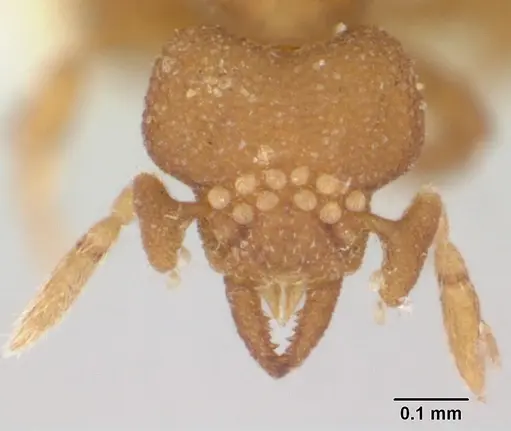
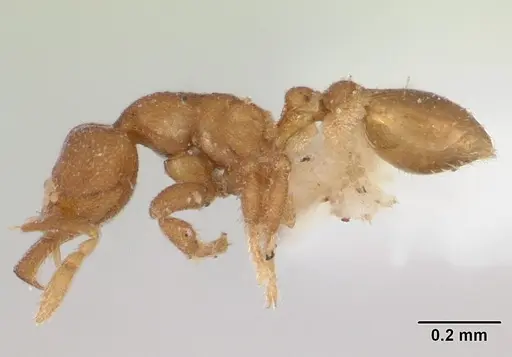
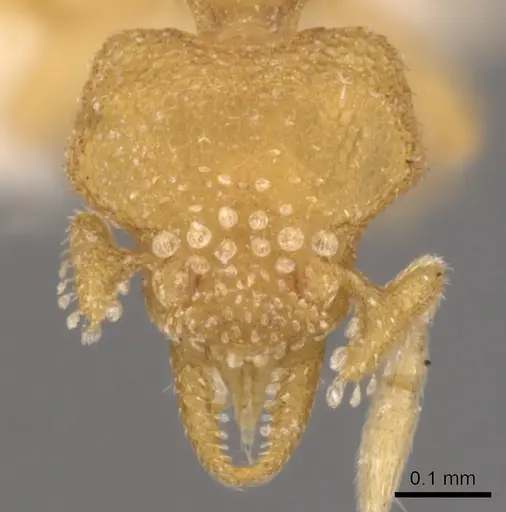
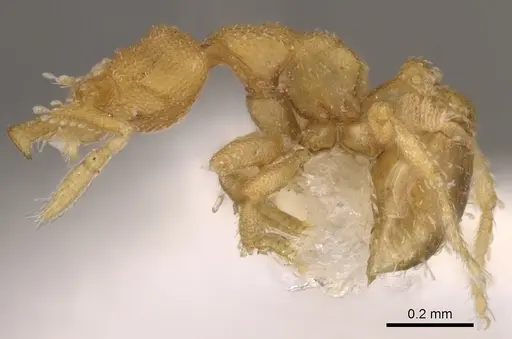
Strumigenys dyschima is an exceptionally tiny ant, measuring just 1.5mm in total length . Workers have a distinctive appearance with a broad, flattened head and small mandibles that have flattened hairs along the inner margin. Two rows of small orbicular hairs sit behind the clypeus, and the pronotum shows fine longitudinal grooves. The gaster has short, club-shaped hairs. This species belongs to the Strumigenys murphyi group and is closely related to the larger Strumigenys murphyi from Malaysia. The two are distinguished by size and by the position of the apicodorsal tooth on the mandible - in S. dyschima this tooth does not overlap the opposing mandible at full closure . Native to the Sundaic region (Borneo, Indonesia, Malaysia), these ants are habitat specialists found only in primary rainforest leaf litter, never in secondary forest or plantations .
Quick Summary
- Difficulty: Expert
- Origin & Habitat: Native to Borneo, Indonesia, and Malaysia in the Sundaic region. Found in primary rainforest leaf litter, specifically in mixed dipterocarp forest and limestone-rainforest [1]. This is a habitat specialist restricted to primary forest, it has never been recorded in secondary forest or rubber plantations [2].
- Colony Type: Colony structure is unconfirmed. Only a few worker specimens have ever been collected, and no queen or colony samples are available. Based on other Strumigenys species, likely single-queen colonies, but this is speculative.
- Size & Growth:
- Queen: Unknown, no queen has been described in scientific literature
- Worker: 1.5mm total length [1]
- Colony: Unknown, only a few individual workers have ever been collected
- Growth: Unknown
- Development: Unknown, development has not been studied (Given their tiny size and membership in the Attini tribe, development is likely relatively fast but unconfirmed)
- Antkeeping:
- Temperature: No specific data exists. As a tropical rainforest floor species, it likely prefers stable moderate temperatures around 20-24°C. Avoid extremes and overheating.
- Humidity: High humidity is essential, these ants live in rainforest leaf litter where conditions are constantly damp. Keep the nest substrate moist but not waterlogged, and provide a humidity gradient so ants can choose their preferred zone [1].
- Diapause: Unknown, no studies on seasonal behavior. As a tropical species from Borneo, diapause is unlikely but not confirmed.
- Nesting: In the wild, they live in leaf litter and soil cores in primary rainforest [1]. In captivity, a naturalistic setup with moist substrate (like a soil or coco peat mix) with plenty of leaf litter and hiding spots works best. Given their tiny size, provide tight, low-ceiling chambers.
- Behavior: These ants are extremely small and docile. They have a functional stinger (common to Myrmicinae-Attini), but it is negligible to humans. They likely flee from threats. They are predatory on micro-arthropods like springtails and mites, which they hunt with their small mandibles. Escape prevention is critical, at 1.5mm, they can squeeze through the tiniest gaps.
- Common Issues: escape prevention is critical, standard mesh won't stop them, use very fine mesh or glass barriers, extreme difficulty in finding and collecting live specimens, this species is virtually unavailable, habitat specialist requires primary forest conditions that are difficult to replicate, no established captive breeding populations exist, high humidity requirements can lead to mold problems if not managed carefully
Why This Species is Expert-Only
Strumigenys dyschima is not a species you will likely ever keep. It represents one of the most challenging ants to maintain in captivity for several reasons. First, it has only ever been collected a handful of times in the wild, from leaf litter samples in Borneo's primary rainforests [1]. There are no established captive colonies, and no queen has ever been described. Second, this is a habitat specialist that exists only in primary rainforest leaf litter [2]. Replicating these exact conditions is extremely difficult. Third, at just 1.5mm, these ants require specialized micro-husbandry techniques that even experienced antkeepers struggle with. Unless you are a professional researcher with access to field collection in Borneo, this species will remain a dream rather than a reality.
Related Species as Alternatives
If you are fascinated by tiny Strumigenys ants, consider keeping more common species in the genus. Strumigenys species are predatory ants that specialize in hunting springtails and other micro-arthropods in leaf litter. They have interesting hunting behaviors and are kept by some experienced antkeepers. Look for species like Strumigenys membranifera or others that have established captive populations. These related species will give you a similar experience without the extreme difficulty of acquiring and maintaining this rare species.
Taxonomy and Identification
Strumigenys dyschima was originally described as Strumigenys dyschima by Bolton in 2000 from a single worker collected in Sarawak, Borneo [1]. It was later transferred to the genus Strumigenys by Baroni Urbani and De Andrade in 2007. The species belongs to the Strumigenys murphyi group and is closely related to Strumigenys murphyi from Malaysia. The two species can be distinguished by size, S. dyschima is much smaller, and by the position of the apicodorsal tooth on the mandible. In S. dyschima, this tooth does not overlap the outer margin of the opposing mandible at full closure, while in S. murphyi it extends beyond [1]. A previous record from Yunnan, China (Liu et al. 2015) was later re-identified as Strumigenys formosa, limiting the confirmed range back to Borneo and surrounding areas [1].
Distribution and Habitat
Strumigenys dyschima is known only from Borneo, Indonesia, and Malaysia in the Sundaic region. The type specimen was collected from a soil core in mixed dipterocarp forest in Sarawak, Malaysia (Gunung Mulu National Park) [1]. Additional specimens have been collected from limestone-rainforest leaf litter [1]. This species is a habitat specialist restricted to primary forest, it has never been found in secondary forest or rubber plantations [2]. This extreme habitat specialization makes it vulnerable and explains why so few specimens have been collected. The ants live in the damp leaf litter layer of the rainforest floor, a microhabitat that maintains high humidity and provides constant access to micro-prey.
Frequently Asked Questions
Can I keep Strumigenys dyschima as a pet ant?
It is highly unlikely. This species is essentially unavailable to antkeepers. It has only been collected a handful of times in the wild, no queen has ever been described, and there are no captive breeding populations. Unless you are conducting field research in Borneo, you will not find this species for sale or collection.
How big are Strumigenys dyschima workers?
They are tiny, workers measure just 1.5mm in total length [1]. This makes them among the smallest ants in the world.
Where does Strumigenys dyschima live?
Only in Borneo, Indonesia, and Malaysia. They are found in primary rainforest leaf litter in mixed dipterocarp forest and limestone-rainforest [1]. They are never found in secondary forest or human-modified habitats [2].
What do Strumigenys dyschima eat?
While not directly studied, Strumigenys species are predatory, hunting micro-arthropods like springtails and mites in leaf litter. They likely specialize in small soft-bodied prey that can be overwhelmed by their small mandibles.
Are Strumigenys dyschima good for beginners?
Absolutely not. This species is expert-only due to its extreme rarity, tiny size, specialized habitat requirements, and complete lack of availability. Even experienced antkeepers would struggle to find and maintain this species.
Do Strumigenys dyschima need hibernation?
Unknown, but unlikely. As a tropical species from Borneo, they would not experience cold winters that require diapause. However, no studies on their seasonal behavior exist.
How many queens does Strumigenys dyschima have?
Unknown. No queen has ever been collected or described in scientific literature. The colony structure of this species remains completely unstudied.
Why was the Yunnan record for Strumigenys dyschima removed?
The specimen collected from Yunnan, China (Liu et al. 2015) was later re-identified as Strumigenys formosa by Tang and Guénard in 2023 [1]. This corrected the distribution back to being limited to the Sundaic region (Borneo).
What is the closest alternative to Strumigenys dyschima?
More common Strumigenys species like Strumigenys membranifera are kept by experienced antkeepers. These species share the same general morphology and predatory behavior on micro-arthropods, but are more readily available and better understood.
Report an Issue
The current care sheet is based fully on literature. See inconsistencies, or something that's incorrect? Please , it will be resolved after review from an admin. Contributing to the blogs tab also helps providing information, to make us be able to further improve the caresheets. Thank you for your support!
References

This caresheet is licensed under CC BY-SA 4.0 .
Community Blogs
CASENT0173572
View on AntWeb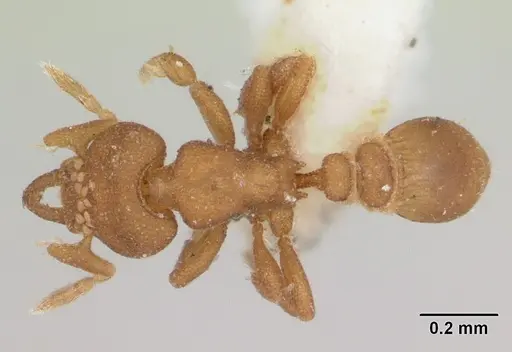
CASENT0900138
View on AntWeb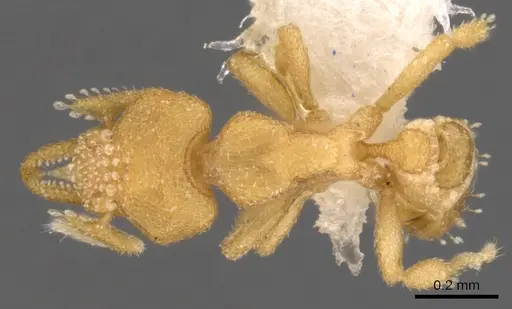
Literature
Loading distribution map...Loading products...