
Strumigenys augustandrewi
- Sci. Name
- Strumigenys augustandrewi
- Tribe
- Attini
- Subfamily
- Myrmicinae
- Author
- Longino, 2006
- Distribution
- Found in 1 countries
Introduction
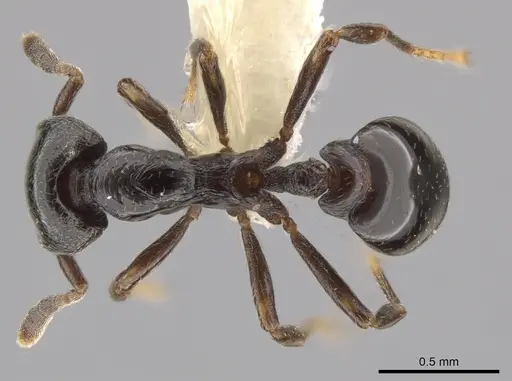
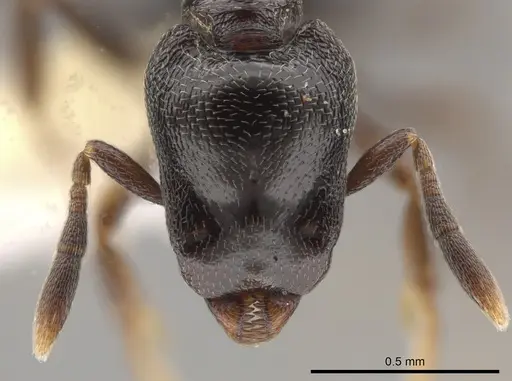
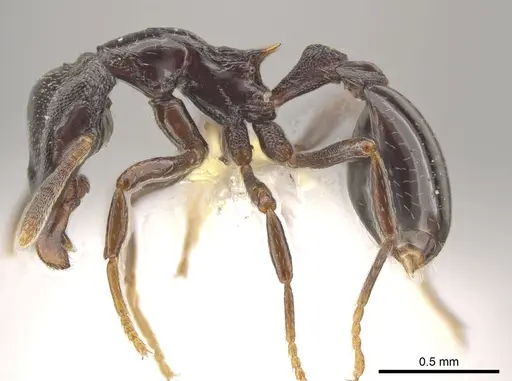
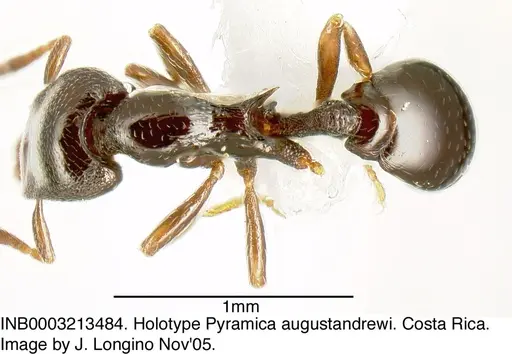
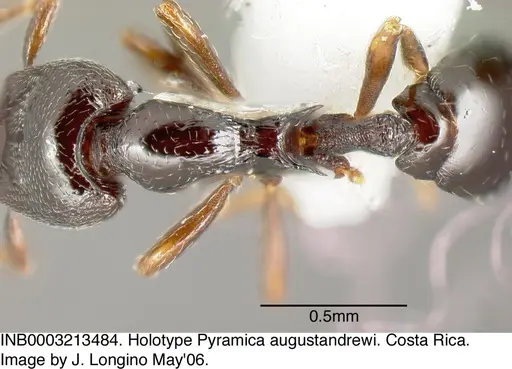
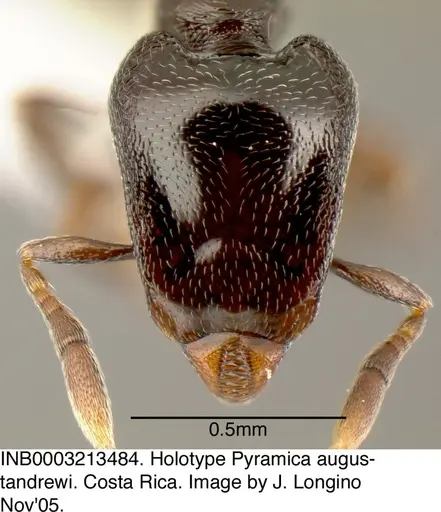
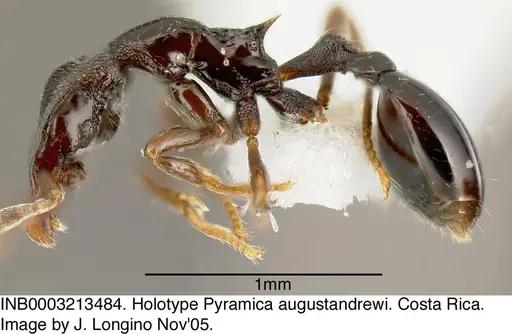
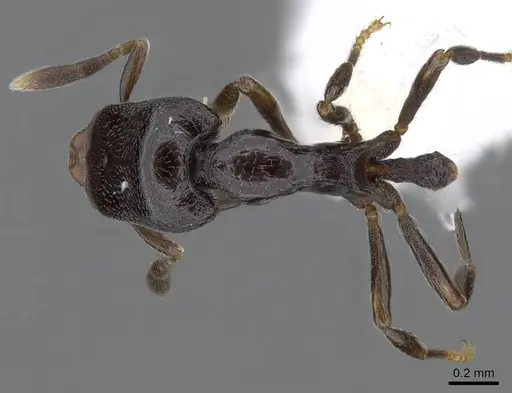
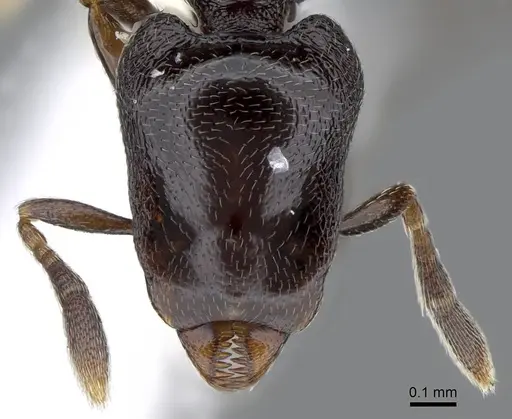
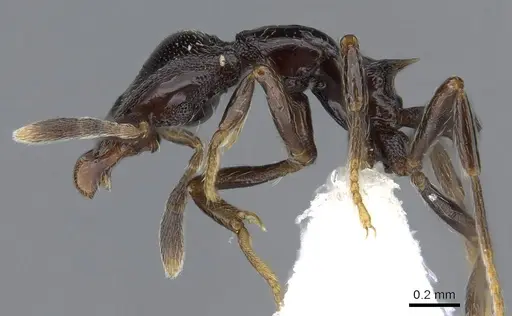
Strumigenys augustandrewi is a tiny predatory ant native to the cloud forests of Costa Rica. Only the worker caste is known . Workers have a total body length inferred at about 2-3 mm (typical for the genus), with a head width of 0.6 mm . They have short, downward-curving mandibles that function as trap‑jaws . The body lacks spongiform tissue on the underside of the petiole, postpetiole, and first gastral sternite . This species belongs to the longinoi group within the excisa group and occurs in mature cloud forest floor litter at 1100-1500 m elevation in Costa Rica’s Heredia Province . It is known from only four workers collected in Winkler samples .
Quick Summary
- Difficulty: Expert
- Origin & Habitat: Costa Rica (Heredia Province), mature cloud forest at 1100-1500 m elevation, found in sifted leaf litter from the forest floor [1][3]
- Colony Type: Unconfirmed, only worker caste has ever been documented [1][2]. No data on queen number or social structure.
- Size & Growth:
- Queen: Undescribed, queen caste is unknown [1][2]
- Worker: ~2-3 mm (total length inferred from Strumigenys genus) [1]
- Colony: Unknown, only four workers have ever been documented in scientific collections [1]
- Growth: Unknown, likely slow, based on typical small Strumigenys colonies
- Development: Unknown, no development data exists for this species. Estimates based on related Strumigenys: roughly 8-12 weeks at 18-22 °C. (All development data is estimated from genus‑level patterns, no direct research is available.)
- Antkeeping:
- Temperature: Inferred from cloud forest habitat: 18-22 °C, stable without large swings. Avoid temperatures above 25 °C [1].
- Humidity: High, substrate should be constantly damp but not waterlogged, mimicking damp forest floor litter [1].
- Diapause: Unknown, no research on seasonal activity. Given the tropical highland origin, mild seasonal cooling might occur, but this is not confirmed [1].
- Nesting: Naturalistic setup with small chambers (e.g., Y‑tong, plaster, or 3D‑printed nests) filled with fine, damp substrate like a mix of soil, sand, and leaf litter. Test tube setups are also possible, but chambers must be scaled to their tiny size (≈2-3 mm high). Avoid acrylic nests.
- Behavior: These are cryptic, slow‑moving ants that spend most of their time hunting in leaf litter. They are not aggressive and rarely use their sting for defense, they rely on their trap‑jaw mandibles to capture prey. Escape risk is high due to their minute size, use fine mesh (≤0.3 mm) or fluon barriers. They are poor climbers.
- Common Issues: very small size means escapes are likely without fine mesh barriers, specialized diet requires constant supply of tiny live prey (springtails, micro‑arthropods), high humidity needs can lead to mold problems if ventilation is poor, no colony establishment data, queen and founding behavior completely unknown, cloud forest species is sensitive to temperature fluctuations and dry air
Housing and Enclosure
Because Strumigenys augustandrewi is so tiny (total length ~2-3 mm), you need an enclosure with very fine barriers. Use a small Y‑tong, plaster, or 3D‑printed nest with chambers about 2-3 mm high. Add a thin layer of damp forest floor substrate, a mix of soil, sand, and decaying leaf litter mimics their natural environment [1]. Cover all openings with mesh of 0.3 mm or finer, or apply fluon barriers. The outworld should be compact to make feeding easier. Test tube setups can work if the water reservoir is carefully managed to avoid flooding. Never use acrylic nests, as they are hard to clean and may cause condensation issues.
Feeding and Diet
Strumigenys augustandrewi are obligate predators that need a constant supply of tiny live prey. In the wild they hunt micro‑arthropods in leaf litter [1]. Offer live springtails (e.g., Folsomia candida), tiny isopods, or other small arthropods. They usually ignore sugar water or honey. Feed 2-3 times per week and remove uneaten prey after 24 h to prevent mold. Because of this specialised diet, you must be able to culture micro‑prey before attempting to keep this species.
Temperature and Humidity
This species comes from cool, stable cloud forest. Keep the temperature between 18-22 °C, never above 25 °C [1]. Use a small heating cable on one side of the nest to create a gentle gradient. Humidity should be high: the substrate should feel consistently damp but not waterlogged [1]. Mist the enclosure every few days if needed, and ensure good ventilation to stop mold. A water reservoir inside the nest helps maintain moisture.
Behavior and Temperament
These ants are secretive and non‑aggressive. Workers move slowly and spend nearly all their time hunting in the substrate rather than exploring open areas. They catch prey with their trap‑jaw mandibles, which snap shut extremely fast [1]. They have a functional sting (typical of Myrmicinae), but they rarely use it for defense. Because of their tiny size and ground‑dwelling habits, they are poor climbers, but you must still seal the enclosure securely to prevent escapes.
Colony Establishment
No queens have ever been described [1][2], and only four workers are known from scientific collections. Wild colonies have never been observed. If a queen were to become available, she would likely found the colony in a small chamber, feeding on prey she catches nearby (typical claustral or semi‑claustral Strumigenys pattern). Growth would almost certainly be very slow, and colonies would remain small. This species is not suitable for beginners, it should only be attempted by very experienced keepers with reliable micro‑prey cultures.
Frequently Asked Questions
How big do Strumigenys augustandrewi colonies get?
Unknown, only four workers have ever been documented [1]. Based on other small Strumigenys, colonies probably stay under 100 workers, but this is speculation.
What do Strumigenys augustandrewi eat?
They are obligate predators that need live tiny prey, mainly springtails and other micro‑arthropods [1]. They do not accept sugar solutions or dead prey.
Can I keep Strumigenys augustandrewi in a test tube?
Yes, a test tube setup can work if the water reservoir is small and the tube diameter is narrow enough to prevent them from drowning. A naturalistic setup with damp substrate is often more appropriate [1].
Are Strumigenys augustandrewi good for beginners?
No, this is an expert‑level species. Their tiny size, specialised diet of live micro‑prey, high humidity needs, and extreme rarity make them very difficult to keep.
What temperature do Strumigenys augustandrewi need?
Keep them at 18-22 °C. As a cloud‑forest species, they cannot tolerate temperatures above 25 °C [1].
Do Strumigenys augustandrewi need hibernation?
Unknown, no research on seasonal activity. They come from a tropical highland area where temperatures are mild year‑round, a winter cooling period is not confirmed.
Why are my Strumigenys augustandrewi dying?
Most likely causes: temperature over 25 °C, humidity too low, lack of live prey, or escapes from inadequate barriers. Because almost nothing is known about keeping this species, problems are hard to diagnose.
How long until first workers in Strumigenys augustandrewi?
Unknown for this species. Based on related Strumigenys, expect 8-12 weeks from egg to worker at 18-22 °C.
Where does Strumigenys augustandrewi live in the wild?
Only known from mature cloud forests in Costa Rica’s Heredia Province at 1100-1500 m elevation, in sifted leaf litter [1][3].
Report an Issue
The current care sheet is based fully on literature. See inconsistencies, or something that's incorrect? Please , it will be resolved after review from an admin. Contributing to the blogs tab also helps providing information, to make us be able to further improve the caresheets. Thank you for your support!
References

This caresheet is licensed under CC BY-SA 4.0 .
Community Blogs
Literature
Loading distribution map...Loading products...