
Stereomyrmex dispar
- Sci. Name
- Stereomyrmex dispar
- Tribe
- Crematogastrini
- Subfamily
- Myrmicinae
- Author
- Wheeler, 1934
- Distribution
- Found in 1 countries
Introduction
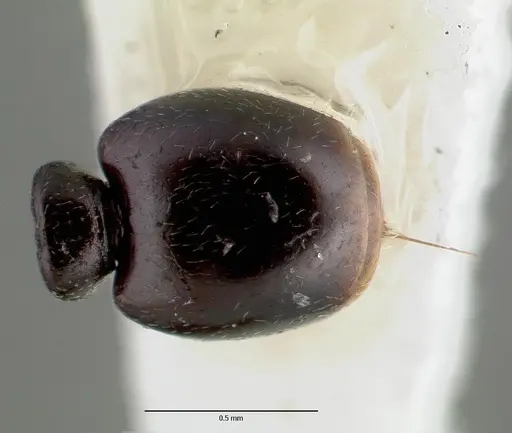
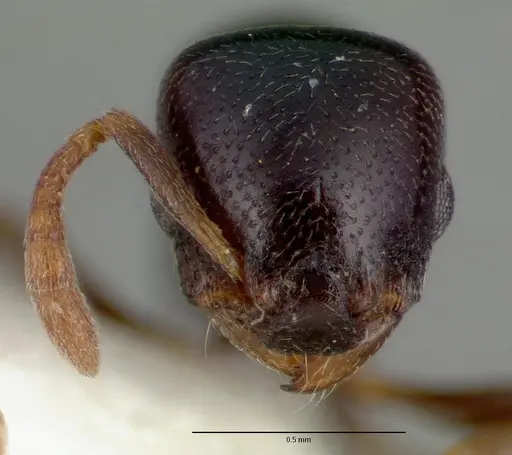
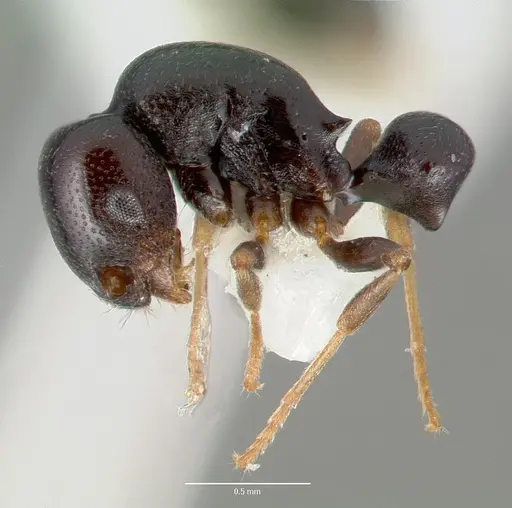
Stereomyrmex dispar is a tiny, dark ant from the subfamily Myrmicinae, tribe Crematogastrini. Workers measure about 2.5-3.2 mm in total length and are nearly black, with yellowish-brown mandibles, antennae, legs, and tip of the gaster . The head is trapezoidal with large semicircular eyes, and the thorax bears distinctive, compressed epinotal spines. Their primary defense mechanism is smearing venom [subfamily knowledge]. This species is known only from a single worker collected in 1933 on Bellona Island, Solomon Islands ; no colonies, queens, or biological observations have ever been recorded. Antkeeping requirements are completely speculative.
Quick Summary
- Difficulty: Expert
- Origin & Habitat: Solomon Islands: Bellona Island (type locality) and Santa Cruz/Nendö islands [3][1]. The habitat is undocumented but likely tropical rainforest.
- Colony Type: Unconfirmed, only a single worker has ever been documented [1].
- Size & Growth:
- Antkeeping:
- Temperature: Based on tropical distribution, keep at 24-28°C, avoid below 22°C. Provide a gentle gradient with a heating cable [3].
- Humidity: As a tropical island species, maintain high humidity. Keep nest substrate consistently moist but not waterlogged.
- Diapause: Unlikely, tropical species, no hibernation required. Keep stable warm year-round [3].
- Nesting: No data exists. Based on related Crematogastrini, likely nest in soil, under stones, or rotting wood. Start with a Y-tong or naturalistic setup with moist substrate.
- Behavior: Behavior is unstudied. Based on related genera, they are likely generalist foragers. Their tiny size (under 4 mm) makes escape prevention critical, use fine mesh. Aggression is unknown.
- Common Issues: no established care information exists, all recommendations are speculative, extremely rare in the hobby, only one worker ever collected, wild colonies essentially impossible to obtain, no queen or colony structure known, captive breeding unprecedented, lack of biological data makes proper care difficult
Species Overview and History
Stereomyrmex dispar was first described by Wheeler in 1934 from a single worker collected on Bellona Island, Solomon Islands, during the Templeton Crocker Expedition [1]. The holotype, collected by Maurice Willows Jr. on June 23,1933,is housed at the California Academy of Sciences. Originally placed in the genus Willowsiella, it was moved to Stereomyrmex by Bolton in 2003. Subsequent surveys recorded it from Santa Cruz and Nendö [3], but no additional specimens have ever been found.
Identification and Morphology
Workers measure 2.5-3.2 mm in total length. They are almost entirely black, with yellowish-brown on the mandibles, antennae, legs, and terminal segments of the gaster [1][2]. The head is trapezoidal, slightly longer than broad, with large semicircular eyes and a convex posterior border. The thorax bears short, compressed, subparallel epinotal spines directed backward and slightly upward. The petiolar node is higher than long, with truncated anterior and posterior surfaces. The body is shining with fine reticulate sculpturing [2].
Distribution and Habitat
Known only from the Solomon Islands: Bellona Island (the type locality) and Santa Cruz/Nendö islands [3][1]. The climate is tropical with high rainfall, but no specific nesting or microhabitat data exists. The original specimen was collected from the northwestern end of Bellona Island.
Care Recommendations
No biological data exists. All advice is inferred from related Crematogastrini and general Myrmicinae care. Keep temperatures at 24-28°C with a heat gradient. Maintain high humidity, moist substrate, but not waterlogged. Provide a constant water source. Use a Y-tong or naturalistic nest with moist soil and hiding spots. Feed a varied diet: small live prey (fruit flies, pinhead crickets), protein sources, and sugar water. Their tiny size means escape prevention is critical, use fine mesh and tight barriers.
Availability and Collection
Essentially unavailable. Only one worker has ever been collected (1933), and no colonies have been documented. Obtaining this species would require fieldwork in the Solomon Islands. For most keepers, it remains a scientific curiosity. [1][3]
Frequently Asked Questions
How do I keep Stereomyrmex dispar ants?
No established care exists. Speculatively: keep at 24-28°C with high humidity, moist substrate, and small live prey plus sugar water. This species is essentially unavailable.
What do Stereomyrmex dispar ants eat?
Diet is unconfirmed. Likely scavenges small insects and tends aphids for honeydew, like related Crematogastrini. Offer fruit flies, small mealworms, and sugar water.
How big do Stereomyrmex dispar colonies get?
Unknown, no colony has ever been documented. A pure guess would be under 500 workers.
Where does Stereomyrmex dispar live?
Only known from the Solomon Islands: Bellona Island, Santa Cruz, and Nendö [3][1].
Can I buy Stereomyrmex dispar ants?
No. Only one worker ever collected (1933). Not available in the hobby.
Do Stereomyrmex dispar ants sting?
As a Myrmicinae, they have a stinger and likely use a smearing defense (smear venom). The effect is unknown, but given their tiny size, any sting is negligible to humans.
What temperature do Stereomyrmex dispar ants need?
Based on tropical distribution, keep at 24-28°C. Avoid below 22°C [3].
Are Stereomyrmex dispar good for beginners?
No. No care knowledge exists. Beginners should choose well-documented species.
How long does it take for Stereomyrmex dispar to develop from egg to worker?
Unknown, no data. Estimate 4-8 weeks at ~26°C, based on tropical Myrmicinae.
Do Stereomyrmex dispar ants need hibernation?
Unlikely. They are tropical and probably do not require a cold period [3].
What does Stereomyrmex dispar look like?
Workers are tiny (2.5-3.2 mm), nearly black with yellowish-brown on mandibles, antennae, legs, and gaster tip. Trapezoidal head, large eyes, and short compressed spines on the thorax [1][2].
Is Stereomyrmex dispar rare?
Extremely rare, only one worker ever collected (1933). No additional specimens or colonies have been found [1][3].
Report an Issue
The current care sheet is based fully on literature. See inconsistencies, or something that's incorrect? Please , it will be resolved after review from an admin. Contributing to the blogs tab also helps providing information, to make us be able to further improve the caresheets. Thank you for your support!
References

This caresheet is licensed under CC BY-SA 4.0 .
Community Blogs
CASTYPE05026
View on AntWeb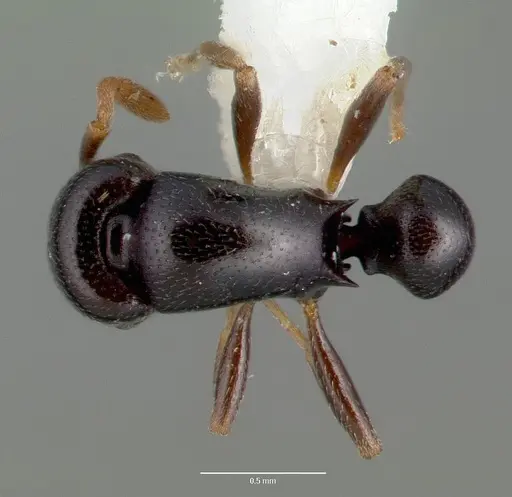
Literature
Loading distribution map...Loading products...