
Stenamma expolitico
- Sci. Name
- Stenamma expolitico
- Tribe
- Stenammini
- Subfamily
- Myrmicinae
- Author
- Branstetter, 2013
- Distribution
- Found in 1 countries
Introduction
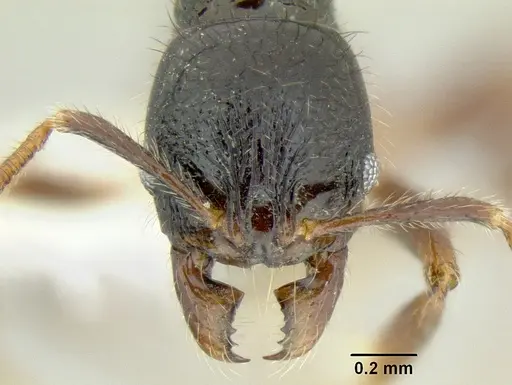
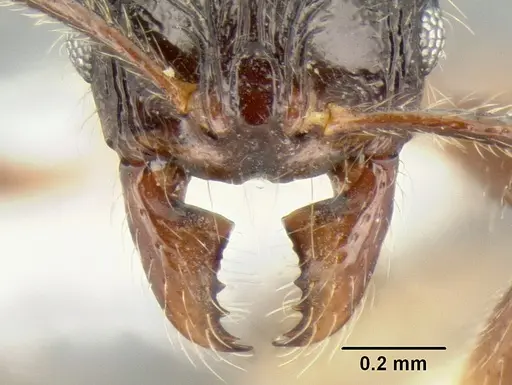
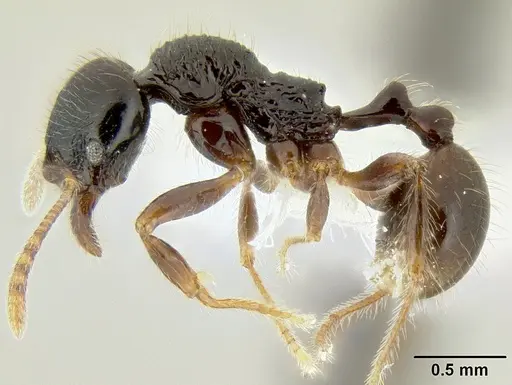
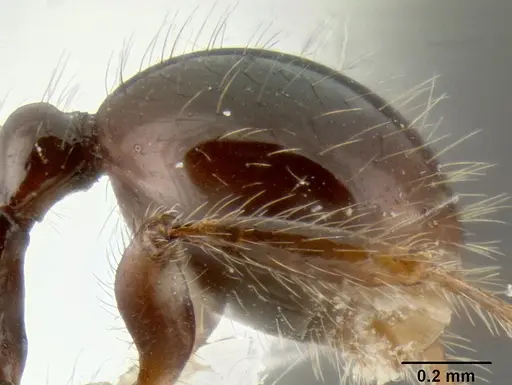
Stenamma expolitico is a medium-sized ant species found only in Costa Rica, living in wet forests at 500-1100 m elevation . Workers have a black to dark red-brown body with almost completely smooth and shiny petiole and postpetiole - the postpetiole looks bulging and globular, clearly bigger than the petiolar node . Their face has a fan of ridges extending from the frontal lobes about three-quarters of the way to the back of the head, and the promesonotum shows distinctive transverse furrows . They lack propodeal spines - instead the back of the body forms a blunt 90° angle. Their eyes are relatively large for a Stenamma, with 8 ommatidia. This species belongs to the expolitum group and is known from just four specimens ever collected, making it one of the rarest ants known . Queens and males have never been found, so almost nothing is known about their colony life or reproduction .
Quick Summary
- Difficulty: Expert
- Origin & Habitat: Costa Rica, wet forests at 500-1100 m elevation. Collected from sifted leaf litter in humid forest floor microhabitats [1][2].
- Colony Type: Unknown, queens have never been collected, so social structure (monogyne/polygyne) is unconfirmed [3].
- Size & Growth:
- Queen: Unknown, queens have never been collected. Based on related Stenamma, queens are likely around 5-6 mm, but this is uncertain [3].
- Worker: Size data unavailable from total length measurements. Based on related Stenamma, workers likely around 3.5-4.5 mm total length (inferred from genus).
- Colony: Unknown, only four workers ever documented [1].
- Growth: Unknown, no colony data exists.
- Development: Unconfirmed, no captive breeding has occurred. Based on related Stenamma, development might take 6-10 weeks at tropical temperatures, but this is a rough genus-level estimate. (No species-specific development data exists.)
- Antkeeping:
- Temperature: Based on their Costa Rican wet forest habitat, likely prefer warm, stable conditions around 22-26°C. Avoid extremes.
- Humidity: High humidity is essential, these ants come from wet forest leaf litter where humidity stays constantly elevated. Keep nest substrate consistently moist but not waterlogged.
- Diapause: Unknown, no data on overwintering. As a tropical species from moderate elevation, they probably do not need a true diapause.
- Nesting: In nature they live in leaf litter and soil. In captivity, a naturalistic setup with moist substrate or a well-humidified Y-tong/plaster nest would likely work best. Avoid dry conditions.
- Behavior: No behavioral observations exist for this species in captivity. Based on typical Stenamma behavior, they are likely cryptic foragers that hunt small prey in leaf litter. Their relatively large eyes suggest they may rely more on vision than many Myrmicinae. Escape risk is high given their tiny size, use tight barriers. Temperament is unknown but Stenamma are generally not aggressive.
- Common Issues: this species has never been kept in captivity, no established care protocols exist., only four specimens have ever been collected, making wild colonies essentially unavailable., queens have never been collected, so founding a colony is currently impossible., no information on diet preferences or feeding behavior exists., extremely limited distribution makes collection for hobby purposes impractical.
Species Overview and Rarity
Stenamma expolitico is one of the rarest and least-studied ant species. Since its description in 2013,only four worker specimens have ever been collected, all from wet forest leaf litter in Costa Rica between 500-1100 m elevation [1][2]. This extreme rarity makes it essentially unavailable to antkeepers, no colonies have ever been exported or established in captivity. The species was described by Michael Branstetter in his revision of Middle American Stenamma [1]. It belongs to the expolitum species group, which also includes Stenamma alas and Stenamma expolitum. The name 'expolitico' combines 'expolitum' with 'tico' (a local term for Costa Ricans), highlighting its resemblance to S. expolitum [3].
Appearance and Identification
Workers are medium-sized for a Stenamma. Their body is mostly black to dark red-brown, with brown patches on the gaster and yellow-brown legs [2]. The most distinctive features are the almost completely smooth and shiny petiole and postpetiole (unlike most Stenamma which have sculptured nodes), and the bulging globular postpetiole that looks bigger than the petiolar node [1]. The face has a fan of coarse ridges extending from the frontal lobes about three-quarters of the way to the back of the head. The promesonotum has distinctive transverse furrows that merge and become reticulate toward the rear. Propodeal spines are absent, only tiny tubercles, and the back forms a blunt 90° angle where the top and sloping faces meet [1]. The eyes are relatively large for Stenamma, with 8 ommatidia at the widest point.
Natural History
Virtually nothing is known about the natural history of Stenamma expolitico. All four known specimens were sifted from leaf litter in wet forests at 500-1100 m elevation [1][2]. The type locality is Rio Peñas Blancas in Alajuela Province, Costa Rica, at 800 m elevation [2]. The wet forest environment suggests they need high humidity, like other leaf-litter Stenamma. Males and queens have never been collected, so we have no information about nuptial flights, colony founding, or queen number (monogyne vs polygyne) [3]. This species is part of the Stenamma Middle American Clade (MAC), which phylogenomic studies show originated in temperate regions and later diversified into the tropics, making S. expolitico a tropical offshoot of a generally temperate group [4].
Keeping Prospects
Stenamma expolitico cannot be kept in captivity because it has never been collected in sufficient numbers to establish colonies, and no queens have ever been found [3]. Only four worker specimens exist in museum collections. For antkeepers interested in Stenamma, several other species in the genus are available in the hobby and have established care protocols. Stenamma generally are moderate-care ants that prefer humid, naturalistic setups and feed on small live prey. If you want to keep Costa Rican wet forest ants, consider more commonly available species like various Pheidole or Wasmannia. The extreme rarity of S. expolitico also raises conservation concerns, with only four specimens known and no colonies ever observed, collecting would be highly questionable and could harm a species that may have extremely small populations.
Frequently Asked Questions
Can I keep Stenamma expolitico ants?
No, Stenamma expolitico cannot be kept in captivity. Only four worker specimens have ever been collected, and queens have never been found. No colonies exist in the antkeeping hobby, and the species is essentially unavailable [1][3].
Where does Stenamma expolitico live?
This species is known only from Costa Rica, specifically wet forests between 500-1100 m elevation in Alajuela and Heredia provinces [1][2].
How big do Stenamma expolitico workers get?
Total body length has not been reported. Based on related Stenamma, workers are likely around 3.5-4.5 mm in total length (inferred from genus). Head and mesosoma measurements are given in the original description but do not represent full body size [2].
Do Stenamma expolitico queens exist?
Queens have never been collected. Only four worker specimens have ever been documented, making this one of the rarest ant species known [3].
What do Stenamma expolitico ants eat?
This is unknown, no feeding observations exist. Based on typical Stenamma behavior, they likely hunt small invertebrates in leaf litter, but their specific diet has never been documented [1].
Are Stenamma expolitico ants aggressive?
No behavioral observations exist for this species. Stenamma generally are not aggressive and are cryptic foragers, but nothing specific is known about S. expolitico temperament.
Do Stenamma expolitico need hibernation?
Unknown, no captive colonies exist to test this. As a tropical species from moderate elevation in Costa Rica, they likely do not require true hibernation.
How do I start a Stenamma expolitico colony?
You cannot, founding a colony is currently impossible because no queens have ever been collected [3]. Only four worker specimens exist in museum collections worldwide.
Is Stenamma expolitico endangered?
The conservation status has not been assessed, but given the extreme rarity (only four specimens ever collected), any wild populations would likely be very limited. The species is known only from protected areas in Costa Rica [1].
What makes Stenamma expolitico special?
This species is remarkable primarily for its extreme rarity and the gaps in our knowledge. It belongs to the expolitum species group and is known from only four specimens collected over 16 years. Queens and males have never been found, leaving almost all basic biology unknown [1][3].
Report an Issue
The current care sheet is based fully on literature. See inconsistencies, or something that's incorrect? Please , it will be resolved after review from an admin. Contributing to the blogs tab also helps providing information, to make us be able to further improve the caresheets. Thank you for your support!
References

This caresheet is licensed under CC BY-SA 4.0 .
Community Blogs
INBIOCRI001282473
View on AntWeb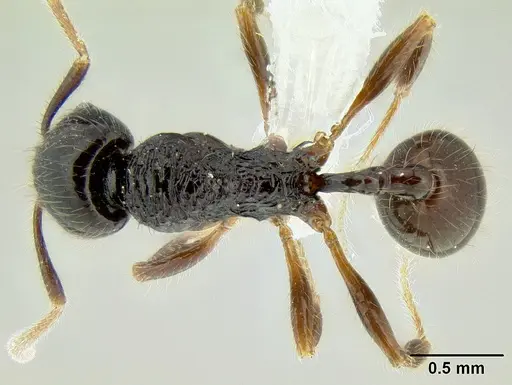
Literature
Loading distribution map...Loading products...