
Simopone emeryi
- Sci. Name
- Simopone emeryi
- Subfamily
- Dorylinae
- Author
- Forel, 1892
- Distribution
- Found in 1 countries
Introduction
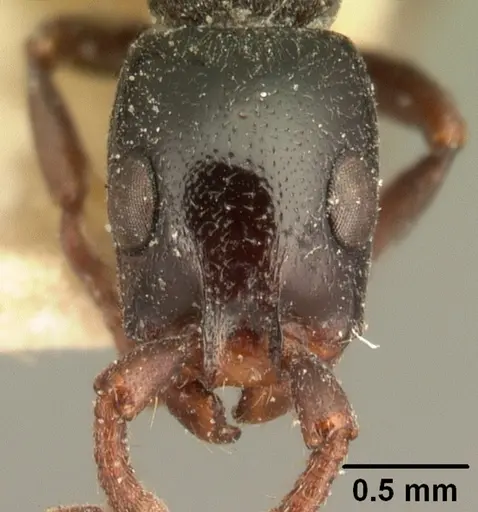
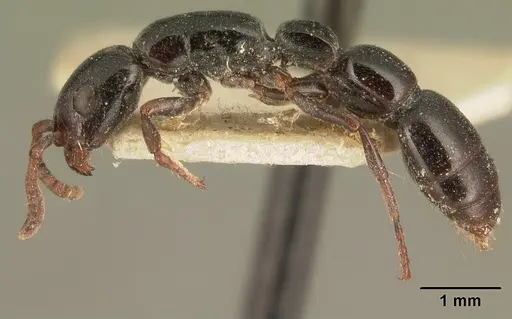
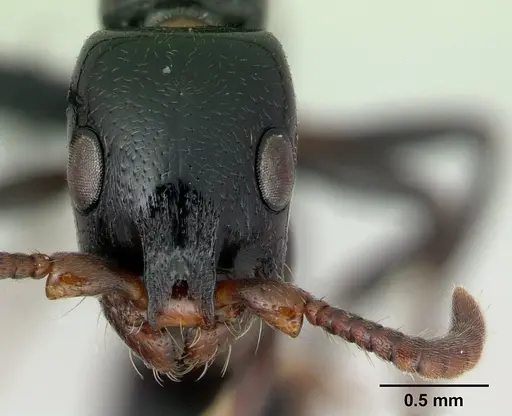
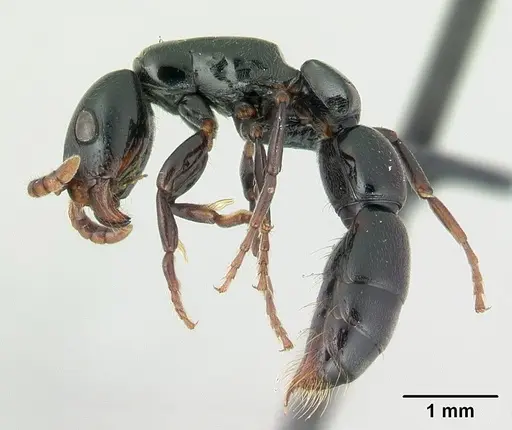
Simopone emeryi is a small, predatory ant native to Madagascar, belonging to the Dorylinae subfamily (army ants and relatives). Workers are very small (total length undocumented) with a distinct black body, reddish-brown appendages and clypeus . Their eyes are relatively large and positioned near the middle of the head . A key identification feature: this species lacks standing bristles (setae) on the upper surfaces of the second, third, and fourth abdominal segments (tergites AII-AIV) . Also, the propodeum meets the slope of the rear body through a blunt angle, without a sharp ridge . Unlike African relatives, Madagascar Simopone species – including emeryi – are thought to have ergatoid queens (wingless) instead of winged queens . Natural habitat is montane rainforest, where they nest inside dead twigs above ground .
Quick Summary
- Difficulty: Expert
- Origin & Habitat: Endemic to Madagascar, specifically recorded from Anosibé in Bezanozano Province. Found in montane rainforest, nesting in dead twigs above ground [3][2].
- Colony Type: Ergatoid queen system – Madagascar Simopone species, including emeryi, are thought to have wingless ergatoid queens as replacement reproductives rather than winged queens [2]. Likely single-queen colonies with the ability to replace the queen.
- Size & Growth:
- Queen: Size data unavailable – ergatoid queens are wingless and probably similar in size to workers [2]
- Worker: Size data unavailable – only head measurements documented in literature (head length ~1.3–1.5 mm) [1]
- Colony: Unknown – no colony size data available for this species
- Growth: Unknown
- Development: Unknown – no direct studies exist. If based on related Dorylinae of similar size, development might take 4–8 weeks at tropical temperatures, but this is speculative. (All developmental data is unconfirmed, nothing is published for Simopone emeryi.)
- Antkeeping:
- Temperature: Keep warm and stable, roughly 22–26 °C – this tropical species likely dislikes sudden drops. A gentle gradient (warm side / cooler side) is recommended [2].
- Humidity: Moderate to high – nest substrate should be consistently moist but not waterlogged. Montane rainforest origins suggest high humidity (60–80% RH) is ideal, but direct data is lacking [2].
- Diapause: Not required – as a tropical species from Madagascar, they likely do not need a winter diapause. Maintain warm conditions year-round [2].
- Nesting: In nature they nest in dead twigs above ground in rainforest. In captivity, start with a test tube setup or a small formicarium with narrow chambers (Y-tong, plaster, or 3D-printed). Their tiny size means gaps must be sealed tightly. [2]
- Behavior: Simopone emeryi is a predatory ant, typical of Dorylinae. Their relatively large eyes (compared to head size) suggest they use vision while hunting small prey [1]. Workers are tiny (under 5 mm) and can slip through fine gaps, so escape prevention is essential. Temperament is not documented, but cerapachyine ants are generally not overly defensive, they are predators that hunt small arthropods. They likely forage individually or in small groups.
- Common Issues: very little documented care info makes proper husbandry a challenge, acceptance of offered prey is uncertain – species-specific preferences are unknown, tropical species may be sensitive to temperature drops or prolonged dry conditions, ergatoid queen system means colony reproduction may be slow or unusual, tiny workers require extremely fine mesh and tight seals to prevent escapes
Housing and Nest Setup
Because Simopone emeryi workers are very small (exact total length undocumented, but head length ~1.3–1.5 mm [1]), their nest must have appropriately scaled chambers. A test tube setup works well for a founding colony – the water reservoir on the cotton end provides humidity and the darkened rear mimics a secure cavity. For larger groups, use a small formicarium with narrow chambers (Y-tong, plaster, or 3D-printed) to prevent stress from oversized spaces. Since they naturally nest in dead twigs above ground in rainforest [2], you can also provide small pieces of bark or rotten twigs in a naturalistic setup. Escape prevention is critical: seal all gaps with fine mesh (gaps must be less than 0.5 mm) and ensure connections are tight.
Feeding and Diet
As a member of the Dorylinae subfamily, Simopone emeryi is predatory [2]. It likely hunts small arthropods in nature – micro-invertebrates such as springtails, tiny fruit flies, and small beetle larvae are good candidates. Offer small live prey items, you can also try tiny pieces of mealworm (fresh or pre-killed). Sugar water or honey water may be accepted occasionally but is not a primary food. Remove any uneaten prey within 24–48 hours to prevent mold. For an established colony, feed every 2–3 days and adjust based on how quickly they consume food.
Temperature and Humidity
This species originates from Madagascar's montane rainforests, so it prefers warm, humid conditions. Aim for a stable temperature of 22–26 °C, avoid letting it drop below 20 °C. If your room is cooler, use a heating cable on one side of the nest to create a gentle gradient. Humidity should be moderate to high (60–80% RH) – keep the nesting substrate consistently moist but not waterlogged. In a test tube, the water reservoir maintains humidity, in a larger formicarium, you can mist the substrate occasionally or use a water reservoir system. Do not let the nest dry out completely. [2]
Colony Structure and Reproduction
Unlike many ants, Simopone emeryi in Madagascar are thought to have ergatoid queens – wingless females that act as replacement reproductives [2]. (African Simopone species have dealate, winged queens.) This means a colony likely has one primary queen (the ergatoid) and may produce additional ergatoid females that can take over if the original queen dies. Mating probably occurs inside or close to the nest, not during a flying nuptial flight. Colony growth is probably slow, but no direct data is available.
Behavior and Temperament
Simopone emeryi is a predatory ant with relatively large eyes compared to head width [1], suggesting they rely on vision when hunting. Workers are small and likely forage alone or in small groups rather than in massive columns. They are not known to be overly aggressive toward humans but will defend the nest if disturbed. Because of their tiny size, they can easily escape through any gap larger than about 0.5 mm, so your setup needs to be escape‑proof. Observing their activity patterns will help you adjust feeding and care.
Frequently Asked Questions
How long does it take for Simopone emeryi to produce first workers?
The egg-to-worker development time is unknown for this species. Based on related Dorylinae and the tiny size of the ants, you might expect roughly 4–8 weeks at optimal temperatures (24–26 °C), but this is only a guess – no confirmed data exists.
Can I keep Simopone emeryi in a test tube?
Yes, a test tube setup is good for this tiny ant. Use a small test tube with a water reservoir on the cotton end. The small, dark chamber mimics the dead twigs they naturally nest in. Ensure the tube is kept dark to give them security [2].
What do Simopone emeryi ants eat?
They are predatory. Offer small live prey like springtails, fruit flies, tiny mealworm pieces. Sugar water may be taken but is not a staple. Remove uneaten prey after 24–48 hours to avoid mold [2].
Are Simopone emeryi good for beginners?
No, this species is rated Expert difficulty. Very little is known about its care, their tiny size creates husbandry challenges, and the ergatoid queen system makes colony growth unpredictable. Only experienced keepers who can adapt to uncertain conditions should attempt this species [2].
Do Simopone emeryi need hibernation?
No. As a tropical species from Madagascar, they do not require a winter diapause. Keep them warm year-round (22–26 °C). A slight seasonal slowdown may occur naturally during cooler months, but that’s not hibernation [2].
How big do Simopone emeryi colonies get?
Colony size data is not available. Based on related Simopone species and the ergatoid queen system, colonies probably remain relatively small – likely under a few hundred workers at maturity [2].
Why are there no winged queens for Simopone emeryi?
Unlike many ants, Madagascar Simopone species, including emeryi, have ergatoid (wingless) queens instead of dealate (winged) queens. This is a geographic pattern: African Simopone have winged queens, but all studied Madagascar species appear to use ergatoid queens that serve as replacement reproductives within the nest [2].
Can I keep multiple Simopone emeryi queens together?
The natural colony structure appears to be single-queen with ergatoid replacement reproductives. Combining unrelated queens has not been documented and is not recommended. The ergatoid system means replacement queens may already be present in established colonies [2].
What temperature is best for Simopone emeryi?
Keep them at 22–26 °C. As a Madagascar montane rainforest species, they prefer warm, stable conditions. Avoid temperatures below 20 °C. A heating cable on one side of the nest can create a gentle gradient if room temperature is insufficient [2].
Report an Issue
The current care sheet is based fully on literature. See inconsistencies, or something that's incorrect? Please , it will be resolved after review from an admin. Contributing to the blogs tab also helps providing information, to make us be able to further improve the caresheets. Thank you for your support!
References

This caresheet is licensed under CC BY-SA 4.0 .
Community Blogs
CASENT0101966
View on AntWeb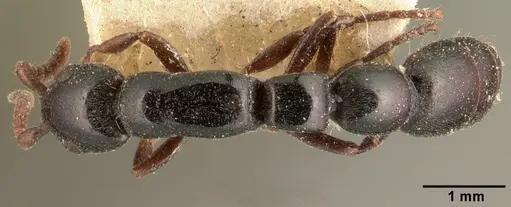
CASENT0487286
View on AntWeb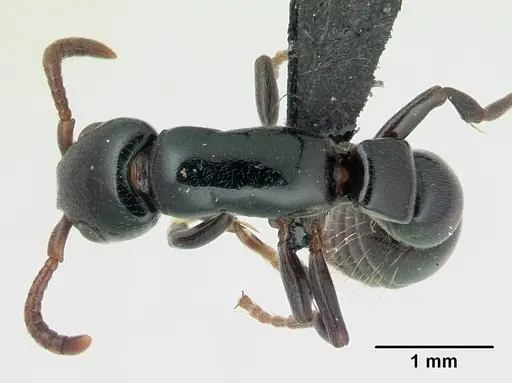
Literature
Loading distribution map...Loading products...