
Simopelta anomma
- Sci. Name
- Simopelta anomma
- Tribe
- Ponerini
- Subfamily
- Ponerinae
- Author
- Fernandes <i>et al.</i>, 2015
- Distribution
- Found in 1 countries
Introduction
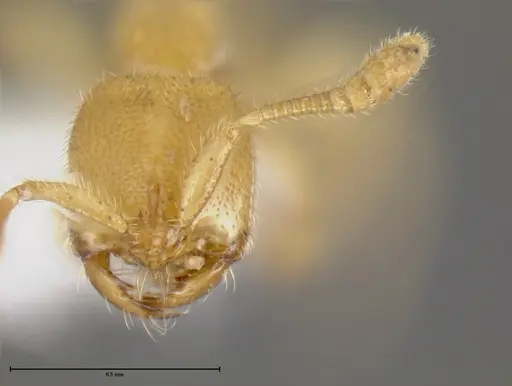
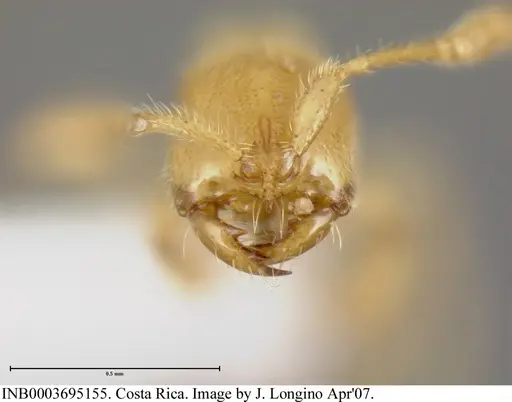
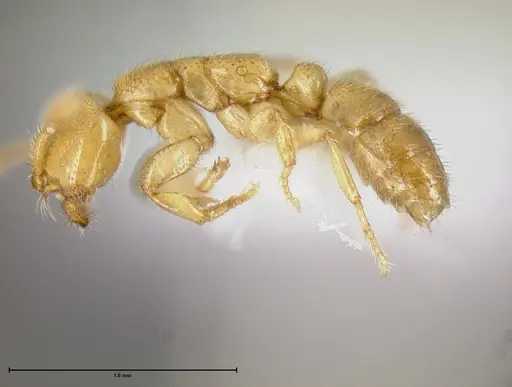
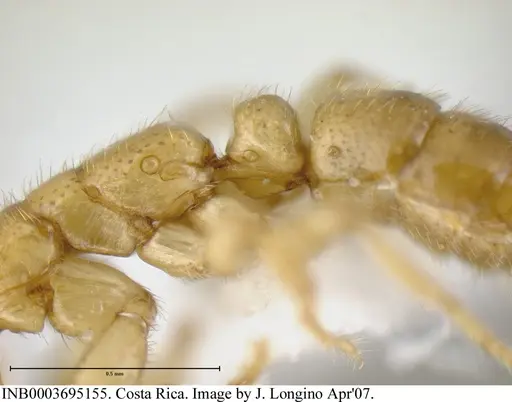
Simopelta anomma is an extremely rare, tiny ponerine ant discovered in 2015,known from only three worker specimens collected in Brazil and Costa Rica . Workers measure just 2.16-2.36 mm in total length, making them among the smallest ants in the genus . They are easily recognized by their complete lack of eyes (the species name means 'without eyes' in Greek), a distinctive 3-segmented antennal club, and a bright yellow body covered in fine golden hairs . These ants belong to the curvata species complex, characterized by an elongate median clypeal spine and total length under 4 mm . This species appears to be primarily subterranean, living underground and rarely coming to the surface. The only known specimens were collected when flooding forced normally underground ants into the leaf litter layer . Their robust forecoxa, clubbed antennae, and reduced arolia (foot pads) all suggest a life spent navigating dark soil passages rather than surface foraging .
Quick Summary
- Difficulty: Expert
- Origin & Habitat: Tropical lowland rainforest in Brazil (Rondônia, Rio Madeira) and Costa Rica (La Selva Biological Station). Specimens were collected from leaf litter during unusual flooding events, but the species is thought to be mostly subterranean [1].
- Colony Type: Unknown, only three worker specimens have ever been collected. Colony structure, queen characteristics, and social organization have not been documented [1].
- Size & Growth:
- Queen: Unknown, queens have not been described or collected [1]
- Worker: 2.16-2.36 mm total length [1]
- Colony: Unknown, colony size has not been documented [1]
- Growth: Unknown
- Development: Unknown, no development data exists for this species [1] (No research has been conducted on their development. Related Simopelta species are believed to develop in 2-4 months, but this is unconfirmed for S. anomma.)
- Antkeeping:
- Temperature: Based on tropical rainforest habitat, maintain warm temperatures around 24-28°C. Specific requirements are unknown, provide a gradient and observe [1].
- Humidity: High humidity is required. Keep the nest substrate consistently moist but not waterlogged. Exact relative humidity levels have not been studied [1].
- Diapause: Unknown, tropical species likely do not require formal hibernation, but research is lacking [1].
- Nesting: Use a deep, naturalistic setup with at least 5-10 cm of moist substrate (e.g., soil mixed with rotting wood). Provide darkness and minimal disturbance, as they are adapted to subterranean life [1].
- Behavior: This species is cryptic, subterranean, and avoids light. As a member of the Ponerinae subfamily, workers likely possess a functional stinger and are predatory on small soil arthropods. They are extremely small (under 2.5 mm), so excellent escape prevention is critical, they can squeeze through gaps smaller than 1 mm. Temperament is unknown, but like most Ponerinae, they may be defensive. Activity is low as they spend most time underground.
- Common Issues: has never been kept in captivity, no established care protocols exist [1], only three specimens have ever been collected, so basic biology remains completely unknown [1], extremely small size makes escape prevention extremely difficult, no documented colony structure means founding behavior and social organization are entirely speculative, wild-caught colonies may be impossible to obtain, and keeping may not be feasible
Discovery and Rarity
Simopelta anomma was described in 2015,making it one of the newest and least‑studied ant species in the world [1]. It is known from just three worker specimens: two collected in Brazil’s Rondônia state near the Madeira River in January 2014,and one from Costa Rica’s La Selva Biological Station in July 2006 [1]. This extreme rarity means virtually nothing is known about its biology in the wild. The Brazilian specimens were collected during an unusual flooding event when the Madeira River rose 19 meters above its maximum level, forcing normally subterranean ants up into the leaf litter where they were captured using Winkler sifting [1]. Following that event, no additional specimens were found despite intensive monitoring, underscoring how elusive this species is [1].
Identification and Morphology
Simopelta anomma is unmistakable among Simopelta species due to its complete lack of eyes, a rare trait in the genus [1]. Workers are tiny at 2.16-2.36 mm total length, with a predominantly yellow body covered in fine golden hairs [1]. The 3‑segmented antennal club is distinctive, as most related species have a 4‑segmented club [1]. Their midtibiae are covered with abundant, golden, stout setae, and their arolia (foot pads) are highly reduced [1]. The clypeus bears a sharp, elongate median spine characteristic of the curvata species complex [1]. These features, blindness, robust forecoxa, and clubbed antennae, all indicate a fully subterranean lifestyle adapted for navigating dark soil tunnels [1].
Natural History
Nothing is known about the natural history of Simopelta anomma [1]. Based on morphology and the single collection event, they appear to be cryptobiotic, living entirely underground in moist soil [1]. The flooding that brought them to the surface suggests they normally nest deep in the ground and only appear in leaf litter during unusual environmental conditions [1]. As Ponerinae ants, they are likely predatory, hunting small soil invertebrates, but their exact diet, foraging behavior, colony structure, and reproductive biology remain completely undocumented [1]. This species has never been observed in captivity [1].
Housing and Care
Since this species has never been kept in captivity, all care recommendations are speculative extrapolations from morphology and related species [1]. Provide a deep, naturalistic setup with at least 5-10 cm of moist substrate, a mixture of soil and rotting wood works well [1]. Keep temperatures warm (24-28°C based on tropical habitat) and maintain high humidity by keeping the substrate moist but not waterlogged [1]. Use excellent escape prevention, these tiny ants can squeeze through gaps smaller than 1 mm. Provide darkness and minimal disturbance, as they are adapted to subterranean life [1]. Do not expect to find this species in the antkeeping hobby, it has never been collected or sold commercially and may not be legally obtainable [1].
Feeding and Diet
As a Ponerinae ant, Simopelta anomma is likely predatory on small soil arthropods [1]. Based on related species, they probably hunt springtails, soil mites, and other tiny invertebrates. No specific dietary data exists for this species [1]. If kept, offer small live prey items like springtails and fruit flies, sugar sources are unlikely to be accepted, as most Ponerinae are strict predators. Feed every 2-3 days and remove uneaten prey to prevent mold.
Frequently Asked Questions
Can I keep Simopelta anomma as a pet ant?
No, this species has never been kept in captivity and is essentially unavailable to antkeepers [1]. Only three specimens have ever been collected worldwide, all from scientific surveys. There are no established care protocols, and the species may not exist in sufficient numbers for any collection efforts [1].
How big do Simopelta anomma colonies get?
Unknown, colony size has never been documented [1]. Based on related Simopelta species, colonies are likely small (perhaps under 100 workers), but this is purely speculative [1].
What do Simopelta anomma ants eat?
Likely small predatory insects and soil arthropods, like other Ponerinae ants. No specific dietary data exists [1]. If kept, they would probably accept springtails, fruit flies, and tiny soil mites.
Are Simopelta anomma good for beginners?
Absolutely not. This is an expert-only species that has never been kept in captivity [1]. There are no care guides, no established protocols, and the species may not even be obtainable. Beginners should start with well-established species like Lasius niger or Camponotus species.
How do I set up a nest for Simopelta anomma?
Use a deep, naturalistic setup with moist substrate (at least 5-10 cm deep). A Y-tong or plaster nest with added substrate depth would work [1]. Keep conditions dark and humid. However, actually obtaining this species is currently impossible.
Do Simopelta anomma need hibernation?
Unknown, as a tropical species from Costa Rica and the Brazilian Amazon, they likely do not require formal hibernation [1]. A slight temperature reduction during a simulated dry season may be beneficial but has not been studied [1].
How long does it take for Simopelta anomma to develop from egg to worker?
Unknown, no development data exists for this species [1]. Related Simopelta species are believed to take 2-4 months, but this is unconfirmed for Simopelta anomma [1].
Report an Issue
The current care sheet is based fully on literature. See inconsistencies, or something that's incorrect? Please , it will be resolved after review from an admin. Contributing to the blogs tab also helps providing information, to make us be able to further improve the caresheets. Thank you for your support!
References

This caresheet is licensed under CC BY-SA 4.0 .
Community Blogs
INB0003695155
View on AntWeb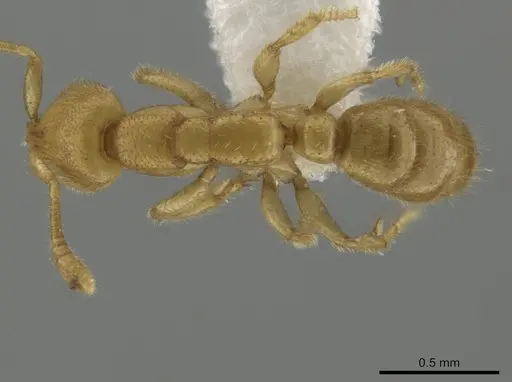
Literature
Loading distribution map...Loading products...