
Royidris pulchra
- Sci. Name
- Royidris pulchra
- Tribe
- Crematogastrini
- Subfamily
- Myrmicinae
- Author
- Bolton & Fisher, 2014
- Distribution
- Found in 1 countries
Introduction
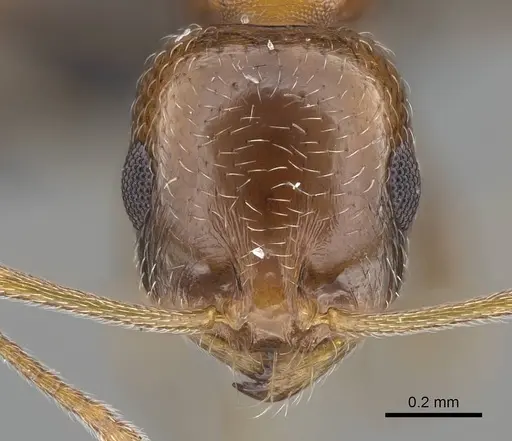
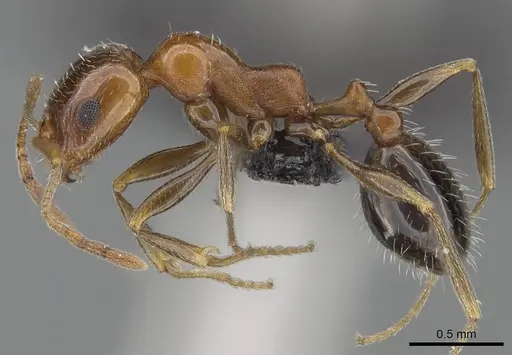
Royidris pulchra is a tiny myrmicine ant endemic to Madagascar, measuring just 3.0mm in total length . Workers have a smooth, polished head, a domed promesonotum, and a black gaster that contrasts with their medium brown head, mesosoma, and legs . This species belongs to the robertsoni group within the genus Royidris and is known from a single collected worker specimen . Described in 2014,it remains one of the most poorly documented ants in Madagascar, with no queens, males, or colony observations ever recorded . The type specimen was collected from tropical dry forest at 250 meters elevation, while other records come from spiny forest litter and pitfall traps .
Quick Summary
- Difficulty: Expert
- Origin & Habitat: Endemic to Madagascar, specifically the Mahajanga region. Type locality is tropical dry forest at Forêt Ambohimanga,26.1 km from Mampikony at 250m elevation. Also recorded from spiny forest [1].
- Colony Type: Unknown, only a single worker specimen has ever been collected. Colony structure, queen presence, and social organization have not been documented [1].
- Size & Growth:
- Queen: Unknown, queen caste has never been described or observed [1]
- Worker: 3.0mm total length (TL) [1]
- Colony: Unknown, no colony data exists
- Growth: Unknown
- Development: Unknown, no development data exists for this species (No brood or colony development has ever been documented. Related Royidris species may provide rough estimates but this species remains unstudied.)
- Antkeeping:
- Temperature: Likely 24-28°C based on Madagascar tropical habitat inference. No direct temperature data exists for this species.
- Humidity: Moderate to high humidity, given collection from forest litter. Provide a humidity gradient with a moist nest area and drier outworld.
- Diapause: Unknown. Madagascar has mild winters, so diapause may not be required, but no seasonal data exists.
- Nesting: Likely nests in soil or rotting wood based on forest floor collection. Small test tubes or plaster nests with tight chambers would be logical starting points.
- Behavior: Behavior is completely unstudied. Their tiny size (3mm) makes them excellent escape risks, fine mesh barriers are essential. Based on tribe Crematogastrini, they likely use a smear defense mechanism, applying venom by wiping rather than stinging. No aggression data exists.
- Common Issues: no captive husbandry information exists, this species has never been kept in captivity, only one wild specimen has ever been collected, suggesting extreme rarity or difficulty in collection, queen and colony information is completely absent, so founding, nesting, and social structure are unknown, escape prevention is critical due to tiny 3mm size, potential legal restrictions: Madagascar has strict wildlife export laws, and collecting this endemic species may be illegal without permits
Species Overview and Identification
Royidris pulchra is an extremely rare ant species described in 2014 and known only from a single worker specimen collected in Madagascar [1]. Workers measure just 3.0mm in total length, making them small ants [1]. They can be identified by their smooth and polished head dorsum, domed promesonotum, three-segmented antennal club, and the distinctive black color of their gaster contrasting with medium brown body and legs [1]. Unlike the similar Royidris pallida, R. pulchra is larger, has relatively longer scapes and metafemur, larger eyes, and two pairs of petiolar setae instead of one [1]. This species belongs to the robertsoni species group within the genus Royidris, which is part of the Crematogastrini tribe in the Myrmicinae subfamily [1].
Distribution and Habitat
Royidris pulchra is endemic to Madagascar, found only in the Mahajanga region of the island [1]. The type specimen was collected from tropical dry forest at Forêt Ambohimanga, approximately 26.1 km from Mampikony at an elevation of 250 meters [1]. Additional records indicate presence in spiny forest habitats as well [1]. The species has only been collected through litter samples and pitfall traps, suggesting they are ground-nesting ants that live in forest floor environments [1]. No specimens have been observed in more open or disturbed habitats.
Current Knowledge Gaps
This is one of the least known ant species, with no captive information available. Only a single worker specimen has ever been collected and described, no queens, males, or colony samples exist in any museum or research collection [1]. Nothing is known about their colony structure (single-queen or multi-queen), founding behavior (claustral or semi-claustral), diet preferences, development timeline, or any aspect of their biology [1]. The original collectors noted they were found in litter samples, suggesting they may be cryptic ground-nesting ants, but even this is an inference rather than direct observation of nesting [1]. Any captive husbandry would be entirely experimental with no established protocols to follow.
Inferred Care Requirements
Based on the species' origin in Madagascar's tropical forests and collection from forest litter, reasonable care assumptions can be made [1]. Temperature likely needs to be warm (24-28°C) matching their tropical origin. Humidity should be moderate to high, similar to other forest-dwelling Myrmicinae. Their tiny 3mm size means escape prevention with fine mesh is absolutely critical, they can easily slip through standard barrier setups. For nesting, small test tubes or plaster nests with tight chambers would be appropriate starting points. Diet is completely unknown, offer a variety of small protein sources (fruit flies, pinhead crickets) and sugar water to test acceptance. However, these are educated guesses only, not established requirements.
Legal and Ethical Considerations
As an endemic Madagascar species with extremely limited wild populations, ethical sourcing is a major concern. No established captive colonies exist, and any specimens would almost certainly need to come from wild collection, which is highly questionable given only one specimen has ever been found in decades of ant research [1]. Additionally, Madagascar has strict wildlife export regulations, and many Royidris species may be protected. Prospective keepers should consider whether attempting to keep this species is ethically justifiable given its extreme rarity and lack of any captive breeding history. Supporting conservation efforts and studying established species may be more responsible choices.
Frequently Asked Questions
Can I keep Royidris pulchra ants as a pet?
This species is not recommended for captive keeping. Only a single worker has ever been collected in the wild, and no captive husbandry information exists. There are no established protocols for keeping this species alive, and any attempt would be entirely experimental with very low chance of success. Consider better-documented Madagascar species instead.
How big do Royidris pulchra colonies get?
Unknown, colony size has never been documented. Only a single worker specimen exists in scientific collections. Related Royidris species may form small colonies, but no data exists for this specific species.
What do Royidris pulchra ants eat?
Diet is completely unstudied. Based on related Crematogastrini ants, they likely forage for small insects and may tend aphids for honeydew. However, no direct observations of feeding behavior exist for this species.
Do Royidris pulchra ants sting?
As a member of the Myrmicinae subfamily and tribe Crematogastrini, this species likely uses a smear defense mechanism rather than a typical sting. They apply venom by wiping a modified stinger over the target instead of piercing. For humans, at 3mm size, any defensive behavior would be negligible. No observations of their defense exist in the wild.
How long does it take for Royidris pulchra to develop from egg to worker?
Unknown, no brood development has ever been documented for this species. Even the queen has never been described, so there is no starting point for development timeline estimates.
Are Royidris pulchra good for beginners?
No. This species is not suitable for beginners or even experienced antkeepers. There is no captive care information available, only one specimen has ever been collected, and no one has successfully kept this species. The difficulty rating is Expert because no information exists, not because they are challenging, but because they are essentially unkeepable with current knowledge.
Do Royidris pulchra need hibernation?
Unknown, no seasonal behavior has been documented. Madagascar has mild tropical winters with temperatures rarely dropping significantly, so a true diapause may not be required. However, this is purely speculative since no biological data exists.
What is the best nest type for Royidris pulchra?
Unknown, no captive nesting has ever been documented. Based on collection from forest litter, small test tubes or plaster nests with tight chambers scaled to their 3mm size would be logical starting points. However, this is entirely speculative.
Can I keep multiple Royidris pulchra queens together?
Unknown, queen caste has never been documented. Without knowing anything about their colony structure, combining queens would be extremely risky and is not recommended. There is no information on whether they are single-queen or multi-queen species.
Where can I get Royidris pulchra ants?
This species is unavailable in the antkeeping hobby. Only one specimen has ever been collected scientifically, and no captive breeding exists. Any source claiming to have this species should be viewed with extreme skepticism. Additionally, Madagascar has strict wildlife export laws that would make legal acquisition extremely difficult.
Report an Issue
The current care sheet is based fully on literature. See inconsistencies, or something that's incorrect? Please , it will be resolved after review from an admin. Contributing to the blogs tab also helps providing information, to make us be able to further improve the caresheets. Thank you for your support!
References

This caresheet is licensed under CC BY-SA 4.0 .
Community Blogs
CASENT0052581
View on AntWeb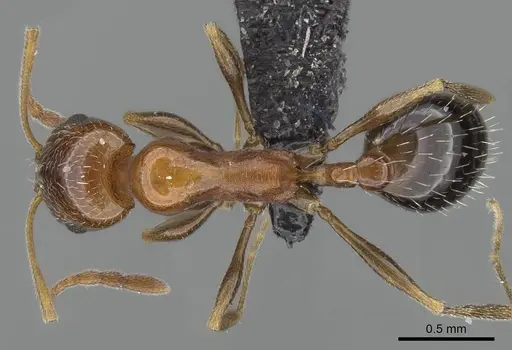
Literature
Loading distribution map...Loading products...