
Royidris gravipuncta
- Sci. Name
- Royidris gravipuncta
- Tribe
- Crematogastrini
- Subfamily
- Myrmicinae
- Author
- Bolton & Fisher, 2014
- Distribution
- Found in 1 countries
Introduction
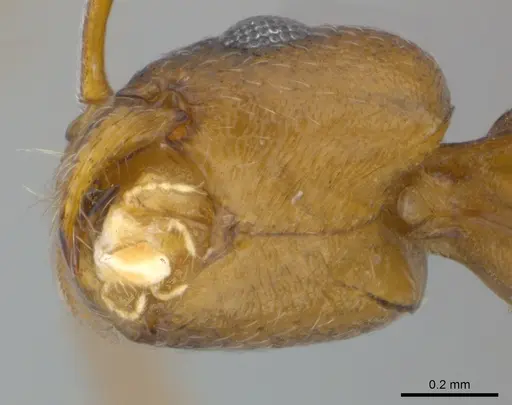
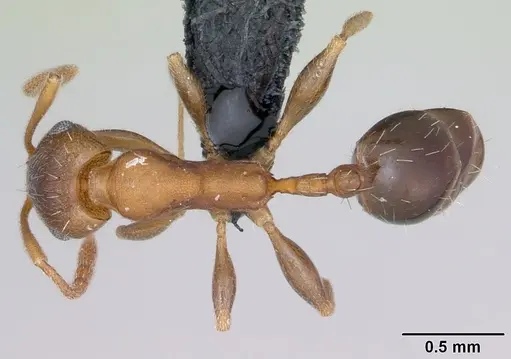
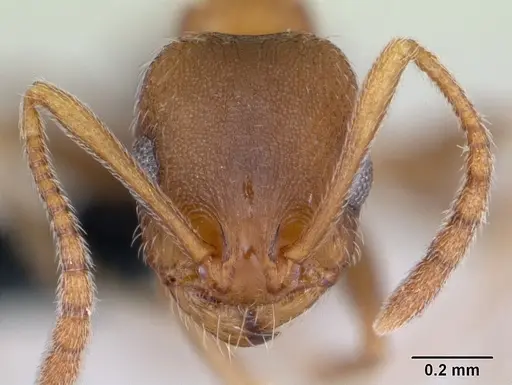
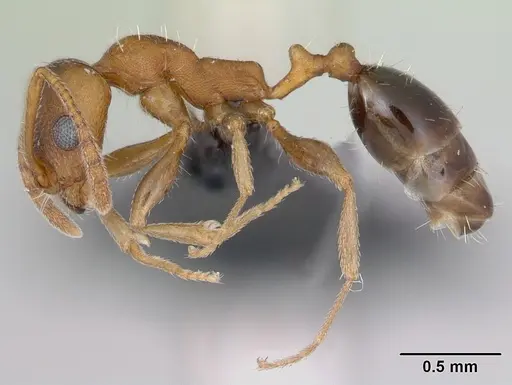
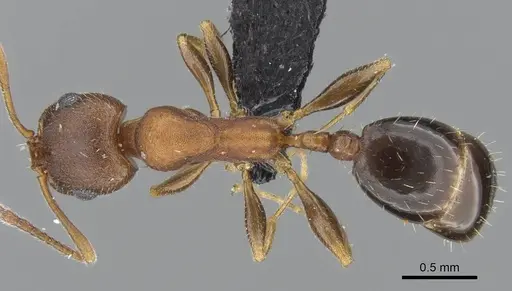
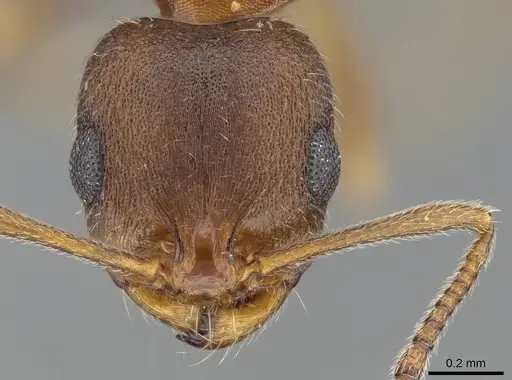
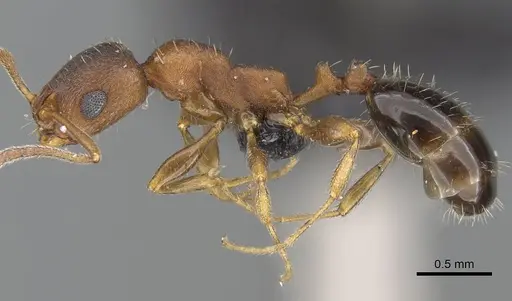
Royidris gravipuncta is a tiny ant endemic to Madagascar, with workers measuring 3.0-3.6mm total length . They have heavily sculptured bodies - the entire head and mesosoma are densely reticulate-punctate, giving a rough texture. The mesosoma is orange-brown to dull reddish brown, the head slightly darker, and the gaster glossy dark brown to almost black . This species belongs to the notorthotenes group within Royidris. These ants forage on the ground in Madagascar's spiny forest, but also turn up in urban gardens, savannah shrubland, and Bismarckia woodland . The type series was collected at a light trap, confirming they are active at night as well as during the day .
Quick Summary
- Difficulty: Medium
- Origin & Habitat: Endemic to Madagascar. Found in spiny forest thicket, urban gardens, savannah shrubland, and Bismarckia woodland [1].
- Colony Type: Colony structure is unconfirmed. Only the worker caste has been described, the queen is unknown [1].
- Size & Growth:
- Queen: Undescribed, queen caste has not been documented [1]
- Worker: 3.0-3.6mm total length [1]
- Colony: Unknown, colony size has not been documented in scientific literature
- Growth: Unknown
- Development: Unconfirmed, development timeline has not been studied (Based on similar small Myrmicinae from Madagascar, a rough estimate would be 6-10 weeks at warm temperatures)
- Antkeeping:
- Temperature: Based on their spiny forest habitat [1], keep around 24-28°C. A gentle gradient allows thermoregulation.
- Humidity: Moderate humidity around 50-70%. Spiny forest experiences seasonal dry periods, so avoid overly damp conditions [1].
- Diapause: Unconfirmed, Madagascar has less extreme seasonal swings than temperate regions. Some reduction in activity during cooler months may occur.
- Nesting: In nature they nest under stones and in dead twigs on the ground [1]. In captivity, a small test tube setup or Y-tong nest with narrow chambers works well. Provide some substrate depth for them to explore.
- Behavior: Small, ground-foraging ants active both day and night, especially at night [1]. They likely forage individually or in small groups. Their defense mechanism, typical of the tribe Crematogastrini, involves smearing venom from a flattened stinger rather than piercing. Their tiny size (under 4mm) means escape prevention must be excellent, use fine mesh and tight barriers.
- Common Issues: tiny size makes escape prevention critical, use fine mesh with holes under 0.5mm., humidity management is uncertain, aim for moderate (50-70%) and adjust based on colony activity to avoid desiccation or mold., queen undescribed, founding success is unknown, success depends on luck., lack of documented care data means keepers must experiment and observe closely., small colony may be vulnerable to stress from temperature fluctuations, maintain stable warmth 24-28°C.
Housing and Nest Setup
Royidris gravipuncta is tiny (3.0-3.6mm), so housing must be scaled down. A small test tube with a water reservoir and cotton plug works for founding colonies. For established colonies, a Y-tong (AAC) nest with narrow chambers or a small 3D-printed nest is suitable. In nature they nest under stones and in dead twigs [1], so include some substrate or small hiding spots in the outworld. Because they are nocturnal, place the setup where natural day/night cycles occur to encourage activity.
Feeding and Diet
Wild ants are generalist foragers, collected from pitfall traps and ground level, suggesting they scavenge small invertebrates [1]. In captivity, offer small protein sources like fruit flies, pinhead crickets, and tiny mealworms. Prey should be no larger than the ants themselves. They likely accept honey water or sugar water, common among Myrmicinae. Feed small amounts every 2-3 days and remove uneaten prey within 24 hours to prevent mold. Their nocturnal activity means they may be more receptive to food in the evening.
Temperature and Seasonal Care
Based on their spiny forest habitat [1], maintain warm temperatures around 24-28°C. A heating cable on one side of the nest creates a gradient, allowing the colony to self-regulate. Place heating on top of the nest to avoid excessive drying. Madagascar has warm year-round temperatures, so these ants likely tolerate a range but prefer consistent warmth. If workers cluster and reduce foraging, the temperature may be too low. A true diapause is likely not needed, but some reduction in activity during cooler months may occur naturally.
Humidity and Water
Maintain moderate humidity around 50-70%. The spiny forest habitat experiences seasonal dry periods [1], so these ants tolerate drier conditions better than many tropical species. Let the nest substrate dry partially between waterings, aim for damp but not waterlogged. Provide a small water tube in the outworld for constant access. Watch for condensation in test tube setups: excessive moisture can drown colonies, while too little causes desiccation. Offer a moist area for the colony and a drier area for foraging.
Behavior and Observation
Royidris gravipuncta is active both day and night, with nocturnal activity confirmed by light trap collection [1]. Workers forage individually or in small groups rather than in large trails. They are ground foragers, found under stones, in pitfall traps, and in dead twigs [1]. As a member of Crematogastrini, they have a modified stinger that smears venom onto enemies rather than piercing. Observe under red light in the evening to see peak activity. Their dark gaster contrasts with the lighter mesosoma, making them visually distinct.
Escape Prevention
With workers only 3.0-3.6mm, escape prevention is critical. Use fine mesh with holes no larger than 0.5mm, standard mesh may let them through. Secure all connections between nest and outworld, and check lid fittings regularly. The outworld should have smooth, vertical walls that ants cannot climb. Apply fluon or similar barrier to the upper edges of the outworld. Because they are nocturnal, do escape checks before bed. A gap that seems insignificant for larger ants is a major escape risk for this species. [1]
Colony Establishment and Growth
Since the queen caste has not been described, the founding behavior of Royidris gravipuncta remains unknown [1]. If you obtain a colony, it may be a queenright group with an undescribed queen or a queenless worker collection. Growth rate is undocumented. Based on similar small Myrmicinae from Madagascar, expect moderate development over months rather than rapid expansion. If a founding queen is ever acquired, the first workers (nanitics) may be smaller than mature workers. Patience is essential, observe brood development and adjust temperature slightly upward if growth stalls.
Frequently Asked Questions
How fast do Royidris gravipuncta develop from egg to worker?
The development timeline has not been scientifically documented. Based on similar small Myrmicinae from Madagascar, a rough estimate would be 6-10 weeks from egg to first worker at optimal warm temperatures around 26°C. The exact timing remains uncertain until more research is conducted.
What do Royidris gravipuncta eat?
They are generalist foragers in the wild, collected from pitfall traps and ground level, suggesting they scavenge small invertebrates [1]. In captivity, offer small protein sources like fruit flies, tiny crickets, and small mealworms. They likely accept sugar water or honey water as well. Feed small amounts every 2-3 days and remove uneaten food promptly.
Are Royidris gravipuncta good for beginners?
This species is rated Medium difficulty. The lack of documented care information and the queen being undescribed makes it less ideal for complete beginners. Experienced antkeepers who can adapt care based on observation will have better success. The tiny size requires attention to escape prevention.
Do Royidris gravipuncta sting?
Royidris belongs to the subfamily Myrmicinae, tribe Crematogastrini, which possesses a specialized flattened stinger that smears venom onto enemies rather than piercing. They do not sting in the typical sense but may apply venom topically. Given their tiny size (3.0-3.6mm), any venom delivery would be mild and not dangerous to humans.
What temperature do Royidris gravipuncta need?
Based on their spiny forest habitat [1], keep them at 24-28°C. A heating cable on one side of the nest creates a gradient. Place heating on top of the nest to avoid excessive drying. They likely tolerate higher temperatures but should avoid major fluctuations.
How big do Royidris gravipuncta colonies get?
Colony size has not been documented in scientific literature. Based on their small worker size (3.0-3.6mm) and typical Myrmicinae patterns, colonies likely reach a few hundred workers at maximum. The exact maximum is unknown due to limited research.
Can I keep Royidris gravipuncta in a test tube?
Yes, a small test tube setup works well for this tiny species. Use a test tube with a water reservoir and cotton plug. Avoid overly large setups where they may get lost. For established colonies, a small Y-tong or 3D-printed nest with narrow chambers is more suitable.
Do Royidris gravipuncta need hibernation?
Diapause requirements are unconfirmed. Madagascar has less extreme seasonal temperature swings than temperate regions, so a true hibernation is likely not necessary. Some reduction in activity during cooler months may occur naturally, but maintain warm temperatures year-round (24-28°C) for optimal colony health.
Why are my Royidris gravipuncta dying?
Without documented care specifics, common issues include: escape through tiny gaps (use fine mesh), excessive humidity causing drowning, temperatures too low for metabolic activity, or inadequate food for growing colonies. Monitor the colony closely and adjust conditions based on activity levels. The lack of published care guides means you are pioneering husbandry for this species.
Is Royidris gravipuncta aggressive?
Aggression levels have not been documented. As small ground foragers, they likely focus on foraging and colony maintenance rather than territorial defense. Their defense mechanism involves smearing venom rather than stinging, so they are not considered dangerous to humans.
Where is Royidris gravipuncta found in the wild?
This species is endemic to Madagascar, found primarily in spiny forest thickets [1]. It has also been collected from urban gardens, savannah shrubland, and Bismarckia woodland. They are ground foragers collected from under stones, dead twigs, and pitfall traps, with nocturnal foraging confirmed via light trap collection.
When are Royidris gravipuncta most active?
They are active both day and night, with nocturnal foraging confirmed by their collection in light traps [1]. This makes evening observation particularly interesting. They may show peak activity during twilight hours when transitioning between day and night cycles.
Report an Issue
The current care sheet is based fully on literature. See inconsistencies, or something that's incorrect? Please , it will be resolved after review from an admin. Contributing to the blogs tab also helps providing information, to make us be able to further improve the caresheets. Thank you for your support!
References

This caresheet is licensed under CC BY-SA 4.0 .
Community Blogs
Literature
Loading distribution map...Loading products...