
Royidris etiolata
- Sci. Name
- Royidris etiolata
- Tribe
- Crematogastrini
- Subfamily
- Myrmicinae
- Author
- Bolton & Fisher, 2014
- Distribution
- Found in 1 countries
Introduction
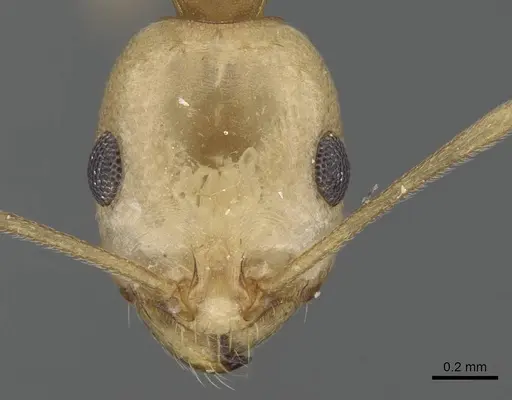
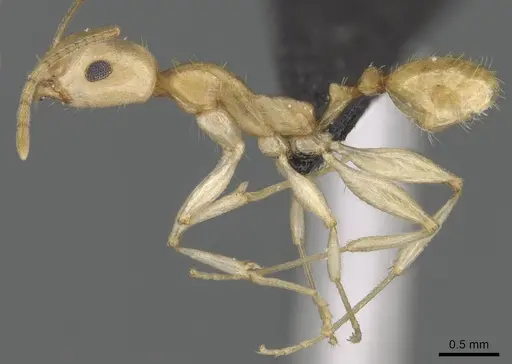
Royidris etiolata is a tiny myrmicine ant endemic to Madagascar. Workers measure 3.5-4.2 mm in total length . They are recognized by their extremely long scapes (the first segment of the antenna), which give them a distinctive slender appearance. Compared to their close relative Royidris notorthotenes, the sides of the head taper sharply behind the eyes . This species was described in 2014 and is only known from the worker caste, queens and males have never been collected. It belongs to the genus Royidris, a group of Madagascan endemics within the tribe Crematogastrini.
Quick Summary
- Difficulty: Unknown, limited data available
- Origin & Habitat: Endemic to southwestern Madagascar, specifically the Mahafaly Plateau near Itampolo in Toliara Province. They nest under stones in spiny forest, a hot, dry, thorny habitat typical of arid regions [1].
- Colony Type: Unknown colony structure, only workers have been collected. No queens or colony structure data available [1].
- Size & Growth:
- Queen: Unknown, queen caste not yet described
- Worker: 3.5-4.2 mm total length [1]
- Colony: Unknown, no colony size data available
- Growth: Unknown
- Development: Unknown, development has not been studied (No data on egg‑to‑worker development exists. Related Crematogastrini species typically develop in 4-8 weeks at optimal temperatures, but this is unconfirmed.)
- Antkeeping:
- Temperature: Based on the spiny forest habitat: keep warm, roughly 24-28 °C, with a gradient so ants can choose their preferred spot [1].
- Humidity: Low to moderate, spiny forest is dry. Keep the nest substrate mostly dry with only a small moist zone for drinking [1].
- Diapause: Unknown, likely minimal or no true diapause given Madagascar’s tropical climate, though some seasonal slowdown may occur.
- Nesting: In nature they nest under stones in soil. A test‑tube setup or a small terrarium with a layer of soil and a flat stone on top should work well. Provide ground contact and small chambers.
- Behavior: Behavior is unstudied. Based on genus and habitat, they are likely ground‑nesters active in warm conditions. Their long antennae probably help them find food in sparse, arid environments. As a member of the tribe Crematogastrini, they likely use a smearing defense: a modified stinger that wipes venom onto enemies rather than piercing. Escape risk is moderate given their small 3.5-4.2 mm size, standard escape prevention is recommended.
- Common Issues: no verified care data exists, most husbandry is guesswork based on habitat., no queens have been described, so captive propagation is currently impossible., likely sensitive to excess humidity and poor ventilation given their dry natural habitat., small size (3.5-4.2 mm) means fine mesh is needed to prevent escapes., rarely available in the hobby and difficult to obtain legally (endemic to Madagascar).
Natural History and Distribution
Royidris etiolata is known only from the Mahafaly Plateau in southwestern Madagascar, specifically near Itampolo in Toliara Province, at about 80 m elevation [1]. The area is dominated by spiny forest, a dry ecosystem with thorny vegetation adapted to arid conditions. Workers were collected under stones, suggesting they nest in soil beneath surface cover rather than in wood or complex galleries. The species was described in 2014 by Barry Bolton and Brian Fisher as part of a revision of Madagascan myrmicine ants related to Eutetramorium [1]. Only the worker caste has ever been found, queens and males remain unknown [1].
Identification and Related Species
Royidris etiolata belongs to the notorthotenes species group within the genus Royidris [1]. It is most closely related to Royidris notorthotenes, but can be told apart by its extremely long scapes and more slender build. In full‑face view, the sides of the head behind the eyes converge strongly, making the back of the head appear shorter and narrower than in R. notorthotenes [1]. The genus Royidris includes several other Madagascan endemics, all small myrmicines in the tribe Crematogastrini.
Housing and Nesting
In the wild, Royidris etiolata nests under stones in spiny‑forest soil [1]. This suggests they prefer ground contact and relatively dry conditions, with only small moist spots for drinking. For captive care, a test‑tube setup works for starting a colony (if you have workers from a wild collection), while a small naturalistic terrarium with a layer of soil and a flat stone on top mimics their natural home. Because workers are only 3.5-4.2 mm, make sure chambers and passages are appropriately small. Avoid keeping them constantly wet, aim for a mostly dry nest with one humid corner.
Care Recommendations
Since Royidris etiolata is rarely kept and poorly studied, these tips are based on its spiny‑forest habitat [1]. Keep the setup warm, around 24-28 °C, with a temperature gradient. Humidity should be low to moderate, think dry forest floor, not rainforest. Offer a varied diet: small protein sources like fruit flies or tiny crickets, and sugar water or honey. Their tiny size means you need fine mesh for escape prevention. Start with modest expectations, this species is new to the hobby, and individual colonies may have specific needs not yet understood.
Availability and Acquisition
Royidris etiolata is not a common ant in the hobby. It was described only in 2014 and has a very limited range in southwestern Madagascar [1]. Because the queen caste has never been found, colonies cannot be founded from a single queen. Any existing captive groups are likely wild‑caught workers. If you obtain this species, it is a rare opportunity to study an almost unknown Madagascan endemic. Record your observations, every data point on behavior, diet, and colony development helps fill gaps in our knowledge.
Frequently Asked Questions
How big do Royidris etiolata ants get?
Workers are tiny, measuring 3.5-4.2 mm in total length [1].
Where does Royidris etiolata live?
This species is endemic to southwestern Madagascar, specifically the Mahafaly Plateau near Itampolo. They live in spiny forest, a hot, dry habitat with thorny vegetation [1].
What do Royidris etiolata ants eat?
Their exact diet is unstudied. Offer small protein sources like fruit flies or tiny insects, along with sugar water or honey.
Can I keep Royidris etiolata in a test tube?
Yes, a test‑tube setup should work well for this species. They nest under stones in soil in the wild, so they may appreciate some soil substrate and a stone or other cover in their outworld [1].
Do Royidris etiolata ants need hibernation?
Probably not. Madagascar has a tropical climate without true winters, so this species likely does not require diapause. Some seasonal slowdown may occur during cooler months.
How long do Royidris etiolata workers live?
Worker lifespan is unknown, no studies have examined this species’ longevity.
Are Royidris etiolata good for beginners?
This species is not recommended for beginners. It is rarely available, poorly studied, and the queen has not been described, making captive breeding impossible.
Do Royidris etiolata ants sting?
They have a stinger, but as a member of the tribe Crematogastrini it is modified for smearing venom rather than piercing. Given their tiny size, any sting would be very mild.
Why are Royidris etiolata antennae so long?
Their extremely long scapes are a key identifying feature [1]. This likely helps them locate food and navigate in the sparse, arid spiny‑forest environment.
How do I set up a Royidris etiolata colony?
Since wild colonies consist only of workers (queens unknown), you would need to collect workers from Madagascar. House them in a small test‑tube setup or naturalistic terrarium with dry soil and a stone cover. Keep the temperature at 24-28 °C and provide low to moderate humidity.
Report an Issue
The current care sheet is based fully on literature. See inconsistencies, or something that's incorrect? Please , it will be resolved after review from an admin. Contributing to the blogs tab also helps providing information, to make us be able to further improve the caresheets. Thank you for your support!
References

This caresheet is licensed under CC BY-SA 4.0 .
Community Blogs
CASENT0002370
View on AntWeb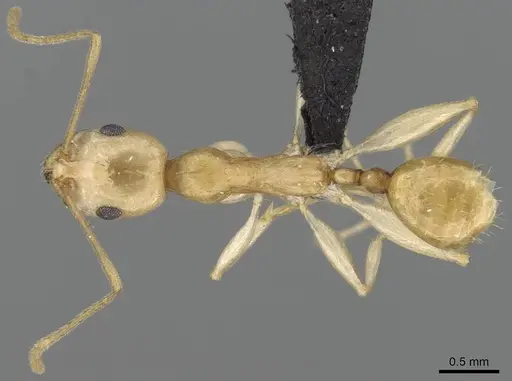
Literature
Loading distribution map...Loading products...