
Royidris admixta
- Sci. Name
- Royidris admixta
- Tribe
- Crematogastrini
- Subfamily
- Myrmicinae
- Author
- Bolton & Fisher, 2014
- Distribution
- Found in 1 countries
Introduction
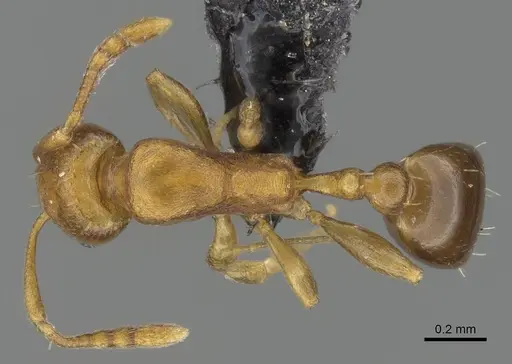
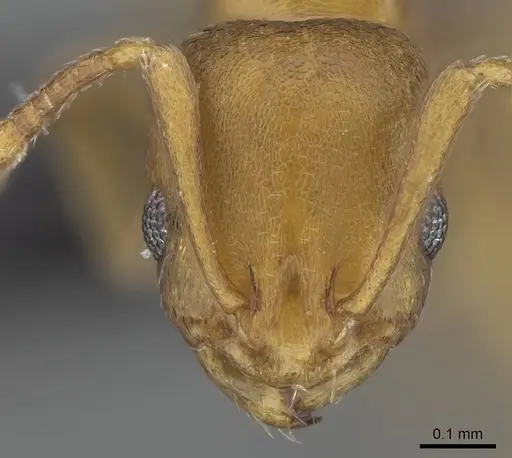
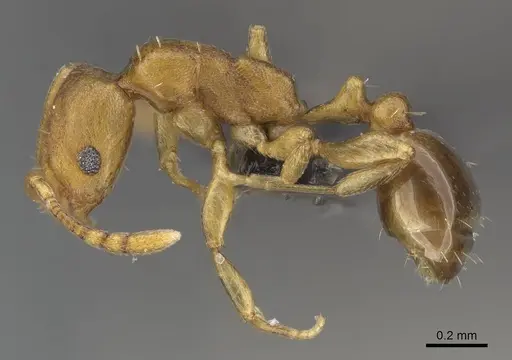
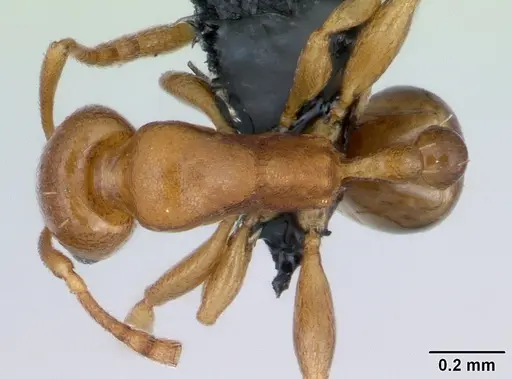
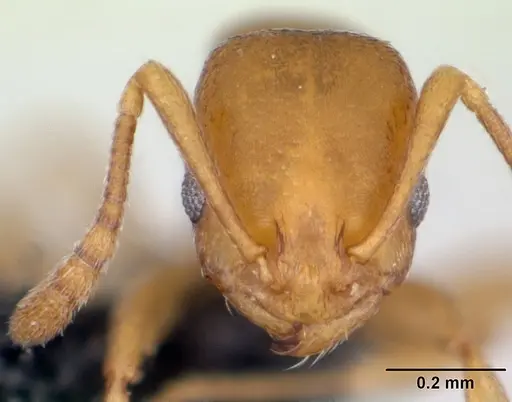
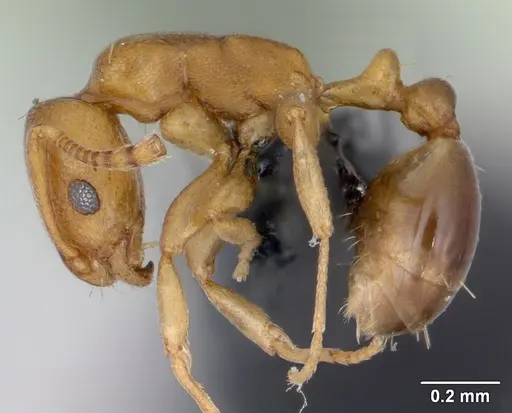
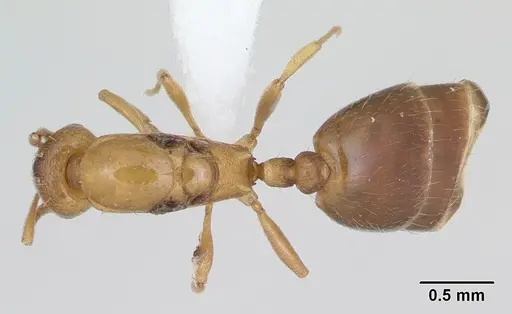
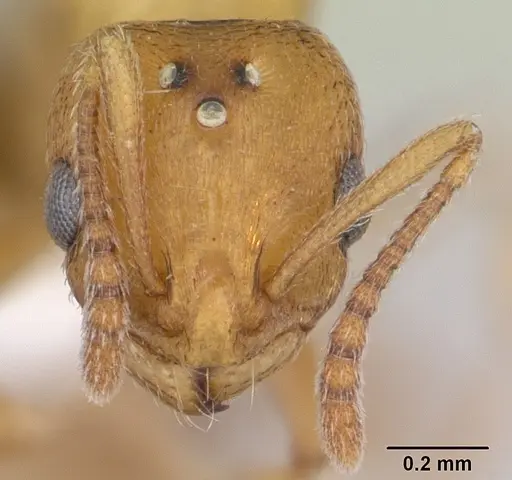
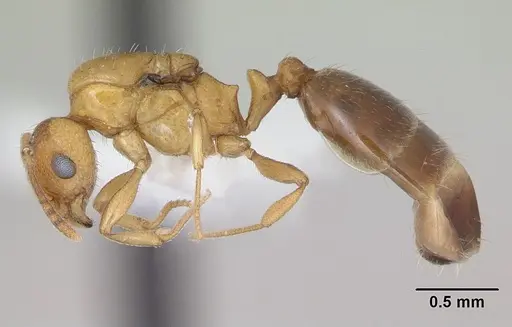
Royidris admixta is a tiny ant endemic to Madagascar, with workers measuring 1.8-2.3 mm and queens 3.9-4.1 mm . Workers are dull yellow to yellowish brown with a 3‑segmented antennal club and short scapes. They are very similar to Royidris depilosa, but you can tell them apart by the setae at the pronotal humeri and the entirely sculptured head and mesosoma . These ants live in the leaf litter layer of spiny forest and tropical dry forest in southern Madagascar, where they nest in rotten logs and among sifted litter .
Quick Summary
- Difficulty: Expert
- Origin & Habitat: Endemic to Madagascar. Found in spiny forest and tropical dry forest in the southern provinces, living in leaf litter and rotting wood [1][2].
- Colony Type: Unconfirmed, no published data on queen number or social structure.
- Size & Growth:
- Queen: 3.9-4.1 mm [1]
- Worker: 1.8-2.3 mm [1]
- Colony: Unknown, no published colony size data.
- Growth: Unknown, no data available.
- Development: Unknown. Based on typical small Myrmicinae, expect roughly 6-10 weeks at optimal temperature, but this is unconfirmed. (Development has not been directly studied. Estimates are based on genus‑level patterns for tiny litter‑dwelling Myrmicinae.)
- Antkeeping:
- Temperature: Keep between 24-28°C. These are tropical forest ants from Madagascar and need steady warmth. A gentle gradient is helpful, but avoid drops below 18°C [1].
- Humidity: Keep the nest substrate lightly moist but not waterlogged. Their natural habitat (spiny forest and tropical dry forest) has moderate humidity, so aim for a balance, not too wet, not bone dry [1][2].
- Diapause: No true diapause, these ants come from tropical Madagascar. Maintain warm conditions year‑round.
- Nesting: Start with a test‑tube setup (small water reservoir, tight cotton plug). For larger colonies, use a small Y‑tong (aerated concrete) or plaster nest with narrow chambers (3-5 mm wide). Add some decaying wood or leaf litter to the outworld to mimic their natural habitat. Never use acrylic nests [1][2].
- Behavior: Royidris admixta is docile and shy. Because of their tiny size (workers under 2.5 mm), they pose no meaningful sting threat, their defense is smearing venom, which is harmless to humans. They forage individually through leaf litter. Excellent escape prevention is essential, they can squeeze through standard mesh. Use fine mesh (0.5 mm or smaller) and fluon barriers.
- Common Issues: tiny size makes escape likely without ultra‑fine mesh and tight seals, use fluon and inspect all gaps, no published care data, you will need to experiment with diet, humidity, and nesting, colony growth may be very slow, and small colony size can be unsatisfying for some keepers, humidity balance is tricky: too wet causes mold, too dry stresses the colony, feeding tiny prey (fruit flies, springtails) is necessary, larger prey may be ignored or rot
Housing and Nest Setup
Because Royidris admixta workers are only 1.8-2.3 mm, you need appropriately scaled housing. A test‑tube setup with a small water reservoir works well for founding colonies. Make sure the cotton plug is packed tight, these tiny ants can squeeze through gaps that larger ants cannot. For established colonies, a small Y‑tong (aerated concrete) or plaster nest with narrow chambers (about 3-5 mm wide) prevents workers from getting lost in oversized spaces. The outworld should be simple and easy to clean. Add a layer of moist substrate (coco fiber or soil) to maintain moderate humidity. Escape prevention is critical, apply fluon to all edges and use fine mesh (0.5 mm or smaller) on any ventilation holes [1].
Feeding and Diet
There is no published data on the diet of Royidris admixta. Based on their tiny size and leaf‑litter lifestyle, they likely hunt tiny arthropods like springtails, mites, and small fly larvae. In captivity, offer flightless fruit flies (Drosophila), pinhead crickets, or small mealworms. You can also try sugar water or honey, but acceptance is unconfirmed. Offer small live prey once or twice a week and remove uneaten food within 24 hours to prevent mold. Because their natural diet is unknown, expect some trial and error, observe which items they accept and adjust accordingly.
Temperature and Seasonal Care
As tropical ants from Madagascar, Royidris admixta needs steady warmth. Keep temperatures between 24-28°C. A heating cable on one side of the nest creates a gentle gradient, letting the ants choose their preferred spot. Because they come from a tropical climate, they do not require a winter diapause. Avoid temperatures below 18°C or above 32°C. If your home is cool, use a heat mat on a thermostat. Monitor activity, if workers become sluggish, slightly increase temperature [1].
Colony Establishment
Since founding behavior is undocumented, you will need to be patient and observant. If you obtain a founding queen (3.9-4.1 mm), place her in a test tube with a water reservoir and keep it dark and quiet at around 26°C. Do not disturb her for several weeks. Because we do not know if she founds claustrally or semi‑claustrally, offer a small prey item (like a fruit fly) after about two weeks, if she takes it, she is semi‑claustral, if she ignores it, she may be claustral. The first nanitic workers will be extremely small. Colony growth is expected to be slow, do not expect rapid expansion. [1]
Handling and Observation
These tiny ants are docile and shy. Their defense is smearing venom (not a sting), but they are far too small to harm you. Use a magnifying glass or macro lens for good observation, they are hard to see with the naked eye. When cleaning or moving the colony, use extreme care because the ants are fragile. They will retreat into the nest when disturbed. To encourage natural foraging, provide a thick layer of leaf litter in the outworld and keep the area dimly lit. Disturb the nest as little as possible [1][2].
Frequently Asked Questions
How long does it take for Royidris admixta to raise their first workers?
The exact time is unknown, no scientific study has measured it. Based on patterns in other small Myrmicinae, expect roughly 6-10 weeks from egg to worker at 26°C, but this is an estimate. Be patient.
What do Royidris admixta ants eat?
Their diet is unconfirmed. Based on their tiny size and litter‑dwelling habits, they likely eat small arthropods like springtails, fruit flies, and mite‑sized prey. In captivity, offer flightless fruit flies, pinhead crickets, or small mealworms. Sugar water or honey may be accepted experimentally. Start with small live prey and observe what they take.
Can I keep Royidris admixta in a test tube?
Yes, a test‑tube setup is ideal for this species. Use a small water reservoir and pack the cotton plug tightly, they can squeeze through tiny gaps. Keep the tube dark and quiet during founding. For larger colonies, upgrade to a small Y‑tong or plaster nest with narrow chambers.
Do Royidris admixta ants sting?
They belong to the Myrmicinae subfamily and have a modified stinger used for smearing venom, not piercing. Because workers are only 1.8-2.3 mm, any defense is negligible to humans. They are docile and not aggressive.
Are Royidris admixta good for beginners?
No, this species is best for experienced keepers. There is almost no published care information, and their tiny size demands meticulous escape prevention and specialized feeding. Beginners may find the slow growth and experimental husbandry frustrating. If you are experienced with small Myrmicinae and enjoy troubleshooting, it could be rewarding.
What temperature do Royidris admixta need?
Keep them warm at 24-28°C. They are tropical ants from Madagascar and need consistent warmth. No winter diapause is needed. Avoid temperatures below 18°C. A heating cable on one side of the nest creates a useful gradient.
How big do Royidris admixta colonies get?
The maximum colony size is unknown, no data exists. Based on their small worker size and litter‑dwelling habits, colonies are probably modest (perhaps under a few hundred workers). Expect slow growth and a small colony.
Do Royidris admixta need hibernation?
No, they are tropical and do not require hibernation or a cooling period. Keep them warm year‑round. A slight seasonal temperature drop is not necessary and could be harmful if it goes below 18°C.
Why are my Royidris admixta escaping?
Their tiny size (workers under 2.5 mm) lets them slip through standard barriers. Apply fluon to all surfaces, use tight‑fitting lids, and ensure any ventilation has mesh of 0.5 mm or smaller. Check for gaps around tube plugs or nest connections. Excellent escape prevention is mandatory.
Report an Issue
The current care sheet is based fully on literature. See inconsistencies, or something that's incorrect? Please , it will be resolved after review from an admin. Contributing to the blogs tab also helps providing information, to make us be able to further improve the caresheets. Thank you for your support!
References

This caresheet is licensed under CC BY-SA 4.0 .
Community Blogs
Literature
Loading distribution map...Loading products...