
Recurvidris recurvispinosa
- Sci. Name
- Recurvidris recurvispinosa
- Tribe
- Crematogastrini
- Subfamily
- Myrmicinae
- Author
- Forel, 1890
- Distribution
- Found in 8 countries
Introduction
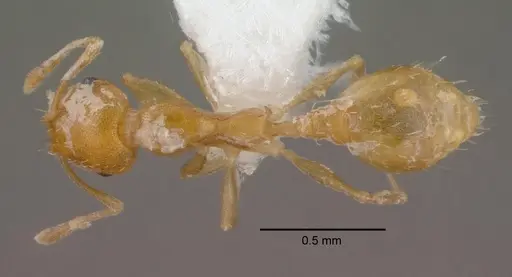
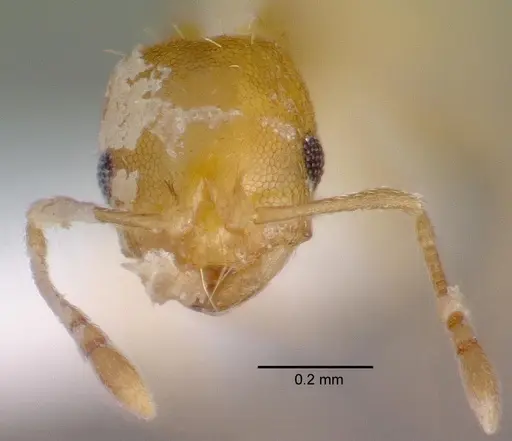
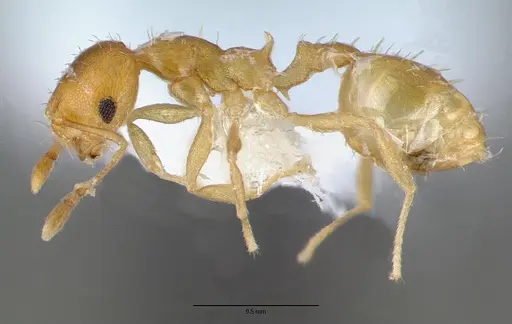
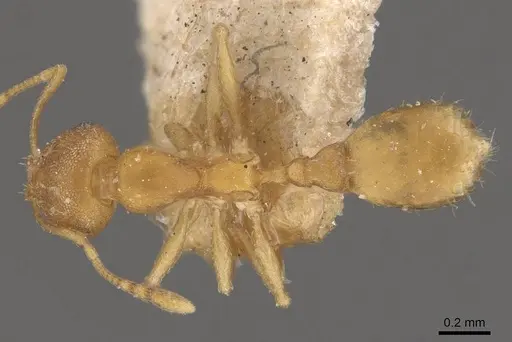
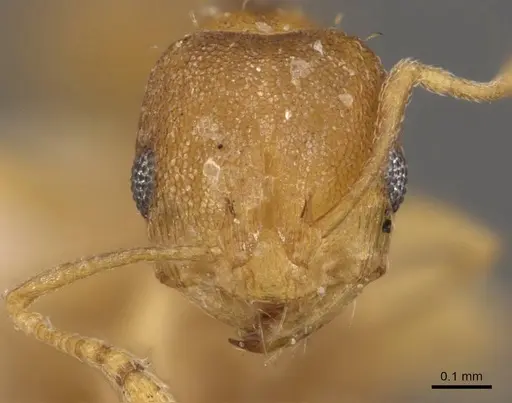
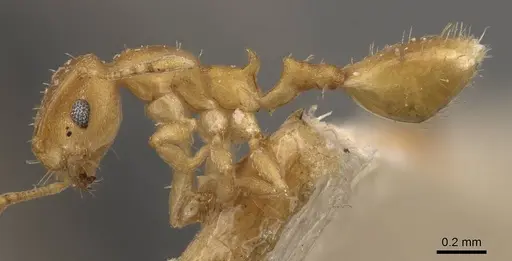
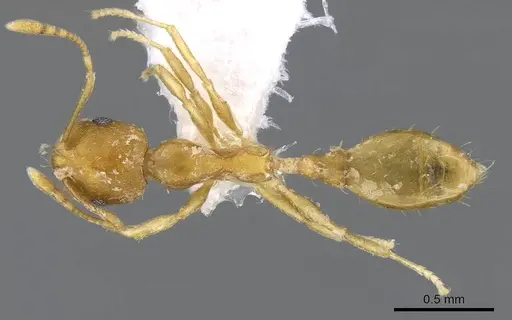
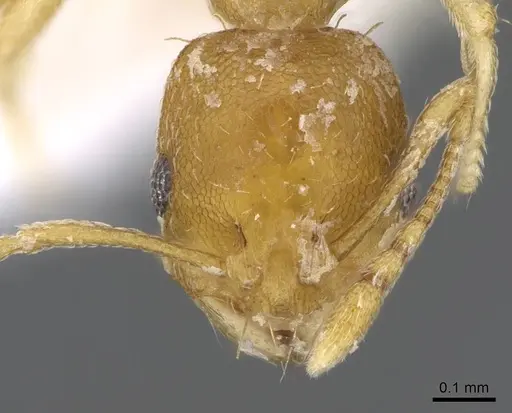
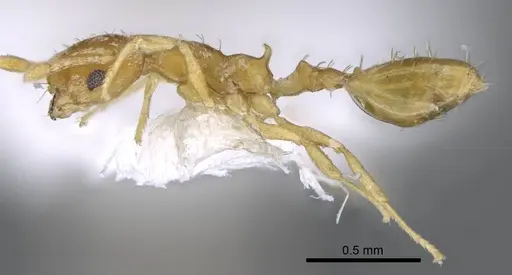
Recurvidris recurvispinosa is a tiny myrmicine ant with worker total length of 1.70-2.10 mm and a yellow to yellowish-brown body color . Its most distinctive feature is the pair of forward-curving propodeal spines, which give the species its name . Workers have four sharp teeth on their mandibles, with the basal tooth enlarged and split into two points . The head is slightly longer than broad with a nearly straight rear edge, and the body is covered in fine, dense punctures that create a matte appearance . This is the most widely distributed species in the genus Recurvidris, found across South Asia, Southeast Asia, and into East Asia . In the wild, they hunt small soil arthropods - researchers found a springtail (Sminthurides parvulus) clamped in a worker’s mandibles, confirming they are predators of micro-arthropods in leaf litter and soil .
Quick Summary
- Difficulty: Medium
- Origin & Habitat: Native to South and Southeast Asia, ranging from India through China, Taiwan, Japan, Thailand, and Laos [1][3]. In Thailand they inhabit dry evergreen forest, mixed deciduous forest, and dry dipterocarp forest [1]. In Japan they are rarely encountered, nesting in soil or under stones in forests and forest margins [3]. Recorded from 14 Indian states from the Himalayas to the south [4].
- Colony Type: Colony structure is unconfirmed, the number of queens and colony organization have not been documented. Workers are found in leaf litter and soil, a single colony was collected by sifting leaf litter in Thailand [1].
- Size & Growth:
- Queen: ~2 mm [5], estimated from a single queen measurement.
- Worker: 1.70-2.10 mm [1][2]
- Colony: Unknown, likely up to a few hundred workers based on typical leaf‑litter ant patterns.
- Growth: Unknown, estimated moderate based on similar small Myrmicinae.
- Development: Estimated 6-8 weeks at 22-26°C based on typical patterns for small Myrmicinae, unconfirmed. (Development time is not directly studied for this species. The estimate above is inferred from related ants.)
- Antkeeping:
- Temperature: Aim for 22-26°C as a starting range. Their distribution across tropical Thailand and subtropical Japan/China suggests they prefer warm conditions. Avoid temperatures below 18°C or above 30°C.
- Humidity: Moderate to high, they live in forest floor leaf litter and soil. Keep the nest substrate consistently moist but not waterlogged, and provide a moisture gradient so ants can choose.
- Diapause: Unknown. Their range includes subtropical Japan with mild winters, but specific overwintering behavior has not been documented. If keeping colonies from temperate areas, consider a mild cooling period (15-18°C) for 2-3 months, but this likely is not necessary for tropical populations.
- Nesting: Naturally nests in soil or under stones in forests [3]. In captivity, a naturalistic setup with moist soil and leaf litter works well, or a Y‑tong/plaster nest with small chambers scaled to their 2 mm size.
- Behavior: These are small, cryptic ants that forage in leaf litter and soil. They are predatory on tiny arthropods like springtails and mites [2]. Workers are not aggressive and rely on their small size and secretive habits. As a Myrmicinae in the tribe Crematogastrini, they have a modified, spatulate stinger used to smear venom onto enemies rather than pierce, but due to their tiny size, stinging is not a concern for keepers. Escape prevention is critical because they can slip through standard test tube barriers, use fine mesh and tight lids. They are rarely seen in the open, so low activity is normal.
- Common Issues: escape prevention is critical due to tiny 2 mm size, they easily slip through standard barriers., predatory diet requires live small prey (springtails, micro‑mites) which can be difficult to culture., secretive nature means low observable activity, beginners may think the colony is dead., wild‑caught colonies may carry parasites from the leaf litter environment., slow growth and small colony sizes require patience.
Housing and Nest Setup
Recurvidris recurvispinosa is a tiny ant that needs appropriately scaled housing. In the wild, they nest in soil or under stones in forests [3]. For captivity, a naturalistic setup with a moist soil and leaf litter mixture works best, this mimics their natural forest floor habitat and provides hunting grounds for their predatory lifestyle. Alternatively, a Y‑tong (AAC) or plaster nest with small, tight chambers can work, but chambers must be sized for their 2 mm bodies. Because they are so small, standard test tube setups may allow escapes, use fine mesh barriers and check all connections regularly. The nest area should be kept humid but allow a moisture gradient so ants can self‑regulate.
Feeding and Diet
These ants are predatory on small arthropods. In the wild, researchers found a springtail (Sminthurides parvulus) in a worker's mandibles, confirming they hunt micro‑arthropods in leaf litter and soil [2]. In captivity, their primary food should be live small prey such as springtails, tiny soil mites, and other micro‑arthropods. They are unlikely to accept larger prey items. Sugar sources may be accepted occasionally but should not be the primary food, their natural diet is protein‑based. Feed small prey every 2-3 days, adjusting based on colony consumption. Remove uneaten prey to prevent mold.
Temperature and Seasonal Care
Based on their distribution across tropical Thailand and subtropical regions of Japan, China, and Taiwan, these ants prefer warm conditions. Aim for 22-26°C. In Thailand, they occur north of the Isthmus of Kra in dry evergreen, mixed deciduous, and dry dipterocarp forests [1]. In Japan, they are found only on Ishigaki and Iriomote Islands, which have a subtropical climate [3]. Avoid temperatures below 18°C or above 30°C. Overwintering requirements are unknown, if you have colonies from temperate zones, consider a mild cool period (15-18°C) for 2-3 months in winter, but this probably isn't needed for tropical populations.
Behavior and Observation
Recurvidris recurvispinosa is a secretive, cryptic species rarely encountered in the wild [3]. Workers forage in leaf litter and soil rather than on open surfaces. They are not aggressive and rely on their small size and secretive habits. As a member of tribe Crematogastrini, they have a modified stinger used to smear venom rather than pierce, but stinging is not a concern for keepers. Colonies are small, and you will not see dramatic foraging trails. Activity levels are typically low, do not be alarmed if workers spend most of their time hidden in the nest or leaf litter. Observation is best done with magnification, as their defining features (curved propodeal spines, four‑toothed mandibles) are small‑scale characteristics.
Finding and Collecting
This species is rarely encountered and considered rare in Japan [3]. In Thailand, all specimens have been collected from the forest floor, with single colonies found by sifting leaf litter [1]. They are distributed across 14 Indian states [4] and recorded from forests in China, Nepal, Myanmar, Laos, Taiwan, and Sri Lanka. To find them in the wild, focus on moist forest floor habitats with accumulated leaf litter. Use sifting methods to collect leaf litter samples and look for tiny yellow ants. They are easily overlooked due to their small size.
Identification Tips
Recurvidris recurvispinosa can be identified by: tiny size (1.70-2.10 mm), yellow to yellowish‑brown color, and most distinctively, the propodeal spines that curve forward (recurved) rather than backward [1]. Workers have four teeth on the mandibles, with the basal (fourth) tooth enlarged and having two tips (bidenticulate) [1]. The head is slightly longer than broad with a nearly straight rear margin. The mesosoma has fine reticulate‑punctate sculpture. They are closely related to Recurvidris hebe from Sulawesi, but differ in having shorter, stouter propodeal spines and petiolar peduncle [1]. Under magnification, the curved spines are the most obvious diagnostic feature.
Frequently Asked Questions
How long does it take for Recurvidris recurvispinosa to develop from egg to worker?
The exact development time is unconfirmed. Based on typical patterns for small Myrmicinae in tropical/subtropical conditions, estimate roughly 6-8 weeks from egg to first worker at optimal temperatures (22-26°C). This is an educated guess, not a documented timeline.
What do Recurvidris recurvispinosa eat?
They are predators of small arthropods. In the wild, they hunt springtails and other micro‑arthropods in leaf litter and soil [2]. In captivity, feed them live springtails, tiny soil mites, and other small live prey. Sugar sources may be accepted occasionally but should not be the primary food.
Can I keep Recurvidris recurvispinosa in a test tube setup?
You can use a test tube setup, but escape prevention is critical due to their tiny 2 mm size. Standard test tube barriers may not be sufficient, use fine mesh and check all connections regularly. A naturalistic setup with moist soil and leaf litter is actually preferable, as it mimics their natural forest floor habitat and provides hunting grounds.
Do Recurvidris recurvispinosa ants sting?
As a Myrmicinae ant in tribe Crematogastrini, they have a modified stinger used to smear venom rather than pierce. Due to their tiny size and secretive nature, stinging is not a concern for keepers. They are not aggressive and rarely come to open areas.
Are Recurvidris recurvispinosa good for beginners?
Rated Medium difficulty. They are not ideal for complete beginners because of their specific predatory diet (live micro‑prey), tiny size making escape prevention tricky, and secretive low‑activity behavior that may cause concern. They require more specialized care than common beginner species like Lasius or Camponotus.
How big do Recurvidris recurvispinosa colonies get?
Colony size is not well documented. Based on typical patterns for small leaf‑litter ants, colonies likely reach a few hundred workers at most. They are secretive ants with low activity levels, so large, visible colonies should not be expected.
Do Recurvidris recurvispinosa need hibernation?
Diapause requirements are unknown. Their range includes subtropical Japan with mild winters, but specific overwintering behavior has not been documented. If keeping colonies from temperate parts of their range, consider providing a mild cool period (15-18°C) for 2-3 months. For tropical populations (Thailand, India), hibernation is likely not necessary.
Why are my Recurvidris recurvispinosa not foraging much?
This is normal behavior. They are secretive, cryptic ants that forage within leaf litter and soil rather than on open surfaces [3]. Low activity is typical for the species, they are not aggressive foragers like larger ant species. Make sure they have appropriate prey available and that the setup provides a humid leaf litter layer for hunting.
When should I move Recurvidris recurvispinosa to a formicarium?
Given their small size and natural habitat in soil/leaf litter, a naturalistic setup is often best from the start. If using a formicarium, wait until the colony has at least 20-30 workers and is actively foraging. The transition should be gradual, and the formicarium must have appropriately scaled chambers and excellent escape prevention.
Where is Recurvidris recurvispinosa found in the wild?
They are found across South and Southeast Asia: India, Nepal, Myanmar, Laos, Thailand, China, Taiwan, and Japan [1][3]. In Thailand, they inhabit various forest types north of the Isthmus of Kra [1]. In Japan, they are only recorded on Ishigaki and Iriomote Islands in the Yaeyama group [3]. They live in forest floor leaf litter and soil.
Report an Issue
The current care sheet is based fully on literature. See inconsistencies, or something that's incorrect? Please , it will be resolved after review from an admin. Contributing to the blogs tab also helps providing information, to make us be able to further improve the caresheets. Thank you for your support!
References

This caresheet is licensed under CC BY-SA 4.0 .
Community Blogs
Literature
Loading distribution map...Loading products...