
Protanilla schoedli
- Sci. Name
- Protanilla schoedli
- Tribe
- Leptanillini
- Subfamily
- Leptanillinae
- Author
- Baroni Urbani & De Andrade, 2006
- Distribution
- Found in 1 countries
Introduction
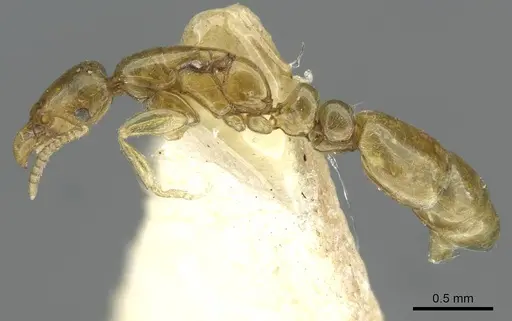
Protanilla schoedli is a tiny subterranean ant species from Sri Lanka, measuring up to 2.8 mm for workers and 3.75 mm for queens . The body is smooth and shiny, colored yellowish-brown to reddish-brown, with short appressed hairs and sparse longer suberect hairs across the body . This species holds special significance in ant taxonomy as it was the first Protanilla species known from a queen with eyes and wings - primitive traits not seen in the related genus Leptanilla, which has dichthadiiform queens (blind, wingless) . The genus Protanilla belongs to the Leptanillinae subfamily, a group of rarely collected subterranean ants known for their predatory habits . Workers have a well-developed sting, though given their tiny size, it poses minimal threat to humans .
Quick Summary
- Difficulty: Hard
- Origin & Habitat: Sri Lanka, specifically found in Sabaragamuwa Province (Ratnapura District: Pompekelle, Gilimale Forest Reserve, Sinharaja Forest Reserve) and North Central Province (Anuradhapura Sanctuary) [2]. They appear to inhabit forested areas in Sri Lanka's tropical environment.
- Colony Type: Colony structure is unconfirmed. The species was originally described from a single dealate queen, and the worker caste was only discovered and described in 2019 [1][2]. No data exists on whether colonies are single-queen or multi-queen.
- Size & Growth:
- Queen: 3.75 mm total length [1]
- Worker: up to 2.8 mm total length [2]
- Colony: Unknown, colony size has not been documented
- Growth: Unknown, no development data available
- Development: Unknown, no direct measurements exist. Based on typical Leptanillinae patterns, development is likely several months, but this is an estimate. (No published data on egg-to-worker development time. Related Leptanillinae species suggest slow development typical of subterranean predators.)
- Antkeeping:
- Temperature: Temperature needs are unclear, start around 24-26°C based on Sri Lanka's tropical climate [2].
- Humidity: Humidity needs are unclear, keep substrate consistently moist but not waterlogged based on their forest habitat [2].
- Diapause: Diapause needs are unclear, Sri Lanka has a tropical climate with year-round warm temperatures, so diapause may not be required [2].
- Nesting: Nesting preferences are unclear, Leptanillinae typically nest in soil or rotting wood underground [1]. Given their tiny size, they need very small chambers and narrow passages.
- Behavior: Behavior is poorly documented. Workers are tiny and have a well-developed sting [2]. As Leptanillinae, they are likely predatory on small soil micro-arthropods [1]. Their small size means escape prevention must be excellent. They are likely shy and non-aggressive, preferring to avoid confrontation rather than engage. Activity level is unknown but likely low, typical of subterranean ants.
- Common Issues: lack of captive husbandry data makes it difficult to prevent colony death, tiny size makes escape likely without fine mesh barriers, predatory diet may be difficult to replicate, may require live micro-prey, growth rate is unknown, making it hard to track colony health, no data on founding behavior or queen requirements, humidity requirements are unconfirmed, trial and error may be needed
Species Discovery and Taxonomic Significance
Protanilla schoedli was first described in 2006 by Baroni Urbani and De Andrade from a single dealate queen collected in Sri Lanka in 1970 [1]. This species is particularly significant because the queen possesses eyes and wings, two primitive traits that distinguish Protanilla from the related genus Leptanilla, whose queens are blind and wingless [1]. The worker caste was not discovered until 2019,when specimens were collected across multiple locations in Sri Lanka, including the Sinharaja Forest Reserve and Anuradhapura Sanctuary [2]. The discovery of the worker caste confirmed the association with the original queen based on type locality and morphological similarity [2]. This species represents a considerable extension of the previously known distribution of the genus Protanilla, which was previously known only from the Oriental region [1].
Distribution and Habitat
Protanilla schoedli is known only from Sri Lanka, making it an endemic species to the island [2]. Specimens have been collected from multiple locations across two provinces: Sabaragamuwa Province in the Ratnapura District (Pompekelle, Gilimale Forest Reserve, and Sinharaja Forest Reserve) and North Central Province in the Anuradhapura Sanctuary [2]. The original type specimen was collected from Inginiyagala in the Uva region of Sri Lanka in February 1970 [1]. The species shows within-species morphological variation in body size, petiolar shape, and color across its range [2]. The workers exhibit variation where lighter coloration correlates with smaller body size, and larger workers have more developed postpetiolar sternite structures [2].
Morphology and Identification
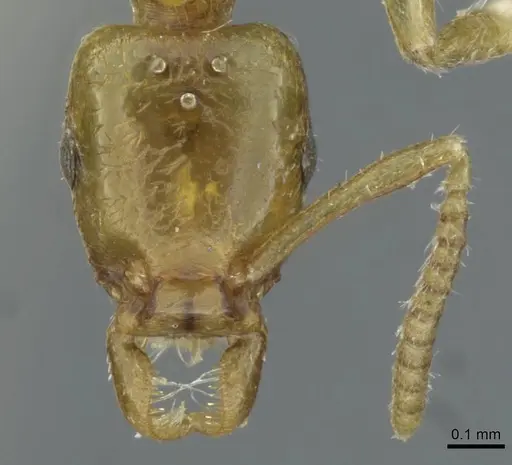
Workers measure up to 2.8 mm in total length, making them among the smaller ant species [2]. The body is smooth and shiny, covered with abundant erect to suberect hairs and decumbent pubescence, with particularly dense pubescence on the head dorsum [2]. Body coloration ranges from yellowish-brown to reddish-brown, with lighter coloring on the mandibles, antennae, legs, and gastral apex [2]. The head is longer than broad in full face view, narrowed anteriorly, with a nearly straight posterior margin and rounded posterolateral corners [2]. The mandibles are elongate triangular with a downwardly curved apex and bear 14 peg-like teeth along the masticatory margin [2]. Antennae are 12-segmented, with the scape reaching the posterolateral corner of the head and the flagellum weakly incrassate toward the apex [2]. A well-developed sting is present, though given the tiny size, it poses minimal danger to humans [2]. Queens are larger at 3.75 mm total length, light yellowish-brown in color, with the characteristic Leptanillinae morphology including large compound eyes and small ocelli [1].
Care Recommendations
Since Protanilla schoedli has never been kept in captivity and has no published husbandry data, all care recommendations are estimates based on the species' biology and related ant behavior. As a subterranean ant from tropical Sri Lanka, they likely prefer warm temperatures around 24-26°C and moderate to high humidity. A naturalistic setup with moist substrate would be most appropriate, Leptanillinae typically nest in soil or rotting wood underground. Given their tiny worker size of just up to 2.8 mm, they require very small nest chambers and narrow passages scaled to their diminutive size. Escape prevention is critical due to their small size, use fine mesh and tight-fitting lids. As predators, they likely require live micro-prey such as springtails, but their exact diet is unknown. Sugar acceptance is also uncertain. Start with basic conditions and adjust based on colony behavior and survival. This species should be considered experimental in captivity, and any successful keeper should document their findings for the antkeeping community.
Related Species and Subfamily Context
Protanilla belongs to the subfamily Leptanillinae, a group of rarely collected subterranean ants distributed throughout the Oriental and South Palaearctic regions of Asia [1]. The genus Protanilla currently contains 12 valid species [3]. Unlike many ant genera, Leptanillinae are characterized by their unusual queen morphology, most have dichthadiiform queens (blind, wingless, and heavily sclerotized) that are rarely encountered. The discovery of Protanilla schoedli's winged queen with eyes was significant because it demonstrated that Protanilla retains the primitive condition of having normal winged queens, unlike Leptanilla which has evolved the derived dichthadiiform condition [1]. The related genus Yavnella was only recently identified from worker caste through phylogenomic inference, showing how little we know about this subfamily [4]. Many Leptanillinae species are known only from a handful of specimens collected over decades of fieldwork.
Frequently Asked Questions
How do I keep Protanilla schoedli ants?
No captive husbandry data exists for this species. Based on their biology as subterranean ants from tropical Sri Lanka, a naturalistic setup with moist substrate at around 24-26°C would be a reasonable starting point. This species should be considered experimental in the antkeeping hobby.
What do Protanilla schoedli ants eat?
Their exact diet is unknown. As Leptanillinae, they are likely predatory on small soil micro-arthropods [1]. Offer small live prey like springtails or micro-arthropods. Sugar acceptance is uncertain, offer sugar water or honey occasionally but do not rely on it.
How big do Protanilla schoedli colonies get?
Colony size is unknown, the species was only recently discovered (worker caste described in 2019) and no colony size data has been published.
Do Protanilla schoedli ants sting?
Yes, they have a well-developed sting [2]. However, given their tiny size (workers are only up to 2.8 mm), the sting is unlikely to penetrate human skin or cause any noticeable pain.
How long does it take for Protanilla schoedli to develop from egg to worker?
This is unknown, no development timing data exists for this species. Based on typical Leptanillinae patterns, development likely takes several months, but this is an estimate.
Where is Protanilla schoedli found?
This species is endemic to Sri Lanka, known from Sabaragamuwa Province (including Sinharaja Forest Reserve) and North Central Province (Anuradhapura Sanctuary) [2].
Are Protanilla schoedli good for beginners?
No. This species has no captive husbandry data and is one of the least-studied ants in the hobby. There are no established care guidelines, making it unsuitable for beginners. Consider starting with more established species like Lasius niger or Camponotus floridanus.
Do Protanilla schoedli need hibernation?
Unknown, no data exists. Sri Lanka has a tropical climate with year-round warm temperatures, so diapause may not be required. However, this has not been studied.
Can I keep multiple Protanilla schoedli queens together?
Unknown, colony structure (monogyne vs polygyne) has not been documented. Do not attempt combining unrelated queens without data on their social structure.
What makes Protanilla schoedli special?
This species was the first Protanilla queen discovered with eyes and wings, primitive traits that distinguish it from the related genus Leptanilla (which has blind, wingless queens). The worker caste was only described in 2019,making this one of the most recently discovered ant species in the hobby.
Report an Issue
The current care sheet is based fully on literature. See inconsistencies, or something that's incorrect? Please , it will be resolved after review from an admin. Contributing to the blogs tab also helps providing information, to make us be able to further improve the caresheets. Thank you for your support!
References

This caresheet is licensed under CC BY-SA 4.0 .
Community Blogs
CASENT0911228
View on AntWeb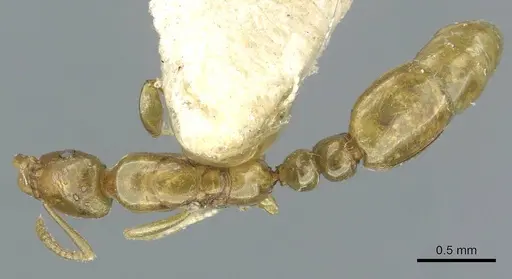
Literature
Loading distribution map...Loading products...