
Probolomyrmex maryatiae
- Sci. Name
- Probolomyrmex maryatiae
- Tribe
- Probolomyrmecini
- Subfamily
- Proceratiinae
- Author
- Eguchi <i>et al.</i>, 2006
- Distribution
- Found in 2 countries
Introduction
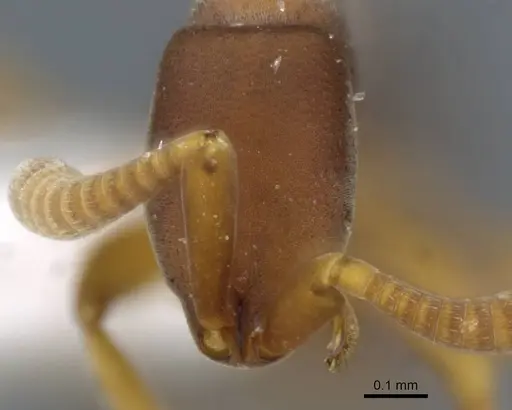
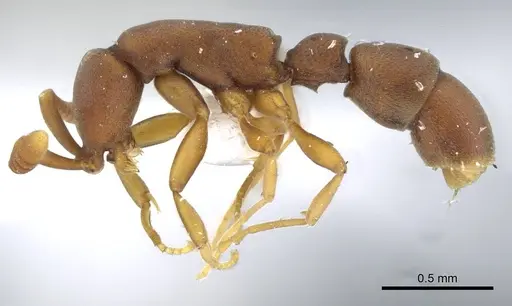
Probolomyrmex maryatiae is a tiny ant species from the rainforests of Borneo (Sabah and Sarawak). Workers are ferruginous brown and completely blind, with a distinctive petiole featuring projections underneath . This species belongs to the Proceratiinae subfamily and is morphologically similar to other Probolomyrmex species, with key differences in petiole shape . Only one colony has been documented, making it extremely rare in both wild and captive settings.
Quick Summary
- Difficulty: Expert
- Origin & Habitat: Borneo (Sabah and Sarawak, Malaysia) in the Indomalaya region, found in rainforest and wet forest habitats [1][2]
- Colony Type: Unknown, colony structure has not been documented, with only five workers from a single colony ever studied [1]
- Size & Growth:
- Queen: Size data unavailable, no queen has been documented [1]
- Worker: Size data unavailable, full body length not specified in research [1]
- Colony: Likely small, but unconfirmed, based on genus patterns for Proceratiinae
- Growth: Unknown
- Development: Unconfirmed, no development data exists for this species (Development timeline is completely unstudied)
- Antkeeping:
- Temperature: Inferred from rainforest habitat: keep warm and stable, roughly 24-28°C [2]
- Humidity: Keep substrate consistently moist but not waterlogged, based on wet forest habitat [2]
- Diapause: Unknown, Borneo has no true winter, so diapause may not be necessary [1]
- Nesting: Inferred from habitat: likely nests in soil or rotting wood, use small test tubes or tight chambers for their tiny size [2]
- Behavior: Behavior is completely unstudied. Based on Proceratiinae patterns, they are likely predatory and slow-moving. Escape prevention is critical due to their minute size. Sting ability is unconfirmed but likely present, though too small to affect humans.
- Common Issues: experimental care due to complete lack of biological data., escape risk is high due to tiny size, use fine mesh and tight seals., diet is unconfirmed, may refuse standard ant foods., colony growth is slow and size is small, requiring patience., queens are extremely rare in the hobby, wild capture may be necessary.
Discovery and Taxonomy
Probolomyrmex maryatiae was described in 2006 by Eguchi, Yoshimura, and Yamane. The holotype and four paratype workers were collected from a single colony in Gunong Rara, Sabah, Malaysia in February 1997 [1]. This species is morphologically similar to P. greavesi, P. salomonis, and P. vieti, with key differences in petiole shape and subpetiolar process [1]. It is extremely rare, with only one colony documented since its description.
Appearance and Identification
Workers are very small, completely blind, and ferruginous brown. The head has weakly convex sides and a shallowly concave occipital border. The mesosoma has an almost straight dorsal outline, and the propodeum has a translucent lamella. The petiole is roughly as long as it is high, with a gentle anterior slope and concave posterior outline [1]. Identification relies on subtle differences in petiole and subpetiolar process compared to similar species.
Distribution and Habitat
Probolomyrmex maryatiae is known only from Borneo, specifically Sabah and Sarawak in Malaysia, within the Indomalaya region [1]. It is found in rainforest and wet forest habitats, which are characterized by high humidity and stable temperatures [2]. This species appears to be extremely localized or rare.
Care and Husbandry
All care recommendations are inferred from habitat and genus patterns, as no captive care data exists. Keep temperature stable around 24-28°C and humidity high with moist substrate [2]. Use small test tubes or tight chambers for nesting, and ensure excellent escape prevention due to their tiny size. Diet is unconfirmed, offer small live prey like springtails and observe acceptance [2].
Why Keep This Species?
This species is for advanced keepers interested in rare and challenging ants. It offers an opportunity to document unknown biology, but requires patience and experimental care. Prior experience with micro-ants is recommended before attempting this species.
Frequently Asked Questions
How hard is Probolomyrmex maryatiae to keep?
This is an Expert-level species due to the complete lack of biological data and rarity [1]. All care is experimental, and it should only be attempted by experienced keepers.
What do Probolomyrmex maryatiae eat?
Diet is unconfirmed. Based on Proceratiinae patterns, they are likely predatory on tiny arthropods, offer small live prey like springtails [2].
How big do Probolomyrmex maryatiae colonies get?
Colony size is unknown, but likely small based on genus patterns [1]. Only five workers from one colony have been documented.
Do Probolomyrmex maryatiae queens need to forage during founding?
Founding behavior is unconfirmed. No data exists on whether queens forage or are claustral [1].
What temperature should I keep Probolomyrmex maryatiae at?
No specific data exists. Inferred from rainforest habitat: keep around 24-28°C [2].
Do Probolomyrmex maryatiae ants sting?
Sting ability is not documented but likely present in Proceratiinae, though too small to affect humans [1].
Can beginners keep Probolomyrmex maryatiae?
No, this species is not recommended for beginners due to experimental care and rarity [1].
Where can I get a Probolomyrmex maryatiae queen?
Extremely unlikely to find for sale, only one colony has been documented [1]. Wild capture in Borneo may be necessary, but check local laws.
Do Probolomyrmex maryatiae need hibernation?
Unknown. Borneo has no true winter, so diapause may not be necessary [1].
How do I prevent escape with such tiny ants?
Use fine mesh (0.5mm or smaller), tight-fitting lids, and barrier methods like fluon. Check connections regularly due to their minute size [2].
Report an Issue
The current care sheet is based fully on literature. See inconsistencies, or something that's incorrect? Please , it will be resolved after review from an admin. Contributing to the blogs tab also helps providing information, to make us be able to further improve the caresheets. Thank you for your support!
References

This caresheet is licensed under CC BY-SA 4.0 .
Community Blogs
CASENT0911224
View on AntWeb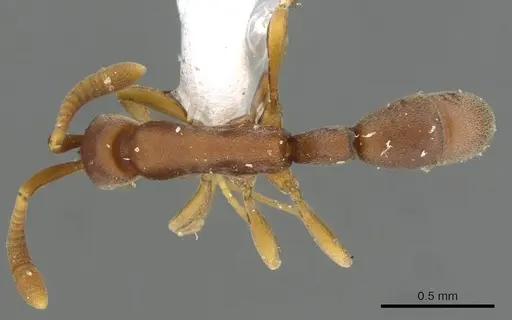
Literature
Loading distribution map...Loading products...