
Ponera colaensis
- Sci. Name
- Ponera colaensis
- Tribe
- Ponerini
- Subfamily
- Ponerinae
- Author
- Mann, 1921
- Distribution
- Found in 2 countries
Introduction
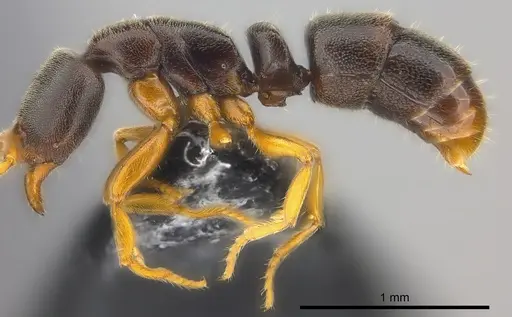
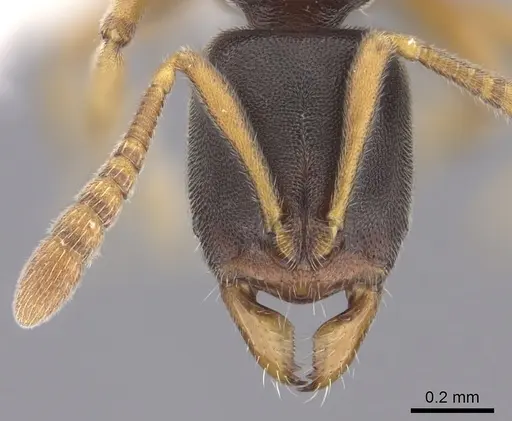
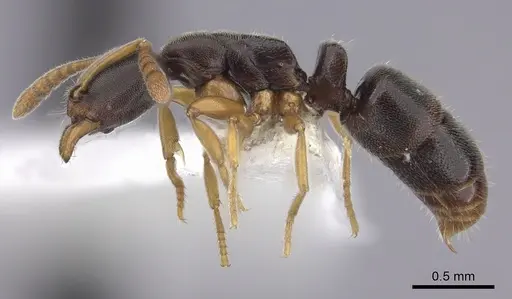
Ponera colaensis is a small ant endemic to the Fiji Islands. Workers are dark reddish brown with bright yellowish-brown mandibles, antennae, legs, and gastric apex. Body size data is unavailable from current research. The species is found on Viti Levu and the Lau group, typically in rain forest habitats at elevations around 840-900 meters . Pupae are enclosed in cocoons . This species is one of the larger members of the Ponera taipingensis species group and lacks a distinctly incised dorsal mesometanotal suture, which distinguishes it from other Fijian Ponera species .
Quick Summary
- Difficulty: Hard
- Origin & Habitat: Endemic to Fiji Islands (Viti Levu and Lau group). Found in rain forest habitats at 840-900m elevation, typically in leafmold, moss off rotting logs, and debris from tree fern stumps [2][1].
- Colony Type: Colony structure is unconfirmed. Only known from limited worker and queen specimens. No data on whether colonies are single-queen or multi-queen.
- Size & Growth:
- Queen: size data unavailable
- Worker: size data unavailable
- Colony: Unknown, only known from small worker series
- Growth: Unknown
- Development: Unknown, no development data available for this species (No species-specific development data exists)
- Antkeeping:
- Temperature: Based on their tropical Fiji origin, likely warm temperatures around 24-28°C, but specific requirements are unknown. Use a heating cable to create a gradient if needed.
- Humidity: High humidity is likely required, but specific levels are unknown. Keep nest substrate consistently moist but not waterlogged.
- Diapause: Unknown for this species. Fiji has a mild tropical climate, so a true diapause may not be necessary.
- Nesting: In nature, they nest in rotting wood, under bark, and in leaf litter [1]. In captivity, provide a humid nest with small chambers scaled to their size, using Y-tong or plaster nests.
- Behavior: Behavior is poorly documented. Like other Ponera species, they are likely predatory on small arthropods and have a stinger, but due to their small size, it is ineffective against humans. They are probably nocturnal foragers. Escape prevention is critical due to their very small size, use fine mesh and tight barriers.
- Common Issues: very small size makes escape likely without fine mesh barriers, humidity requirements are high, drying out kills colonies quickly, no species-specific development data makes timing uncertain, limited availability, rarely collected or sold, wild-caught colonies may have parasites that are difficult to treat
Natural History and Distribution
Ponera colaensis is endemic to the Fiji Islands, specifically found on Viti Levu and the Lau group islands [2][1]. This species was originally described by Mann in 1921 based on worker specimens, with a queen described later by Santschi in 1928 [3]. It has been collected from rain forest habitats at elevations around 840-900 meters, in the Nandarivatu Forestry Nature Preserve on Viti Levu and the slopes of Mt Lomolaki [1]. Specimens are found in leaf litter, moss on rotting logs, and debris from tree fern stumps [1]. One collection included workers with pupae under spongy moss-covered bark on a rotting log, indicating nesting in decaying wood [1].
Identification and Morphology
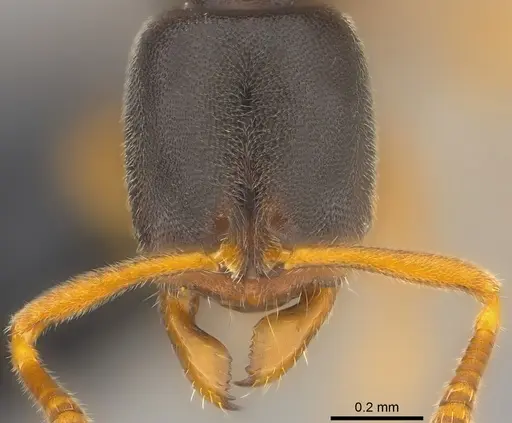
Workers of Ponera colaensis have a dark reddish-brown body with bright yellowish-brown mandibles, antennae, legs, and gastric apex [1]. They have a vestigial median clypeal tooth appearing as a blunt, low tumosity, and very small eyes with 3-5 indistinct facets [1]. The dorsal mesometanotal suture is never distinctly incised, which is unique among known Fijian Ponera species [1]. Queens are similar in color and sculpturation to workers [1]. All known pupae are enclosed in cocoons, typical for the genus [1].
Housing and Nesting
In captivity, provide a setup that mimics their natural habitat in rotting wood and moist leaf litter [1]. Use a humid nest with small chambers, such as Y-tong or plaster nests, scaled to their tiny size. Keep the nest substrate consistently moist but not waterlogged [4]. Due to their very small size, escape prevention is critical, use fine mesh on ventilation holes and ensure tight seals [4]. A dark cover over the nest will help them feel secure.
Feeding and Diet
Like other Ponera species, P. colaensis is likely predatory on small micro-arthropods [4]. Feed small live prey such as springtails, micro-mites, or fruit fly larvae. Offer prey twice weekly and remove uneaten prey after 24 hours. Sugar water or honey may be accepted occasionally but should not be relied upon as a primary food source [4].
Temperature and Seasonal Care
Based on their Fiji rain forest origin, these ants likely prefer warm, stable temperatures around 24-28°C [4]. Fiji has a tropical climate with mild seasonal variation, so dramatic temperature swings should be avoided. A heating cable placed on one side of the nest can create a gentle gradient. Humidity should remain high to prevent desiccation [4]. A true diapause is likely not required due to the mild climate.
Frequently Asked Questions
How long does it take for Ponera colaensis to produce first workers?
The egg-to-worker development time is unknown for this species as it has not been scientifically studied. No estimates are available.
Are Ponera colaensis good for beginners?
No. This species is not recommended for beginners. They are very small, require high humidity, have no documented care requirements, and are rarely available. They are best suited for experienced antkeepers.
Do Ponera colaensis ants sting?
Ponera ants have a stinger, but due to their very small size, it is unlikely to penetrate human skin effectively. Any sting would likely be negligible.
What do Ponera colaensis eat?
They are likely predatory on small micro-arthropods. Feed small live prey like springtails, micro-mites, or fruit fly larvae. Small pieces of protein may also be accepted.
Can I keep multiple queens together?
Unknown. The colony structure (single-queen vs multi-queen) has not been documented for this species. Do not attempt combining unrelated queens without evidence.
What temperature do Ponera colaensis need?
Likely warm temperatures around 24-28°C based on their tropical origin, but specific requirements are unknown.
How big do Ponera colaensis colonies get?
Unknown. Only small worker series have been documented. Colony size estimates are not available.
When do Ponera colaensis have nuptial flights?
Unknown. Nuptial flight timing has not been documented for this species.
Do Ponera colaensis need hibernation?
Unlikely. Fiji has a mild tropical climate with minimal seasonal temperature variation. A true diapause is probably not necessary.
Why is my Ponera colaensis colony dying?
The most likely causes are: low humidity (drying out kills these forest-floor ants quickly), improper feeding (they need small live prey), or escape (their tiny size means they can slip through standard barriers). Review humidity levels, food offerings, and escape prevention measures.
Report an Issue
The current care sheet is based fully on literature. See inconsistencies, or something that's incorrect? Please , it will be resolved after review from an admin. Contributing to the blogs tab also helps providing information, to make us be able to further improve the caresheets. Thank you for your support!
References

This caresheet is licensed under CC BY-SA 4.0 .
Community Blogs
CASENT0194711
View on AntWeb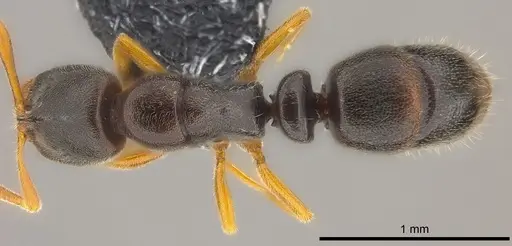
CASENT0249221
View on AntWeb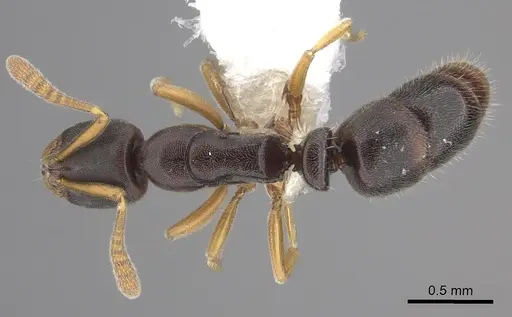
Literature
Loading distribution map...Loading products...