
Polyrhachis eremita
- Sci. Name
- Polyrhachis eremita
- Subgenus
- Hirtomyrma
- Tribe
- Camponotini
- Subfamily
- Formicinae
- Author
- Kohout, 1990
- Distribution
- Found in 1 countries
Introduction
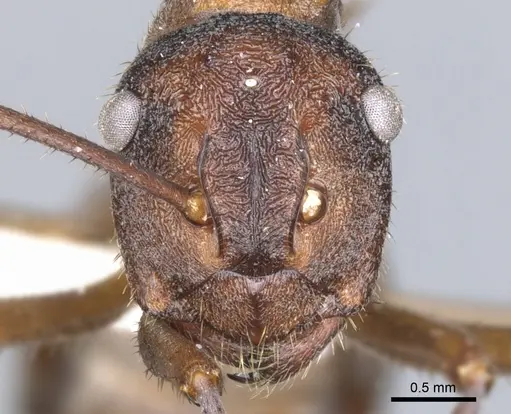
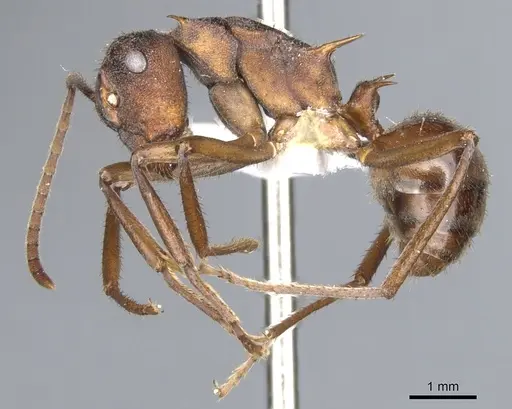
Polyrhachis eremita is a medium-sized Australian ant with a bicoloured appearance: medium reddish-brown body with light yellowish-brown markings on the head, pronotal collar, and mesosomal dorsum . Workers measure 6.5-8.7 mm in total length . It is native to Queensland, Australia, specifically found in open sclerophyll forest near Marlborough . This species is a social parasite, living within colonies of Rhytidoponera ants . Queens invade host colonies and use chemical mimicry to integrate, with host workers raising P. eremita brood .
Quick Summary
- Difficulty: Expert
- Origin & Habitat: Native to Queensland, Australia, in open sclerophyll forest near Marlborough [1][3].
- Colony Type: Social parasite, queens invade and live within Rhytidoponera host colonies [2].
- Size & Growth:
- Antkeeping:
- Temperature: Unknown, no specific research data available
- Humidity: Unknown, no specific research data available
- Diapause: Unknown, likely none based on geographic range
- Nesting: Requires a host Rhytidoponera colony to survive [2]
- Behavior: As a social parasite, P. eremita likely uses chemical mimicry to integrate with host colonies [1]. Workers are 6.5-8.7 mm, so escape prevention is important but not due to small size. Aggression levels are unknown.
- Common Issues: parasitic lifestyle makes captive keeping extremely difficult, queens cannot found colonies independently, requires a live Rhytidoponera host colony which is challenging to maintain, host colony decline in wild due to habitat degradation may affect availability, mixed colonies may experience stress or rejection if integration fails, very limited availability in the antkeeping hobby
Understanding the Parasitic Lifestyle
Polyrhachis eremita is a social parasite that cannot establish its own colony. Queens must invade an established colony of Rhytidoponera ants and use chemical mimicry to be accepted by host workers [2]. Once integrated, the host workers raise P. eremita brood alongside their own [1]. This makes P. eremita fundamentally different from most ant species in captivity.
Housing and Nest Requirements
Standard ant keeping setups will not work for P. eremita. This species absolutely requires a host Rhytidoponera colony to survive [2]. Practical attempts would involve obtaining both the parasite and a compatible host colony, then successfully introducing the parasite queen, which is extremely challenging.
Feeding and Diet
Specific diet data is unavailable. As a social parasite, P. eremita likely feeds from the host colony's food sources.
Temperature and Seasonal Care
Temperature requirements are unknown based on available research. No diapause is likely due to the mild Queensland climate, but specific data is lacking.
Why This Species Is Not Recommended for Most Keepers
P. eremita is essentially impossible to keep for most ant enthusiasts due to its obligate parasitic lifestyle. Without a host Rhytidoponera colony, the queen cannot survive [2]. Wild populations may be declining due to habitat degradation near Marlborough, Queensland [3].
Frequently Asked Questions
Can I keep Polyrhachis eremita in a test tube like other ants?
No. P. eremita is a social parasite that requires a host Rhytidoponera colony to survive. A queen alone in a test tube will not found a colony [2].
How do I establish a Polyrhachis eremita colony?
You cannot establish an independent colony. The queen must invade an existing Rhytidoponera colony, which is extremely difficult and rarely succeeds [2].
What do Polyrhachis eremita eat?
Specific diet data is unavailable, but as a social parasite, they likely feed from the host colony's food sources.
Are Polyrhachis eremita good for beginners?
No. This species is expert-only due to its parasitic lifestyle, which makes captive keeping extraordinarily difficult.
How long do Polyrhachis eremita workers live?
This has not been specifically studied. Worker lifespan would depend on colony conditions, but without a colony, it is not practically relevant.
Where is Polyrhachis eremita found in the wild?
P. eremita is only known from a limited range in Queensland, Australia, around 4-10 km north of Marlborough in open sclerophyll forest [1][3].
Why is Polyrhachis eremita so hard to find in the antkeeping hobby?
Because it is a social parasite that cannot establish independent colonies. Unlike most ants, you cannot catch a queen and start a colony [2].
Do Polyrhachis eremita need hibernation?
Unknown, but likely no diapause is required due to the mild Queensland climate.
What makes Polyrhachis eremita different from other Polyrhachis species?
Most Polyrhachis species are independent colony-founding ants, but P. eremita is an obligate social parasite that must live within a host Rhytidoponera colony [2].
Report an Issue
The current care sheet is based fully on literature. See inconsistencies, or something that's incorrect? Please , it will be resolved after review from an admin. Contributing to the blogs tab also helps providing information, to make us be able to further improve the caresheets. Thank you for your support!
References

This caresheet is licensed under CC BY-SA 4.0 .
Community Blogs
CASENT0903355
View on AntWeb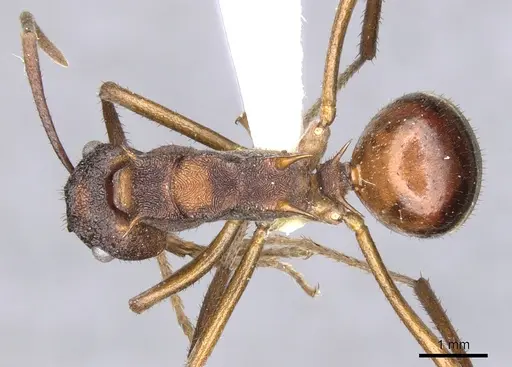
Literature
Loading distribution map...Loading products...