
Poecilomyrma myrmecodiae
- Sci. Name
- Poecilomyrma myrmecodiae
- Tribe
- Crematogastrini
- Subfamily
- Myrmicinae
- Author
- Mann, 1921
- Distribution
- Found in 1 countries
Introduction
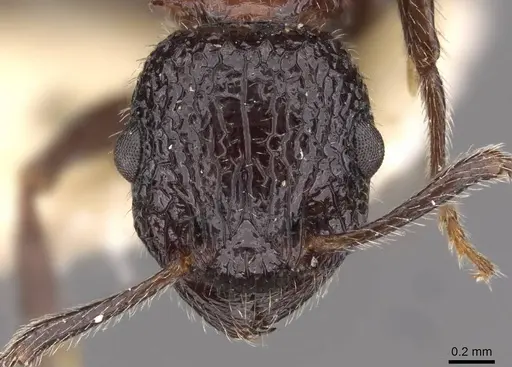
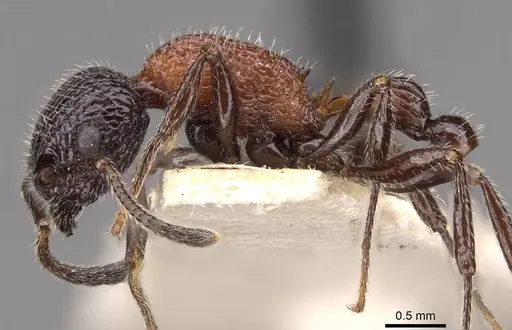
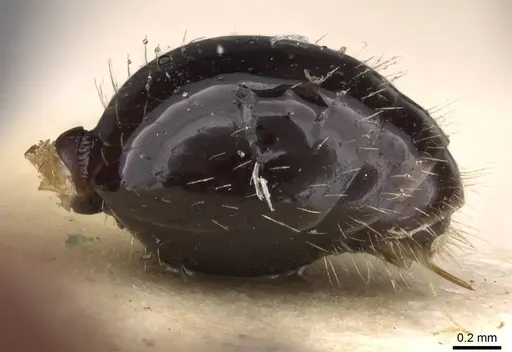
Poecilomyrma myrmecodiae is a large myrmicine ant endemic to the Fiji islands, specifically Viti Levu. Workers measure around 5 mm and have a black head infuscated posteriorly, red mesosoma and petiole, an infuscated postpetiole, black gaster, and dark appendages . This species belongs to an Indo-Pacific clade and is phylogenetically related to Paratopula . What makes this species unique is its association with ant plants; the type series was collected from a Myrmecodia bulb, and ergatoid (wingless) queens have been found nesting in Hydnophytum ant plants .
Quick Summary
- Difficulty: Expert
- Origin & Habitat: Endemic to Fiji, specifically Viti Levu island in the central and southeastern mountain ranges [1][3]. In the wild, these ants nest exclusively inside ant plant bulbs (Myrmecodia and Hydnophytum) [1].
- Colony Type: Ergatoid (wingless) queens have been documented, but the number of queens per colony is not specified in the research [1].
- Size & Growth:
- Antkeeping:
- Temperature: Unknown, likely tropical preferences given Fiji habitat. Start around 24-28°C and observe colony activity.
- Humidity: High humidity required, ant plant interiors are humid microenvironments. Keep nest substrate consistently moist but not waterlogged.
- Diapause: No, Fiji has no cold season, so diapause is unlikely.
- Nesting: Must nest in ant plant cavities or similar enclosed spaces [1]. In captivity, use Y-tong, plaster, or 3D-printed nests with tight chambers. Avoid acrylic nests.
- Behavior: No behavioral data documented for captive colonies. Based on their ant plant nesting habit, they likely remain cryptic and do not forage openly. Ergatoid queens suggest they can replace their queen if she dies without nuptial flights. Escape risk is moderate given their 5mm size, but standard barriers should suffice.
- Common Issues: lack of captive breeding data makes care challenging., ergatoid queen system may complicate colony establishment., high humidity requirements risk mold development., ant plant nesting habit is difficult to replicate in captivity., legal restrictions may apply due to endemic status.
Natural History and Distribution
Poecilomyrma myrmecodiae is found only on the island of Viti Levu in Fiji [1][3]. This species was originally described as a subspecies of P. senirewae by Mann in 1921,but was elevated to full species status by Sarnat and Economo in 2012 [1]. The species is restricted to the central and southeastern mountain ranges of Viti Levu [1]. It has an obligate association with ant plants (Myrmecodia and Hydnophytum), with the type series of 21 workers collected from a Myrmecodia bulb and ergatoid queens found nesting inside Hydnophytum ant plants [1].
Identification and Distinguishing Features
Workers measure approximately 5 mm and have a distinctive coloration: black head infuscated posteriorly, red mesosoma and petiole, infuscated postpetiole, black gaster, and dark appendages [1]. This helps distinguish it from similar species like P. senirewae, which has a lighter head [1]. Ergatoid queens are characterized by long flexuous pilosity and more margined carinae and rugae [1].
Housing and Nesting in Captivity
Housing this species is challenging due to their unique natural history. In the wild, they nest exclusively inside ant plant bulbs [1]. Replicating this requires enclosed, humid nest cavities. Use Y-tong, plaster, or 3D-printed nests with tight chambers. Avoid acrylic nests. Maintain high humidity by keeping the nest substrate consistently moist but not waterlogged.
Feeding and Diet
The natural diet is undocumented. As a myrmicine ant, they likely accept sugar sources and protein. Offer sugar water or honey, and small insects like fruit flies. Due to lack of data, observe what the colony accepts.
Temperature and Seasonal Care
As a Fiji endemic, they prefer warm, stable conditions around 24-28°C. No diapause is needed. Start with these temperatures and adjust based on colony activity.
Frequently Asked Questions
Is Poecilomyrma myrmecodiae available in the antkeeping hobby?
This species is endemic to Fiji and has not been reported in the antkeeping hobby [1][3].
How do I house Poecilomyrma myrmecodiae?
This is an expert-level challenge. In the wild, they nest exclusively inside ant plant bulbs [1]. Replicating this requires small, enclosed nest chambers with very high humidity. Use Y-tong, plaster, or 3D-printed nests, and avoid acrylic nests.
What do Poecilomyrma myrmecodiae eat?
Their diet has not been documented. As a myrmicine ant, they likely accept sugar sources and protein. Offer sugar water or honey and small insects. Due to lack of data, experimentation and careful observation are required.
Do Poecilomyrma myrmecodiae queens have wings?
This species has ergatoid (wingless) queens documented [1]. Winged queens may or may not be produced, the ergatoid form serves as replacement reproductives within established colonies.
How big do Poecilomyrma myrmecodiae colonies get?
Unknown. Only small colonies have been documented in ant plant bulbs [1]. The maximum colony size has not been studied.
Do Poecilomyrma myrmecodiae need hibernation?
No. As a Fiji endemic species, they come from a tropical climate with no winter and likely remain active year-round.
Is Poecilomyrma myrmecodiae aggressive or do they sting?
No behavioral data exists for this species. As a 5 mm myrmicine ant, they likely have a stinger but its potency is unknown. Given their cryptic ant-plant nesting lifestyle, they are probably not aggressive.
Can beginners keep Poecilomyrma myrmecodiae?
Not recommended. This species is rated Expert difficulty due to: no captive breeding data, specialized ant plant nesting requirements, unknown temperature/humidity needs, and extreme rarity.
What is the defense mechanism of Poecilomyrma myrmecodiae?
Like other myrmicine ants, they likely use a smear defense with a modified stinger. No specific studies on this species exist.
Report an Issue
The current care sheet is based fully on literature. See inconsistencies, or something that's incorrect? Please , it will be resolved after review from an admin. Contributing to the blogs tab also helps providing information, to make us be able to further improve the caresheets. Thank you for your support!
References

This caresheet is licensed under CC BY-SA 4.0 .
Community Blogs
CASENT0908990
View on AntWeb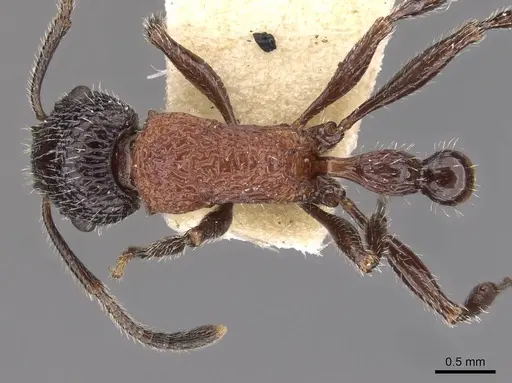
Literature
Loading distribution map...Loading products...