
Pheidole viserion
- Sci. Name
- Pheidole viserion
- Tribe
- Attini
- Subfamily
- Myrmicinae
- Author
- Sarnat <i>et al.</i>, 2016
- Distribution
- Found in 1 countries
Introduction
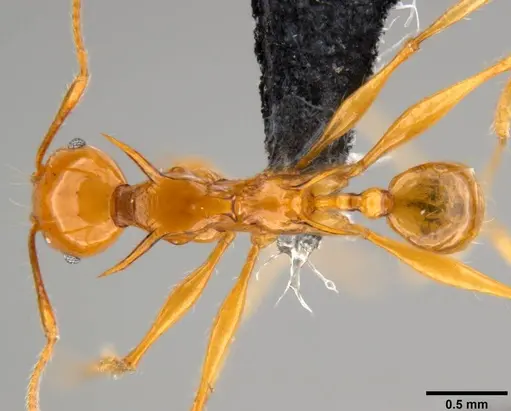
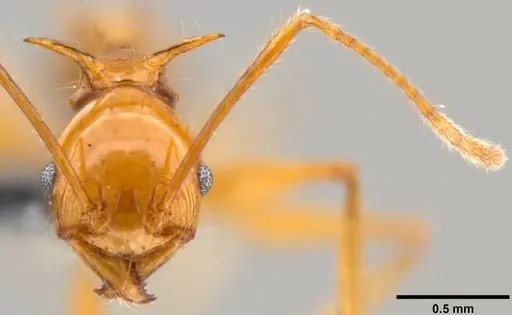
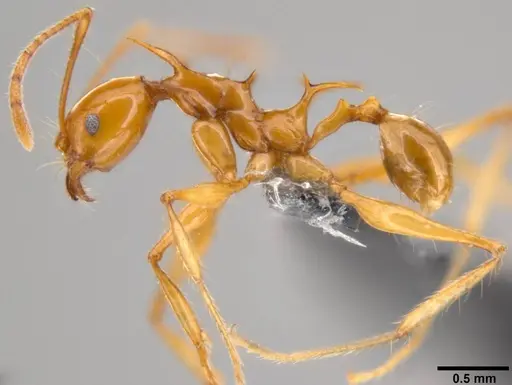
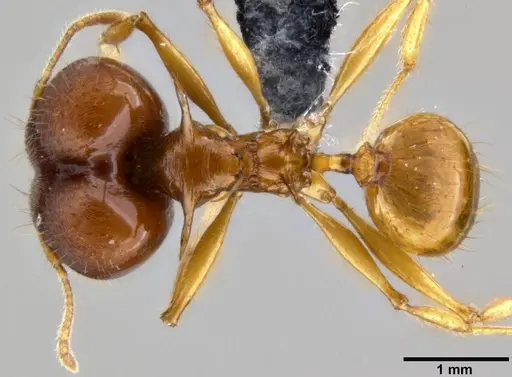
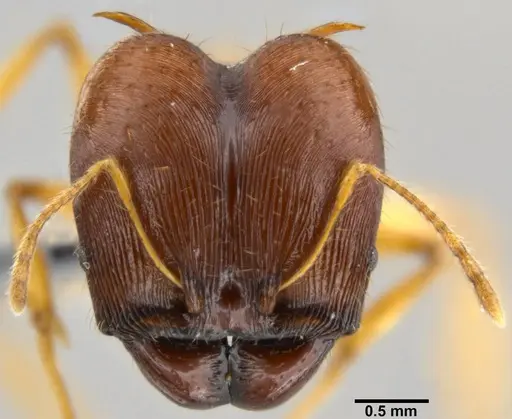
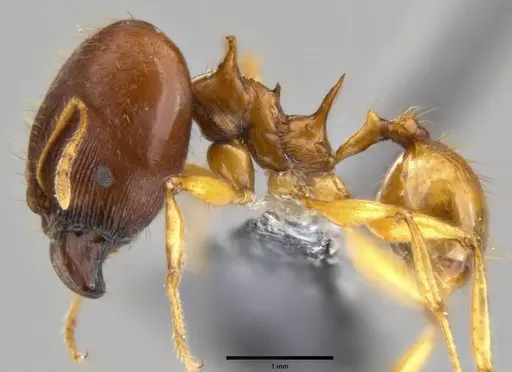
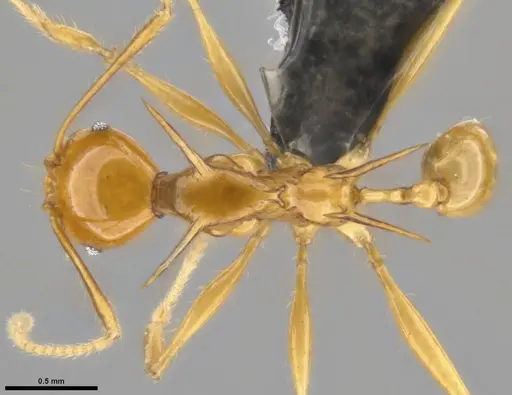
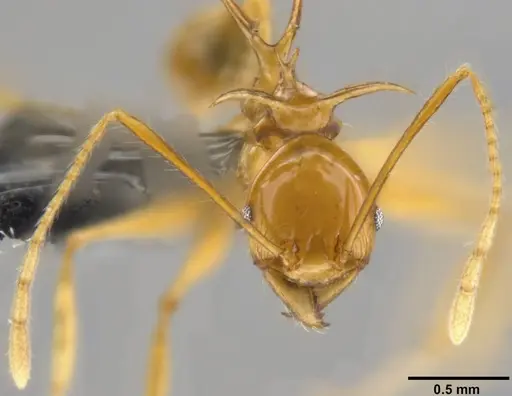
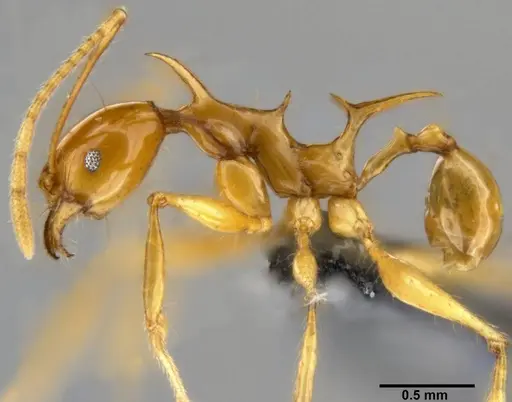
Pheidole viserion is a yellow ant native to Papua New Guinea, named after Viserion, the cream and gold dragon from Game of Thrones. It is the only member of the cervicornis group with uniform yellow coloration . The species is found in montane primary forests and lowland habitats transitioning between primary and secondary forest at elevations of 160-1600m . Body size data is unavailable for this species. Majors have enlarged heads and long spines on the pronotum, mesonotum, and propodeum, while minors are smaller with extremely long pronotal spines . The species forages in leaf litter and hollow tree trunks above ground .
Quick Summary
- Difficulty: Medium
- Origin & Habitat: Papua New Guinea, from montane primary forests and lowland habitats transitioning between primary and secondary forest at elevations of 160-1600m [1].
- Colony Type: Unconfirmed, no specific data on queen number or social structure.
- Size & Growth:
- Queen: size data unavailable
- Worker: size data unavailable
- Colony: Unknown, estimated from related Pheidole species to reach several hundred workers [2]
- Growth: Moderate, inferred from genus patterns
- Development: Estimated 6-8 weeks at tropical temperatures [2] (Timeline inferred from typical Pheidole development, specific data for this species unavailable)
- Antkeeping:
- Temperature: Keep warm around 24-28°C, based on tropical habitat [1].
- Humidity: Keep substrate moist but not waterlogged, as they inhabit leaf litter [1].
- Diapause: No, tropical species do not require hibernation [2].
- Nesting: Y-tong or plaster nests with spacious chambers to accommodate spines [2].
- Behavior: Peaceful species with sting defense but rarely aggressive. Minors are small so escape risk is high, use fine mesh barriers [2]. Foraging occurs on ground and in elevated areas [1].
- Common Issues: tropical species may struggle in cool, dry environments, monitor temperature closely., long spines can get tangled in cotton or fabric, use water reservoirs with glass wool barriers instead., small minor workers can escape through standard mesh, use fine mesh or fluon barriers., colonies may be slow to establish, patience is required during founding phase., wild-caught colonies may carry parasites that affect captive survival.
Appearance and Identification
Pheidole viserion is uniformly yellow, the only member of the cervicornis group with this trait [1]. Majors have enlarged heads and long spines on the pronotum, mesonotum, and propodeum, while minors are smaller with extremely long pronotal spines [1]. The species is named after Viserion, referencing its distinctive coloring [1].
Natural Habitat and Distribution
This species is endemic to Papua New Guinea, found in montane primary forests and lowland habitats transitioning between primary and secondary forest at 160-1600m elevation [1]. It inhabits leaf litter and forages in hollow tree trunks above ground [1].
Nest Preferences and Housing
In captivity, use Y-tong or plaster nests with spacious chambers to accommodate workers' long spines [2]. Avoid tight passages or cotton that can cause entanglement. Provide a humidity gradient with moist substrate [1].
Feeding and Diet
Pheidole viserion is likely a generalist omnivore. Offer protein sources like fruit flies or mealworms, seeds for majors to process, and sugar water available at all times [2].
Temperature and Seasonal Care
Keep temperatures at 24-28°C based on tropical habitat [1]. No hibernation is required for this tropical species [2].
Behavior and Colony Structure
This species is peaceful with sting defense but rarely aggressive [2]. Foraging occurs on ground and in elevated areas [1]. Colonies likely have single queens, but this is unconfirmed.
Frequently Asked Questions
How long does it take for Pheidole viserion to produce first workers?
Based on typical Pheidole development, expect first workers in approximately 6-8 weeks at optimal tropical temperatures [2].
What do Pheidole viserion ants eat?
They are omnivores. Offer protein like fruit flies, seeds for majors, and sugar water available at all times [2].
What temperature do Pheidole viserion ants need?
Keep them at 24-28°C, based on their tropical habitat [1].
Are Pheidole viserion good for beginners?
They are rated as Medium difficulty due to warm, humid requirements and escape risks for small minors [2].
How big do Pheidole viserion colonies get?
Colony size is unconfirmed, but estimated to reach several hundred workers based on related species [2].
What type of nest is best for Pheidole viserion?
Y-tong or plaster nests with spacious chambers to prevent spine entanglement [2].
Do Pheidole viserion need hibernation?
No, as a tropical species, they do not require hibernation [2].
Can I keep multiple queens together?
Not recommended, as colony structure is unconfirmed and Pheidole typically form single-queen colonies [2].
Why are my Pheidole viserion dying?
Common causes include low temperature, low humidity, poor escape prevention, or parasites from wild-caught colonies. Review care conditions first [2].
Report an Issue
The current care sheet is based fully on literature. See inconsistencies, or something that's incorrect? Please , it will be resolved after review from an admin. Contributing to the blogs tab also helps providing information, to make us be able to further improve the caresheets. Thank you for your support!
References

This caresheet is licensed under CC BY-SA 4.0 .
Community Blogs
Literature
Loading distribution map...Loading products...