
Pheidole nasutoides
- Sci. Name
- Pheidole nasutoides
- Tribe
- Attini
- Subfamily
- Myrmicinae
- Author
- Hölldobler & Wilson, 1992
- Distribution
- Found in 2 countries
Introduction
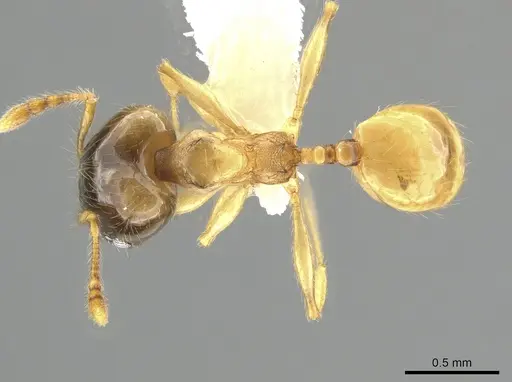
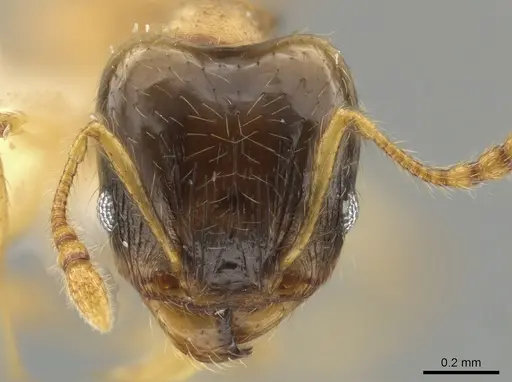
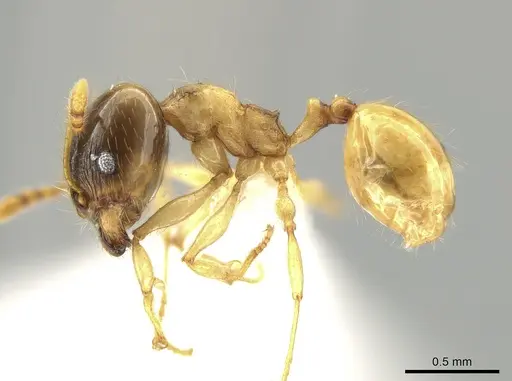
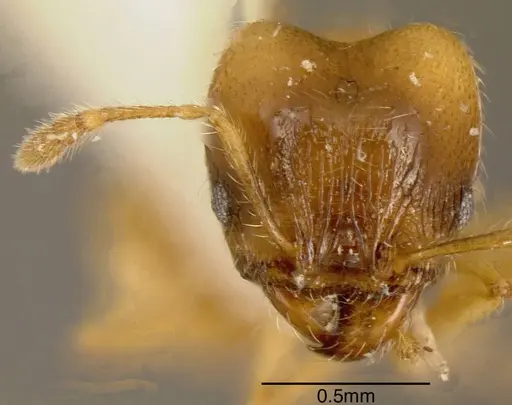
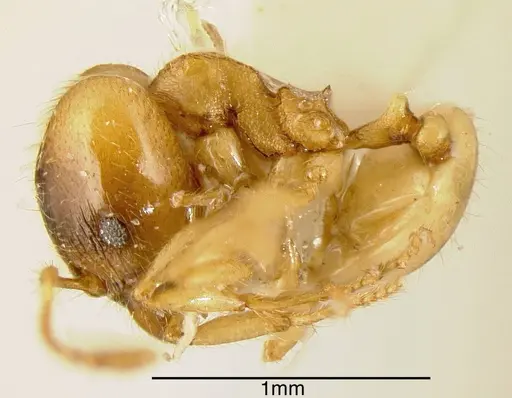
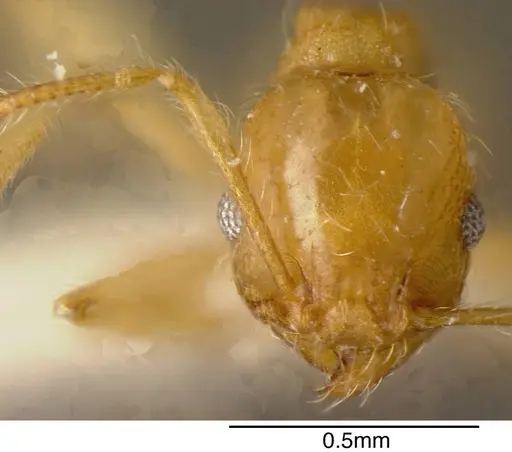
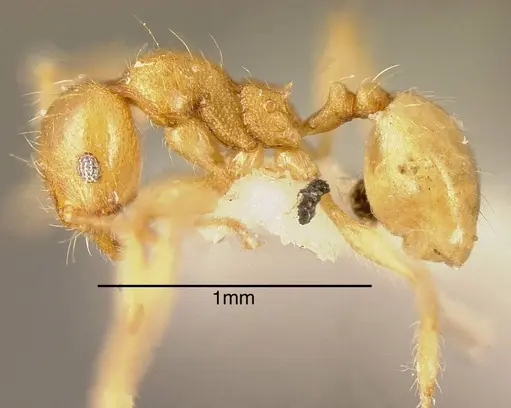
Pheidole nasutoides is a medium-sized ant species endemic to Costa Rica, known only from La Selva Biological Station . The majors have a distinctive dark mask on their heads, while minors are uniformly medium yellow . Body size data is unavailable, but the species belongs to the flavens group and exhibits unique bicoloration in majors . This species is notable for its termite mimicry: when disturbed, majors and minors run in erratic patterns to form a spreading wave, closely resembling nasute termites .
Quick Summary
- Difficulty: Expert, Species is virtually unknown in captivity and may be extinct in the wild
- Origin & Habitat: Only known from La Selva Biological Station, Costa Rica. Found at the edge of second-growth forest bordering experimental fields [1].
- Colony Type: Colony structure is unconfirmed. The type colony had over 100 major and minor workers but no queens were recovered [1].
- Size & Growth:
- Queen: Unknown, no queens have ever been documented [1]
- Worker: Size data unavailable, inferred from Pheidole genus to be approximately 2-5 mm in body length
- Colony: Up to 100 workers based on type colony observation [1]
- Growth: Unknown
- Development: Unknown, no captive colonies exist for study (Development timeline has not been studied due to extreme rarity)
- Antkeeping:
- Temperature: Temperature needs are unclear, start around 22-26°C and observe, based on tropical habitat inference [1]
- Humidity: Keep moderately humid with a humidity gradient, based on natural rainforest edge habitat [1]
- Diapause: Unknown, likely minimal or no diapause given Costa Rican tropical origin
- Nesting: The type colony nested in dried vegetation 1.5m up in a tree. In captivity, use a naturalistic setup with dried plant material or a Y-tong nest with dry chambers [1].
- Behavior: When disturbed, majors and minors rush out and run in erratic looping patterns to form a spreading wave away from the nest, mimicking termite defense behavior [1]. Escape risk is moderate, related Pheidole species can climb, but this species' behavior is poorly known. Defense mechanism: possesses a stinger, but less medically significant to humans based on subfamily Myrmicinae, tribe Attini.
- Common Issues: this species has never been found in captivity, it may be extinct in the wild, no captive breeding stock exists anywhere in the antkeeping hobby, the species is extremely rare, only one colony has ever been documented despite repeated search attempts, no biological data exists for captive care (founding, development, diet), related Pheidole species can be aggressive and have powerful bites
The Termite Mimicry
Pheidole nasutoides majors have evolved a striking resemblance to nasute termites, particularly in their behavior when the nest is disturbed. When Hölldobler discovered the colony, he initially thought he had found Nasutitermes termites and nearly walked past the nest [1]. The majors possess a distinctive dark mask on their heads that contrasts with their light yellow bodies, mimicking the appearance of termite soldiers. This illusion is heightened when the ants are in motion, creating a Nasutitermes-like gestalt [1]. This mimicry likely provides protection from predators that avoid termites.
Extreme Rarity and Conservation Status
This species is one of the rarest ants in the world. Despite extensive searching by Hölldobler, Wilson, and Longino at and around the type locality, no additional colonies have been found since the type colony was collected in 1992 [1]. Researchers speculate that the species may exist in extremely sparse populations, or it may be a canopy-dwelling species that rarely comes down to ground level [1]. The single known nest was found at the edge of disturbed forest and may have fallen from a higher location.
Why This Species Is Not Available to Keepers
Pheidole nasutoides is not a species that antkeepers can obtain. The entire global knowledge of this species is based on a single colony collected over 30 years ago. No live colonies exist in any ant farm, research facility, or private collection [1]. The species has never been exported or bred in captivity because no additional colonies have ever been found [1]. Any antkeeper claiming to sell this species is either mistaken or engaging in fraud.
Related Species for Antkeepers
If you're interested in the Pheidole genus, several species are readily available in the antkeeping hobby, such as Pheidole megacephala, Pheidole pallidula, and Pheidole nodus [1]. These species have well-documented care requirements and established breeding protocols, making them suitable for both beginners and experienced antkeepers.
Frequently Asked Questions
Where can I buy Pheidole nasutoides ants?
You cannot buy this species. Pheidole nasutoides is known from only a single colony collected in 1992,and no additional colonies have ever been found despite extensive searching [1]. No live specimens exist in the antkeeping hobby, and any seller claiming to offer this species is likely misidentifying a different Pheidole or engaging in fraud.
Is Pheidole nasutoides extinct?
We don't know. The species has not been observed since 1992,despite repeated search attempts by expert myrmecologists [1]. It may be genuinely extinct, or it may exist as a very rare or canopy-dwelling species that has simply never been rediscovered.
What makes Pheidole nasutoides special?
This species has remarkable termite mimicry. The major workers look and act like nasute termites, they even run in spreading waves when disturbed, just like termite soldiers defending their colony [1]. The discoverer initially thought he had found termites and nearly walked past the nest.
How big do Pheidole nasutoides colonies get?
The only colony ever documented had up to 100 major and minor workers when found [1]. We don't know the maximum colony size because no other colonies have been discovered.
Do Pheidole nasutoides queens exist?
No queens have ever been documented for this species. The type colony contained adult males but neither alate nor dealate queens were recovered [1].
What do Pheidole nasutoides eat?
This is completely unknown. No feeding observations have ever been recorded for this species [1].
Can I keep a similar species instead?
Yes, several readily available Pheidole species have interesting major workers and similar behaviors, such as Pheidole megacephala, Pheidole pallidula, and Pheidole nodus [1]. These species have well-established care requirements in the antkeeping hobby.
Where does Pheidole nasutoides live?
Only from La Selva Biological Station in Costa Rica. The single known colony was nesting in dried vegetation about 1.5 meters up in a small tree at the forest edge [1].
Why hasn't anyone found more colonies?
Researchers have tried extensively but failed. The leading theory is that P. nasutoides is a canopy-dwelling species that lives high in trees, rarely coming down to where entomologists search [1].
Report an Issue
The current care sheet is based fully on literature. See inconsistencies, or something that's incorrect? Please , it will be resolved after review from an admin. Contributing to the blogs tab also helps providing information, to make us be able to further improve the caresheets. Thank you for your support!
References

This caresheet is licensed under CC BY-SA 4.0 .
Community Blogs
Literature
Loading distribution map...Loading products...