
Pheidole lamellinoda
- Sci. Name
- Pheidole lamellinoda
- Tribe
- Attini
- Subfamily
- Myrmicinae
- Author
- Forel, 1902
- Distribution
- Found in 1 countries
Introduction
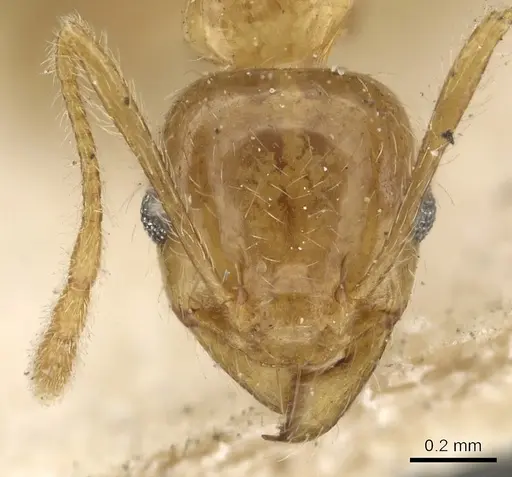
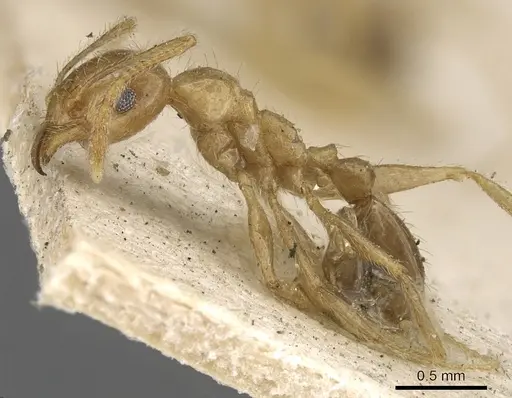
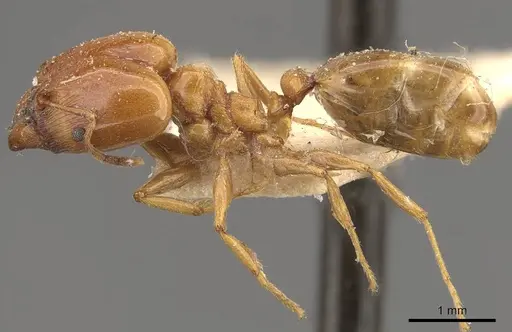
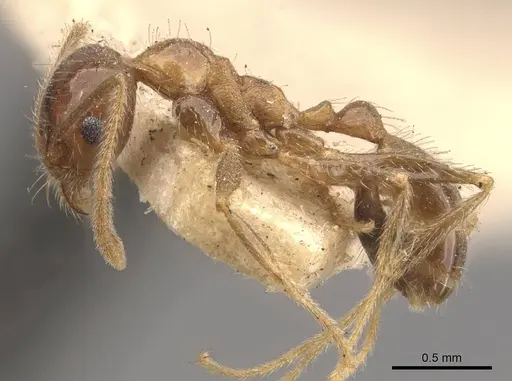
Pheidole lamellinoda is a small myrmicine ant native to India and the Socotra Archipelago. Workers measure 4.5-5 mm in total length and have a distinctive color pattern: the head is reddish-yellow, the mesosoma and petiole are yellow, and the gaster is brownish-yellow . Major workers have a unique ventral forward-directed translucent lobe on the petiole that sets them apart from related species . Minor workers lack this feature and can be tricky to tell apart from other Pheidole like Pheidole indica . This species is poorly studied, with no published ecological or biological data .
Quick Summary
- Difficulty: Medium
- Origin & Habitat: Native to the Indian mainland (Delhi, Maharashtra, Meghalaya) and the Socotra Archipelago in Yemen. Found at elevations around 940 m on Socotra. Records suggest the species is rather local in India [3][4]. No ecological information is available about its natural habitat.
- Colony Type: Colony structure is unconfirmed. Based on typical Pheidole patterns, likely single-queen (monogyne), but no data confirms this. Major and minor worker castes are present.
- Size & Growth:
- Queen: Unknown – size not described in available literature.
- Worker: 4.5-5 mm [1]
- Colony: Unknown – no colony size data available.
- Growth: Unknown – no development data available.
- Development: Inferred from typical Pheidole patterns: 6-10 weeks at warm temperatures. (No development studies exist for this species. Related Pheidole species develop from egg to worker in 6-10 weeks depending on temperature.)
- Antkeeping:
- Temperature: Keep at 24-28°C, inferred from its tropical/subtropical range [3][4]. Provide a gentle gradient so workers can self-regulate.
- Humidity: Provide a moderate moisture gradient: keep one part of the nest substrate slightly moist but not waterlogged, and let the rest dry out a bit. This matches the dry-to-moderate conditions of its Indian and Socotran range.
- Diapause: Unknown – likely minimal or no true diapause given the tropical/subtropical range. You may see reduced activity in cooler months, just feed less often rather than forcing cold dormancy.
- Nesting: Nesting preferences are unconfirmed. Most Pheidole nest in soil, under stones, or in rotting wood. Start with a test tube for founding, larger colonies can move to a Y-tong or naturalistic setup.
- Behavior: Temperament is unconfirmed, but Pheidole are generally non-aggressive and docile. Workers are small and unlikely to sting. Escape risk is moderate due to their small size – standard barriers like fluon work well. They scavenge and may collect seeds, typical for the genus.
- Common Issues: lack of species-specific care data – start with generic Pheidole guidance and adjust based on your colony's response, colony founding can be slow, no specific timeline is known, so patience is needed, maintain good escape prevention despite their small size, no confirmed diet preferences – offer standard Pheidole foods and observe what they accept, winter care is uncertain – watch for reduced activity and adjust feeding as needed
Appearance and Identification
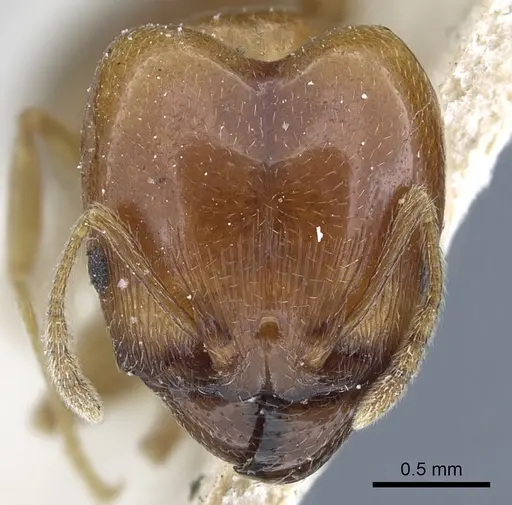
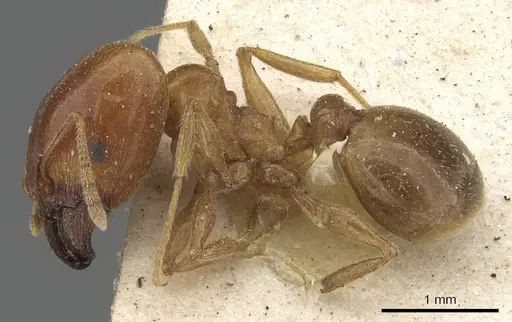
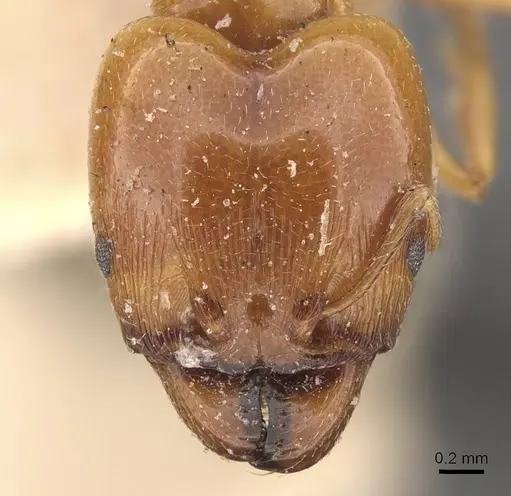
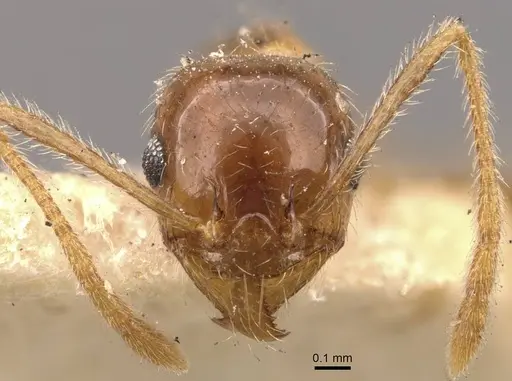
Pheidole lamellinoda is a small ant with a clear size difference between major and minor workers. Workers measure 4.5-5 mm total length [1]. Color is distinctive: head reddish-yellow, mesosoma and petiole yellow, gaster brownish-yellow [2]. The key marker is the ventral forward-directed translucent lobe on the petiole of major workers – this is unique among related species [3]. Minor workers lack this lobe and can be hard to tell apart from other Pheidole, especially Pheidole indica which has a distinctly lower postpetiolar node [3]. The major worker's head has a striated front half, while the back half is smooth and shiny, and the rear edge of the head is strongly concave [2].
Distribution and Habitat
Pheidole lamellinoda has a scattered distribution. It's native to mainland India, found in Delhi, Maharashtra, and Meghalaya, where records suggest it is rather local [3][4][1]. It also occurs on the Socotra Archipelago in Yemen, over 2000 km from India – an unusual pattern. Specimens were collected at around 940 m elevation on Socotra (Adho Dimello base camp) [3]. The species hasn't been found in Arabia and isn't reported as introduced elsewhere [3]. No habitat or ecological details are known.
Nest Preferences and Housing
Nesting preferences are not documented. Most Pheidole nest in soil, under stones, or in rotting wood. For captive care, start with a test tube setup for founding – it gives the humidity and darkness queens need. Once the colony reaches around 30 workers, you can move them to a Y-tong or plaster nest, or a naturalistic setup with soil. Since workers are under 5 mm, chambers should be small. Make sure escape barriers are in place – they're small enough to slip through tiny gaps.
Feeding and Diet
Diet preferences are unconfirmed for this species. As a genus, Pheidole are omnivores with a fondness for seeds and protein. Start with standard ant food: small protein sources (fruit flies, pinhead crickets, tiny mealworms) offered 2-3 times a week, and constant access to sugar water or honey. Provide appropriately small prey items. Watch your colony and adjust. Remove uneaten food after 24-48 hours to avoid mold.
Temperature and Seasonal Care
No specific temperature data exists. Based on its tropical to subtropical range in India and Socotra, aim for 24-28°C [3][4]. A slight gradient helps workers self-regulate. Room temperature (20-24°C) may be okay, but warmer likely boosts growth. Regarding diapause: the species comes from areas with little cold, so true hibernation probably isn't needed. You may notice less activity in cooler months – just cut back feeding rather than trying to force dormancy.
Colony Development and Growth
No development timeline data exists for Pheidole lamellinoda. Based on typical Pheidole patterns, expect eggs to become workers in about 6-10 weeks at 26-28°C. The first workers (nanitics) will be smaller than later ones. Colony growth starts slow as the queen focuses on a small initial brood, then speeds up as more workers help. Be patient during founding – this species has no documented timeline, so observe and adjust care accordingly.
Frequently Asked Questions
How long does it take for Pheidole lamellinoda to produce first workers?
The exact timeline is unknown since no development studies exist. Based on typical Pheidole patterns, expect 6-10 weeks from egg to first worker at warm temperatures (26-28°C). Patience is key during founding.
What do Pheidole lamellinoda ants eat?
Diet is unconfirmed. Start with standard ant foods: small protein sources (fruit flies, pinhead crickets, tiny mealworms) 2-3 times a week, plus constant access to sugar water or honey. Adjust based on what your colony accepts.
What temperature should I keep Pheidole lamellinoda at?
Aim for 24-28°C based on their tropical/subtropical range in India and Socotra [3][4]. Provide a gradient so workers can choose. Room temperature may work, but warmer likely improves growth.
Can I keep multiple queens together?
Colony structure is unconfirmed. Pheidole are typically single-queen (monogyne), but some can be multi-queen. Without data, it's not recommended to combine unrelated foundress queens – fighting may occur.
How big do Pheidole lamellinoda colonies get?
Maximum colony size is unknown – no data exists. Most Pheidole colonies reach several hundred to a few thousand workers. Growth will likely be slow at first and speed up as the colony establishes.
What nest type is best for Pheidole lamellinoda?
Start with a test tube for founding. Once the colony reaches around 30 workers, move them to a Y-tong or plaster nest, or a naturalistic setup. Make sure chambers are sized for their small workers.
Does Pheidole lamellinoda need hibernation?
Diapause requirements are unknown. Given their tropical/subtropical range, true hibernation is likely unnecessary. You may see reduced activity in cooler months – just feed less often instead of inducing cold dormancy.
Are Pheidole lamellinoda ants good for beginners?
This species is poorly documented in antkeeping, making it challenging even for experienced keepers due to the lack of species-specific care data. If you want to keep Pheidole, more commonly kept species like Pheidole indica or Pheidole pallidula have better-established guides.
Why is my Pheidole lamellinoda colony not growing?
Without species-specific data, growth issues are hard to troubleshoot. Make sure temperature (24-28°C), humidity, and food are appropriate. Colony founding is slow – if the queen is alive and producing brood, be patient. If workers are dying, check for mold, dehydration, or poor nutrition.
Report an Issue
The current care sheet is based fully on literature. See inconsistencies, or something that's incorrect? Please , it will be resolved after review from an admin. Contributing to the blogs tab also helps providing information, to make us be able to further improve the caresheets. Thank you for your support!
References

This caresheet is licensed under CC BY-SA 4.0 .
Community Blogs
CASENT0901499
View on AntWeb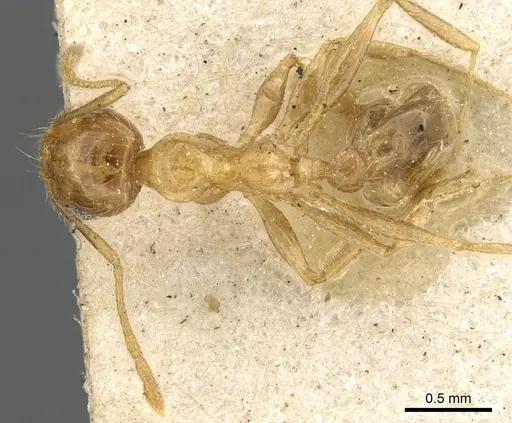
CASENT0901500
View on AntWeb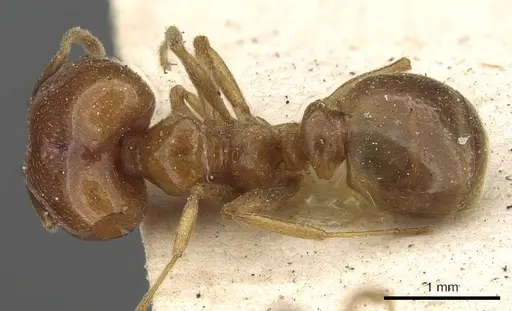
CASENT0907920
View on AntWeb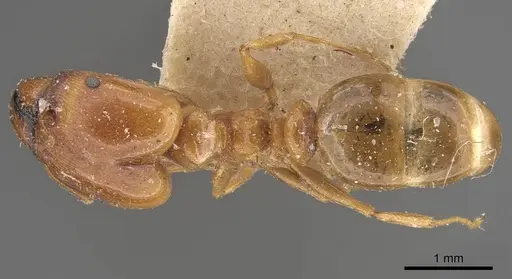
CASENT0907921
View on AntWeb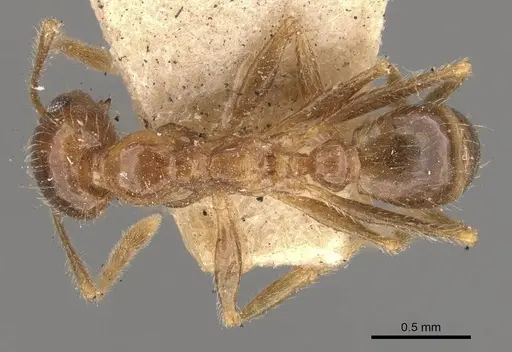
Literature
Loading distribution map...Loading products...