
Pheidole gilvescens
- Sci. Name
- Pheidole gilvescens
- Tribe
- Attini
- Subfamily
- Myrmicinae
- Author
- Creighton & Gregg, 1955
- Distribution
- Found in 2 countries
Introduction
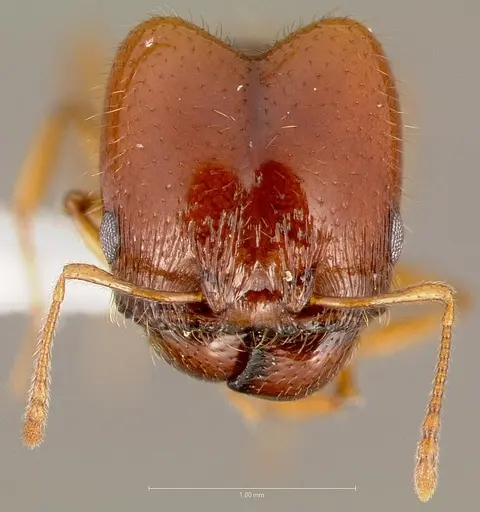
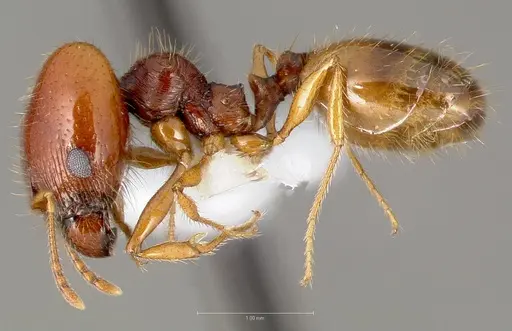
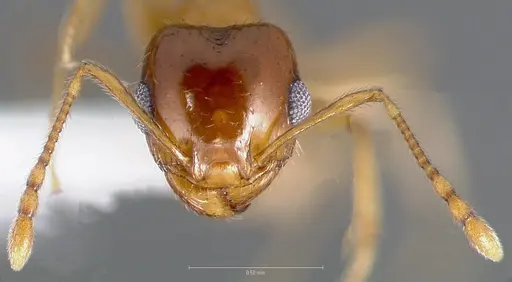
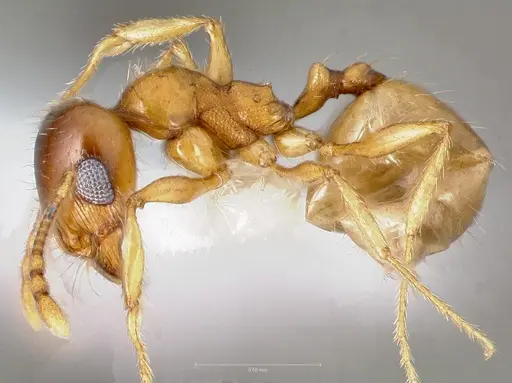
Pheidole gilvescens is a small seed-harvesting ant native to the deserts of the southwestern United States and northern Mexico. Minors are entirely yellow, while majors have a reddish-yellow body with a transversely oval postpetiolar node . Workers average about 2.2 mm in body length , and colonies build small crater nests in sandy soil, often surrounded by chaff . These ants form polydomous colonies, meaning they spread across multiple connected nest sites .
Quick Summary
- Difficulty: Easy
- Origin & Habitat: Native to southwestern United States (southern California, Arizona, southern Nevada) and northern Mexico, found in desert habitats like grassland, creosote bush scrub, and wash woodlands at elevations of 150-1500 m [1][4].
- Colony Type: Unconfirmed, no specific data on queen number in the research context.
- Size & Growth:
- Queen: Size data unavailable, no total length measurements in context.
- Worker: Minors: ~2.2 mm [2], Majors: size data unavailable.
- Colony: Up to 500 workers [1].
- Growth: Moderate
- Development: 6-8 weeks (estimated based on typical Pheidole development) (Development time may vary with temperature, no specific data in context.)
- Antkeeping:
- Temperature: Keep warm, roughly 24-28°C, based on desert habitat preferences [4].
- Humidity: Provide a humidity gradient, mostly dry nest chamber with one small moist area, as they nest in sandy soil [4].
- Diapause: Unknown, no specific data on diapause in context, but desert species may benefit from a mild winter rest.
- Nesting: Preferred nest types: Y-tong, plaster, or soil nests. They naturally nest in exposed sandy soil [4].
- Behavior: These ants are primarily granivorous and scavenge arthropods [1]. They forage in groups during dusk through early morning, typically within 3-4 m of the nest [2]. Majors rarely leave the nest, and colonies show reduced aggression toward neighbors [5]. Workers are not aggressive and have a moderate escape risk due to small size.
- Common Issues: small colony size means slow growth, patience is needed during founding, desert species prone to mold if kept too humid, balance moisture carefully, seed-harvesting behavior may limit acceptance of protein foods, offer seeds and dead insects, polydomous nature may lead to spreading between spaces if not managed, nocturnal foraging means activity is highest at night, this is normal
Nest Preferences and Housing
Pheidole gilvescens naturally nests in exposed sandy soil, building small crater nests often marked by chaff debris [1][4]. In captivity, use Y-tong, plaster, or soil nests with compact chambers suited to their small size. Because they are polydomous, provide connected spaces for expansion. Keep the nest area slightly moist while maintaining a dry outworld to mimic their natural habitat.
Feeding and Diet
These ants are primarily seed harvesters, collecting and storing seeds [1][2]. They also scavenge small arthropods. In captivity, offer grass seeds, millet, and other small seeds as a staple, plus protein sources like dead insects 2-3 times per week. Repletes are occasionally found in wild colonies [1], indicating food storage ability. Remove uneaten seeds to prevent mold.
Temperature and Seasonal Care
These desert ants prefer warm conditions around 24-28°C [4]. Avoid extreme heat above 32°C. Provide a thermal gradient using a heating cable on one side. Diapause is unknown, but a mild winter rest at 10-15°C for 4-6 weeks may be beneficial based on desert species patterns. Reduce feeding during this period.
Foraging Behavior
Pheidole gilvescens is nocturnal, foraging from dusk through early morning [1]. They forage in groups within 3-4 m of the nest [2] and use recruitment strategies [6]. Majors rarely leave the nest, so minor workers handle external tasks. In captivity, offer food in evening hours to match their natural activity.
Colony Structure and Development
Colonies are polydomous, maintaining multiple connected nest sites [3]. Wild colonies are small, often with half a dozen majors and a few dozen minors [1]. Growth is moderate, and founding behavior is unconfirmed. Queens are not observed in context, so colony type is unknown.
Frequently Asked Questions
How long does it take for Pheidole gilvescens to produce first workers?
Expect first workers in about 6-8 weeks at warm temperatures, based on typical Pheidole development. Growth is slow, so patience is needed.
Can I keep multiple Pheidole gilvescens queens together?
No data on queen number in context, so it is unconfirmed. Combining queens may lead to conflict if the species is monogyne.
What do Pheidole gilvescens eat?
They are primarily seed harvesters, offer grass seeds, millet, and small seeds. They also accept dead insects for protein [1][2].
Do they need hibernation?
Diapause is unknown in context, but a mild winter rest at 10-15°C for 4-6 weeks may be beneficial based on desert species patterns.
Why are my ants only active at night?
This is normal, Pheidole gilvescens is nocturnal, foraging from dusk through early morning [1].
When should I move them to a formicarium?
You can keep founding colonies in test tubes for months. Move to a larger nest like Y-tong or plaster once the colony is crowded, but avoid oversized enclosures.
How big do Pheidole gilvescens colonies get?
Maximum colony size is around 500 workers [1]. Growth is slow, and most colonies are smaller.
Are Pheidole gilvescens good for beginners?
Yes, they are considered easy to keep, forgiving of minor fluctuations, not aggressive, and don't require live prey. Main challenges are slow growth and nocturnal activity.
Why do my ants have majors that never leave the nest?
This is normal for this species, majors rarely leave the nest, and minor workers handle foraging [1].
Report an Issue
The current care sheet is based fully on literature. See inconsistencies, or something that's incorrect? Please , it will be resolved after review from an admin. Contributing to the blogs tab also helps providing information, to make us be able to further improve the caresheets. Thank you for your support!
References

This caresheet is licensed under CC BY-SA 4.0 .
Community Blogs
CASENT0005759
View on AntWeb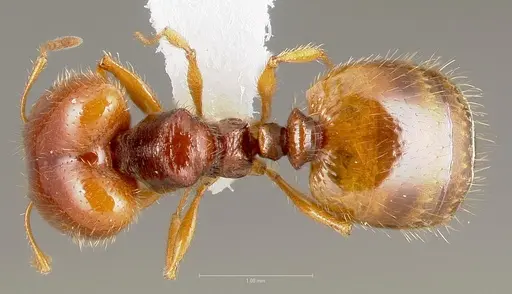
CASENT0005760
View on AntWeb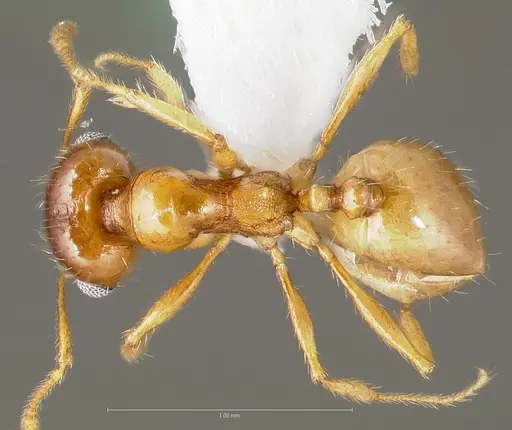
Literature
Loading distribution map...Loading products...