
Pheidole drogon
- Sci. Name
- Pheidole drogon
- Tribe
- Attini
- Subfamily
- Myrmicinae
- Author
- Sarnat <i>et al.</i>, 2016
- Distribution
- Found in 1 countries
Introduction
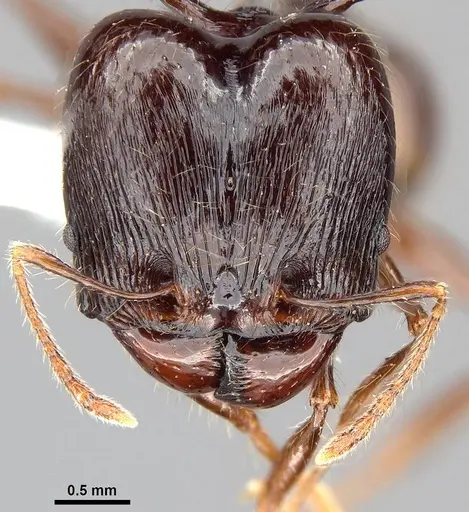
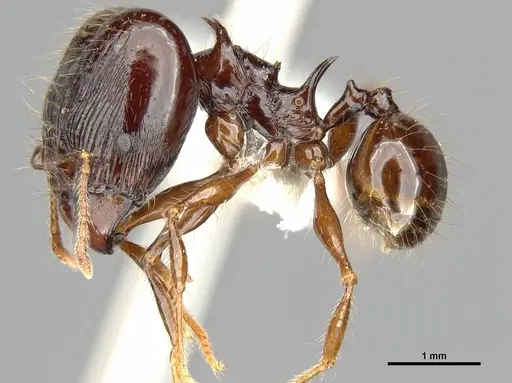
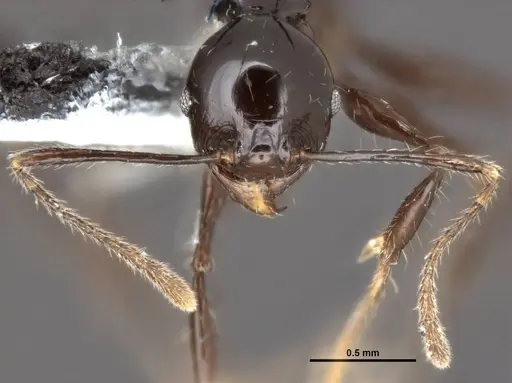
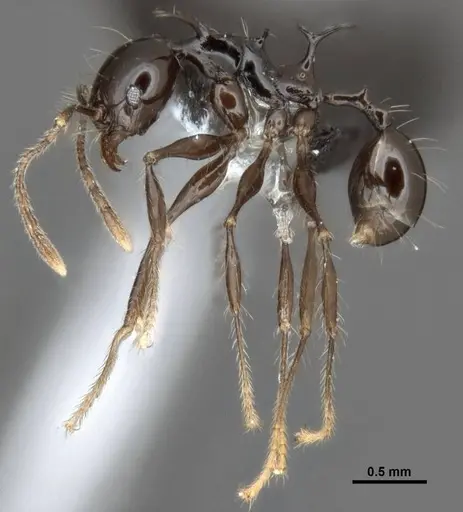
Pheidole drogon is a striking ant species native to the montane rainforests of Papua New Guinea, named after Drogon, the black dragon from Game of Thrones. Major workers have extremely long pronotal and propodeal spines, giving them a dramatic appearance. Both castes are uniform reddish-brown with lighter legs. The species is only known from its type locality at 1900m elevation in the Baiyer River area of Morobe Province . This species belongs to the P. cervicornis group, known for extraordinarily long spines, making it a rare and sought-after species for antkeepers who appreciate unusual morphology .
Quick Summary
- Difficulty: Medium
- Origin & Habitat: Montane rainforest in Papua New Guinea at approximately 1900m elevation. The type locality is 11km east of Baiyer River Sanctuary in Morobe Province [1].
- Colony Type: Colony structure is unconfirmed. Based on typical Pheidole genus patterns, likely single-queen (monogyne) colonies, but no specific data for this species.
- Size & Growth:
- Queen: Size data unavailable, no total length measurements provided in literature.
- Worker: Size data unavailable, no total length measurements provided in literature. Minor workers are very small, major workers are larger with long spines.
- Colony: Unknown, only known from type locality with limited specimens [1].
- Growth: Moderate, estimated based on typical Pheidole development patterns.
- Development: 6-10 weeks estimated based on typical Pheidole genus patterns at optimal temperature. (Timeline is estimated, no specific development data exists for this species. Temperature dependency applies.)
- Antkeeping:
- Temperature: Keep at room temperature, roughly 22-26°C, based on montane origin inference [1].
- Humidity: Keep substrate moderately moist but not waterlogged, based on montane rainforest habitat [1].
- Diapause: Unknown, no studies on overwintering requirements exist.
- Nesting: Use nests with fine chambers scaled to their small size. Y-tong (AAC) nests or plaster nests work well [2]. The long spines may require some vertical space in tunnels.
- Behavior: Pheidole drogon is not aggressive. Major workers serve as soldiers and defenders, using their sting for defense. Minor workers are tiny and active foragers. Escape prevention is critical due to small size, minor workers can squeeze through standard barriers.
- Common Issues: escape prevention is critical, minor workers are extremely tiny and can squeeze through standard mesh and cotton barriers, limited availability as only known from type locality, captive colonies may be rare or non-existent in the hobby, no established captive breeding protocols exist since species was only described in 2016, humidity control is important, too wet causes mold, too dry causes desiccation, slow colony growth may frustrate beginners expecting rapid development
Appearance and Identification
Pheidole drogon is visually striking due to its extraordinarily long spines. Major workers have pronotal and propodeal spines that are nearly as long as their body. Minor workers are tiny but proportionally have even longer spines. Both castes are uniform reddish-brown with lighter legs. The most distinctive feature of major workers is the glossy, sculpture-free posterolateral lobes and gastral tergite [1].
Natural History and Distribution
This species is endemic to Papua New Guinea and is only known from its type locality in Morobe Province. Specimens were collected at 1900m elevation in montane rainforest, approximately 11km east of the Baiyer River Sanctuary [1]. The ants were collected on low vegetation and were actively recruiting to a tuna bait, demonstrating that they are opportunistic scavengers [1].
Feeding and Diet
Based on collection data showing recruitment to tuna bait, Pheidole drogon is an opportunistic scavenger that readily accepts protein sources. In captivity, offer protein-rich foods such as small insects, and occasionally tuna or other fish as a treat. Sugar sources may be accepted but are not a primary dietary need [1][2].
Housing and Nesting
Keep founding colonies in test tubes with a water reservoir and cotton stoppers. Once the colony reaches a small size, consider moving to a proper nest. Y-tong (AAC) nests or plaster nests work well, providing chambers that can be kept humid [2]. Ensure excellent escape prevention, especially for tiny minor workers.
Temperature and Seasonal Care
The montane origin suggests they prefer cooler temperatures. Aim for room temperature around 22-26°C, which is achievable in most homes without additional heating [1]. Avoid temperatures above 30°C as this can stress the colony.
Colony Development
The queen has not been described in scientific literature, so exact founding behavior is unknown. Based on typical Pheidole patterns, the queen likely seals herself in a claustral chamber, but this is unconfirmed. Development from egg to worker is estimated at 6-10 weeks at optimal temperature, but this is based on genus-level inference.
Frequently Asked Questions
How long does it take for Pheidole drogon to produce first workers?
First workers typically appear within 6-10 weeks after the queen lays eggs, assuming optimal temperature around 24°C. This is an estimate based on typical Pheidole development patterns since no specific data exists for this species.
What do Pheidole drogon ants eat?
They are opportunistic scavengers that accept protein-rich foods. Offer small insects like fruit flies or mealworms, and occasionally tuna or other fish as a protein source [1][2].
Are Pheidole drogon ants aggressive?
No, Pheidole drogon is not considered aggressive. Major workers serve as soldiers and defenders but primarily for defense against predators.
What temperature do Pheidole drogon ants need?
Keep them at room temperature, roughly 22-26°C, based on their montane rainforest origin [1].
How big do Pheidole drogon colonies get?
Colony size is unknown, as only limited specimens from the type locality have been studied [1].
Do Pheidole drogon ants need hibernation?
Diapause requirements are unknown. The montane origin suggests they may tolerate cooler temperatures, but true hibernation is not confirmed.
Can I keep multiple Pheidole drogon queens together?
Not recommended. Pheidole species are typically single-queen colonies, and combining unrelated queens has not been documented for this species.
Why are my Pheidole drogon ants dying?
Common causes include escape (minor workers are extremely tiny), improper humidity, temperature stress, and poor nutrition. Ensure excellent escape prevention, maintain moderate humidity, keep temperatures stable, and offer appropriate protein foods.
What makes Pheidole drogon special compared to other Pheidole?
Pheidole drogon has some of the most dramatic spines in the entire genus, giving majors and minors a dragon-like silhouette. It is also one of the rarest Pheidole species in captivity, being only known from a single location in Papua New Guinea [1].
Are Pheidole drogon ants hard to keep?
Difficulty is rated Medium. The main challenges are escape prevention (tiny minors), limited availability, and lack of established captive protocols. Otherwise, their care is straightforward with moderate temperature, humidity, and protein feeding.
Report an Issue
The current care sheet is based fully on literature. See inconsistencies, or something that's incorrect? Please , it will be resolved after review from an admin. Contributing to the blogs tab also helps providing information, to make us be able to further improve the caresheets. Thank you for your support!
References

This caresheet is licensed under CC BY-SA 4.0 .
Community Blogs
CASENT0716380
View on AntWeb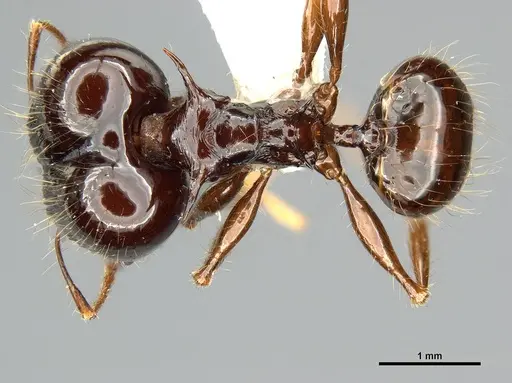
CASENT0753009
View on AntWeb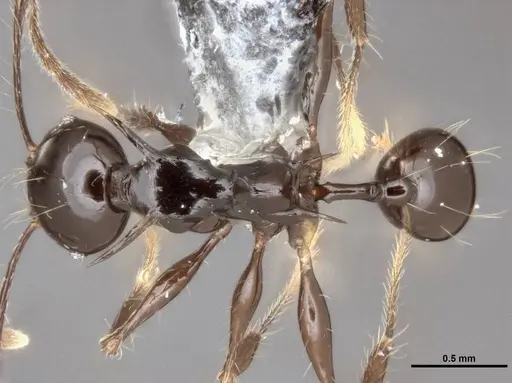
Literature
Loading distribution map...Loading products...