
Ocymyrmex sphinx
- Sci. Name
- Ocymyrmex sphinx
- Tribe
- Crematogastrini
- Subfamily
- Myrmicinae
- Author
- Bolton, 1981
- Distribution
- Found in 2 countries
Introduction
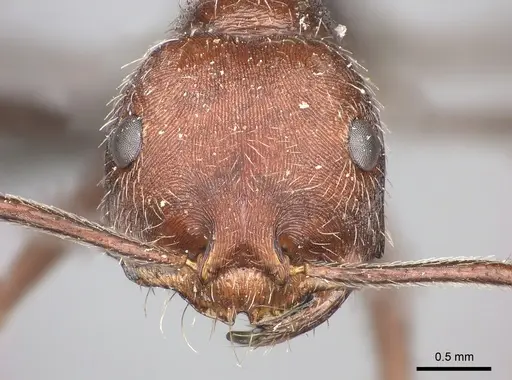
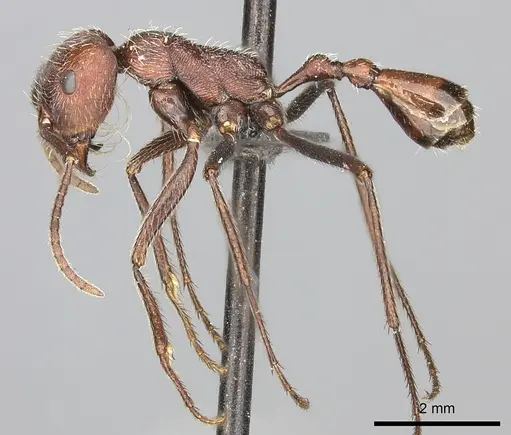
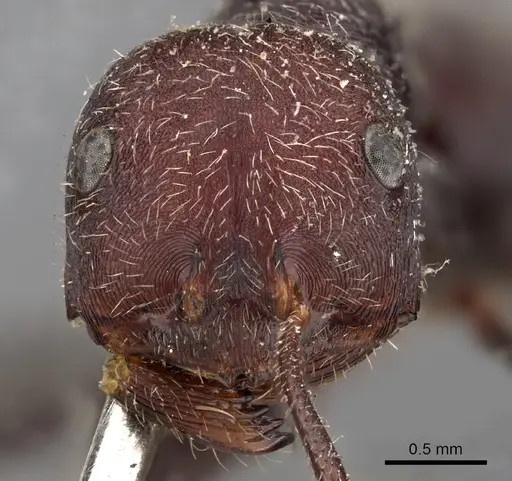
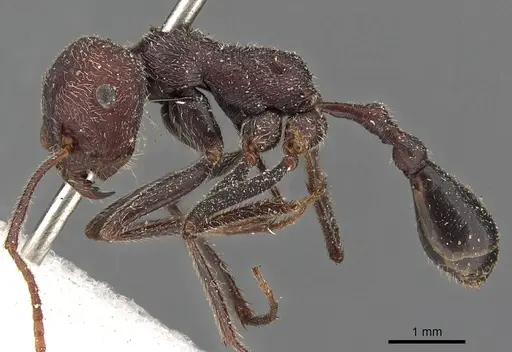
Ocymyrmex sphinx is a large ant species native to the hot, arid regions of Botswana and South Africa. Workers have a total length of approximately 9-10 mm, with a dull dark red alitrunk and black gaster, covered in dense silvery hairs . This species belongs to the Ocymyrmex hirsutus group and is closely related to Ocymyrmex picardi, distinguished by its smaller size and silvery body hairs . In the wild, they build deep nests with a single entrance leading to a vertical tunnel about 1.5 meters underground, with brood and food chambers branching off at various depths . This species has ergatoid (wingless) queens that have larger ovaries than workers and can serve as replacement reproductives .
Quick Summary
- Difficulty: Medium
- Origin & Habitat: Native to Botswana and South Africa, in hot, arid desert and savanna environments where they build deep underground nests [1].
- Colony Type: Single-queen colonies with ergatoid (wingless) replacement reproductives. Ergatoid queens have larger ovaries than workers and can serve as replacements if the primary queen is lost [1].
- Size & Growth:
- Queen: size data unavailable
- Worker: ~9-10 mm total length [1]
- Colony: Unknown, no specific colony size data available
- Growth: Unknown
- Development: Unknown, no direct measurements available. Based on related Ocymyrmex species, estimate 6-10 weeks at optimal temperature, but this is inferred [1]. (Development time may vary with temperature.)
- Antkeeping:
- Temperature: Keep warm, around 25-30°C. This species is thermophilic, adapted to hot temperatures [1].
- Humidity: Keep the nest substrate consistently moist but not waterlogged, with a gradient to allow dry areas [1].
- Diapause: Based on geographic range, likely requires winter diapause. Reduce temperatures to 15-18°C for 2-3 months during winter [1].
- Nesting: Deep nests are essential. Use a naturalistic setup with deep substrate (at least 10-15 cm) or a Y-tong nest with multiple chambers [1].
- Behavior: Workers are active foragers with a moderate temperament. They are not overly aggressive but will defend their nest. Escape prevention is important due to their large size [1].
- Common Issues: deep nesting requirement means standard test tube setups are inadequate for established colonies, heat requirements may be difficult to maintain in cooler climates without additional heating, wild-caught colonies may be difficult to locate due to their deep nesting habits, ergatoid queen system means colony reproduction may be slower than typical ants, dry habitat requirements can be tricky to balance with humidity needs for brood development
Nest Preferences and Housing
Ocymyrmex sphinx requires deep nesting space that reflects their natural habitat of digging tunnels up to 1.5 meters underground. For founding colonies, a test tube setup can work initially, but you should plan to move them to a deeper setup within a few months as the colony grows. A naturalistic formicarium with a soil or sand substrate depth of at least 10-15 cm works best, allowing the ants to create their own tunnel system. Alternatively, a Y-tong nest with multiple connected chambers can work, though you may need to provide additional digging medium. The nest should have a water reservoir to maintain slight moisture in part of the substrate while allowing dry areas as well. These ants are not arboreal, they are strictly ground-nesting and will not use setups designed for tree-dwelling species. [1]
Feeding and Diet
Based on typical Myrmicinae diet, Ocymyrmex sphinx is likely omnivorous with a preference for protein [1]. In captivity, offer protein sources such as small crickets or mealworms, and provide constant access to sugar water or honey.
Temperature and Seasonal Care
These are thermophilic ants requiring warm conditions. Maintain nest temperatures between 25-30°C, with a slight gradient allowing workers to self-regulate. In their native habitat, surface temperatures can be extremely hot, but the deep nests remain cooler and more stable. A heating cable placed on one side of the nest can help maintain appropriate temperatures, but avoid overheating. During winter, reduce temperatures to around 15-18°C to simulate their natural seasonal cycle. Reduce feeding frequency during this period but do not stop entirely. [1]
Understanding the Ergatoid Queen System
Ocymyrmex sphinx has ergatoid queens, wingless females that develop from worker larvae and can reproduce. Ergatoid queens have larger ovaries than workers and can serve as replacement reproductives if the primary queen is lost [1]. This means if the primary queen dies, a replacement ergatoid queen can take over without the colony needing to produce new queens. For antkeepers, this means colony continuity may be more robust, but you may never see nuptial flights, new ergatoid queens develop internally rather than leaving the nest to mate.
Behavior and Temperament
Ocymyrmex sphinx workers are large and robust, making them impressive to observe. They are likely diurnal foragers, active during the cooler parts of the day in their natural habitat to avoid the extreme heat. Workers are probably alert and may react to vibrations or light changes near their nest. While not overly aggressive, they will defend their colony if threatened. They are likely good climbers but not specifically arboreal, so standard escape prevention measures work well. The deep-nesting behavior means they may be less active on the surface than some other species. [1]
Frequently Asked Questions
How long does it take for Ocymyrmex sphinx to produce first workers?
The exact egg-to-worker timeline is unknown for this species. Based on related Ocymyrmex species, estimate 6-10 weeks at optimal temperature (25-30°C), but this is inferred [1].
What size colony does Ocymyrmex sphinx reach?
Colony size data is not available for this species [1].
Do Ocymyrmex sphinx ants sting?
Ocymyrmex sphinx has a stinger as part of the Myrmicinae subfamily [1].
Can I keep multiple Ocymyrmex sphinx queens together?
This species appears to be functionally monogyne with ergatoid replacement reproductives. Combining unrelated foundress queens has not been documented and is not recommended [1].
What temperature do Ocymyrmex sphinx ants need?
Keep them warm at 25-30°C. These are thermophilic ants from hot African regions [1].
Do Ocymyrmex sphinx need hibernation?
Based on geographic range, likely requires winter diapause. Reduce temperatures to 15-18°C for 2-3 months during winter [1].
What do Ocymyrmex sphinx ants eat?
They are likely omnivorous with a preference for protein. Feed small insects like crickets or mealworms, and provide constant access to sugar water or honey [1].
Are Ocymyrmex sphinx good for beginners?
This species is rated as Medium difficulty based on its care requirements [1].
When should I move Ocymyrmex sphinx to a formicarium?
Move them when the colony outgrows their initial setup, but consider deep substrate from the start [1].
Why are my Ocymyrmex sphinx dying?
Common causes include inadequate temperature, humidity, or nesting space. Ensure proper care as outlined [1].
Report an Issue
The current care sheet is based fully on literature. See inconsistencies, or something that's incorrect? Please , it will be resolved after review from an admin. Contributing to the blogs tab also helps providing information, to make us be able to further improve the caresheets. Thank you for your support!
References

This caresheet is licensed under CC BY-SA 4.0 .
Community Blogs
CASENT0235948
View on AntWeb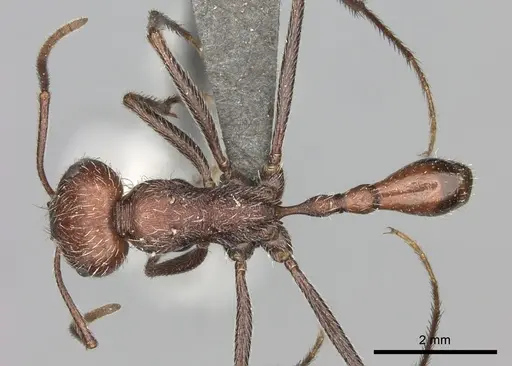
CASENT0900396
View on AntWeb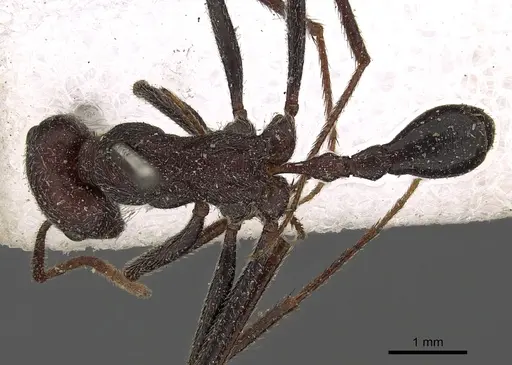
Literature
Loading distribution map...Loading products...