
Ocymyrmex foreli
- Sci. Name
- Ocymyrmex foreli
- Tribe
- Crematogastrini
- Subfamily
- Myrmicinae
- Author
- Arnold, 1916
- Distribution
- Found in 2 countries
Introduction
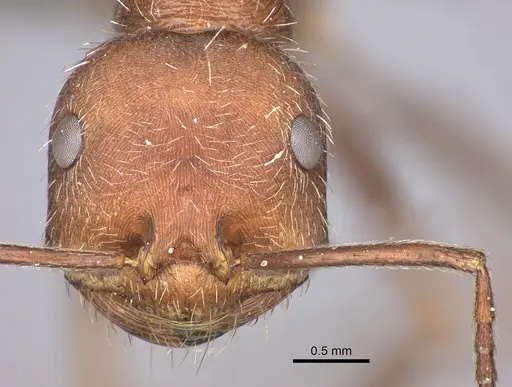
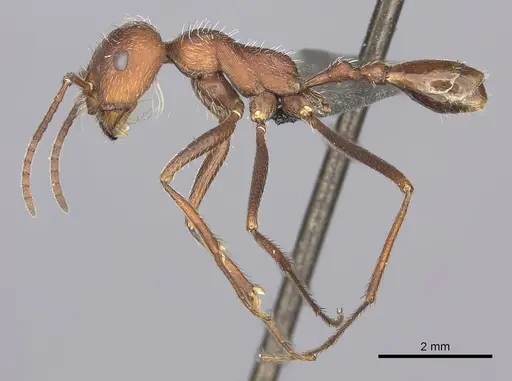
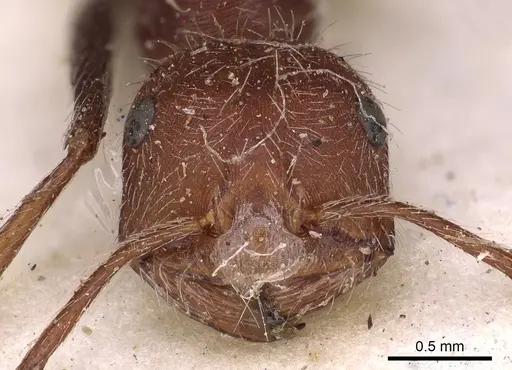
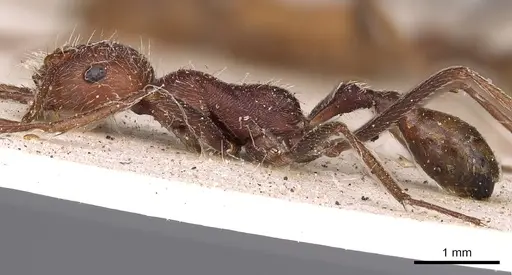
Ocymyrmex foreli is a medium-sized myrmicine ant native to southern Africa, found in South Africa and Zimbabwe. Workers have a total length of 7.3-8.0 mm, with a robust appearance featuring a massively developed, coarsely sculptured petiole node and uniform orange-red to red coloration . This species belongs to the weitzeckeri group and is closely related to Ocymyrmex sobek, separable by more regular petiole sculpture and less contrasting color patterns . Unlike many ants, O. foreli produces ergatoid (wingless) queens that serve as replacement reproductives, with colonies containing up to 1586 adults and only one inseminated female reproductively active per colony .
Quick Summary
- Difficulty: Medium
- Origin & Habitat: Desert and arid regions of South Africa and Zimbabwe in the Afrotropical region. Nests typically have one entrance opening into a vertical tunnel about 30 cm deep, with brood and food chambers branching off at intermediate levels [1].
- Colony Type: Colonies feature an ergatoid queen system with wingless females that can serve as replacement reproductives. Only one inseminated ergatoid female is reproductively active per colony, despite multiple ergatoids being present [1][2].
- Size & Growth:
- Queen: Size data unavailable, no total length measurements for ergatoid queens are provided in the research.
- Worker: ~7.3-8.0 mm [1]
- Colony: Up to 1586 workers [1]
- Growth: Moderate, colony production is positively correlated with rainfall [3]
- Development: Unknown, no specific data available. Based on related desert ant patterns, estimate 6-10 weeks at optimal warm temperatures. (Development likely tied to seasonal rainfall in their native habitat.)
- Antkeeping:
- Temperature: Keep warm, around 24-30°C, as inferred from desert species preferences. Provide a temperature gradient for regulation [1].
- Humidity: Keep nest substrate relatively dry with some moisture in deeper chambers, as inferred from desert ecology [1].
- Diapause: No, desert species do not require hibernation. Maintain stable warm temperatures year-round, with possible reduced activity during cooler periods [3].
- Nesting: Deep nesting species requiring vertical space. Provide naturalistic setups with at least 20-30 cm depth or Y-tong/plaster nests with deep chambers, as they frequently relocate nests in the wild [1].
- Behavior: Diurnal and active foragers known for frequent nest relocation. Entire colonies move together to new sites, with pre-relocation forays occurring weeks beforehand. Workers carry brood and callows to new nests. Escape risk is moderate due to medium size, standard barriers should suffice. Defense mechanism involves smear with a modified stinger, typical of Myrmicinae [1].
- Common Issues: desert species are sensitive to excess moisture, keep conditions dry to prevent mold and fungal issues., frequent nest relocation behavior may stress colonies if disturbed too often., colonies may struggle if temperatures drop below 20°C for extended periods., ergatoid queen system means only one female reproduces, do not expect multiple egg-layers., wild-caught colonies may have parasites that affect survival in captivity.
Nest Preferences and Housing
Ocymyrmex foreli is a deep-nesting desert species. In the wild, they excavate vertical tunnels about 30 cm deep with chambers for brood and food storage [1]. For captive care, provide naturalistic setups with deep sandy soil (20-30 cm depth) or Y-tong/plaster nests with deep chambers. They are active diggers and will excavate tunnels if given appropriate substrate. Avoid wet or compact substrates, desert ants prefer relatively dry conditions with a moisture gradient [1].
Feeding and Diet
As a desert ant species, O. foreli is likely predatory and forages actively for small invertebrates. In captivity, offer small live prey such as fruit flies and pinhead crickets 2-3 times per week, with sugar water continuously available. Remove uneaten prey after 24 hours to prevent mold [1].
Temperature and Seasonal Care
Maintain nest temperatures between 24-30°C with a gradient using a heating cable, as inferred from desert species preferences. They are diurnal and most active during warmer parts of the day. No hibernation is needed, keep stable warm temperatures year-round [3][1].
Colony Structure and Reproduction
O. foreli has ergatoid (wingless) queens that develop from the same caste as workers. Studies show up to 20% of females are ergatoid, but only one is inseminated and reproductively active per colony [2][1]. Ergatoid females are produced throughout the year, and colony growth correlates with rainfall [3]. When colony fission occurs, a newly inseminated ergatoid excavates a new nest with recruited nest-mates [1].
Behavior and Nest Relocation
Nest relocation is normal behavior for this species. Entire colonies move to new sites, with pre-relocation forays occurring for weeks beforehand. Workers carry brood, callows, and intra-nidal individuals to the new nest [1]. Minimize disturbances to reduce stress. Defense involves smear with a modified stinger, typical of Myrmicinae ants [1].
Frequently Asked Questions
How long does it take for Ocymyrmex foreli to produce first workers?
The exact egg-to-worker development time is unknown. Based on related desert ant patterns, expect approximately 6-10 weeks at optimal warm temperatures. Growth is moderate and tied to seasonal conditions [3].
What do Ocymyrmex foreli ants eat?
They are active predators. Feed small live prey such as fruit flies and crickets 2-3 times per week, with sugar water continuously available. Remove uneaten prey after 24 hours [1].
Can I keep multiple Ocymyrmex foreli queens together?
No. This species naturally has only one reproductively active ergatoid female per colony. Combining unrelated foundresses is not recommended and has not been documented [2][1].
Do Ocymyrmex foreli ants sting?
As a Myrmicinae species, they have a stinger used for smearing venom, but sting potency on humans is not well documented. Handle with standard precautions [1].
What temperature do Ocymyrmex foreli need?
Keep them warm at 24-30°C with a temperature gradient, as inferred from desert species preferences. Avoid temperatures below 20°C for extended periods [3][1].
How big do Ocymyrmex foreli colonies get?
Colonies reach up to 1586 workers in the wild. In captivity, expect growth to several hundred workers with proper care [1].
Are Ocymyrmex foreli good for beginners?
This species is rated Medium difficulty due to specific temperature needs, ergatoid queen biology, and nest relocation behavior. Better suited for keepers with some experience [1].
Do Ocymyrmex foreli need hibernation?
No. As a desert species, they do not require hibernation. Maintain stable warm temperatures year-round [3].
Why is my Ocymyrmex foreli colony relocating?
Nest relocation is normal behavior. Triggers may include substrate conditions, temperature preferences, or disturbances. Minimize disruptions to reduce stress [1].
What type of nest should I use for Ocymyrmex foreli?
Use a naturalistic setup with deep sandy soil (20-30 cm) or Y-tong/plaster nests with deep chambers. They need vertical space for tunneling and prefer relatively dry conditions [1].
Report an Issue
The current care sheet is based fully on literature. See inconsistencies, or something that's incorrect? Please , it will be resolved after review from an admin. Contributing to the blogs tab also helps providing information, to make us be able to further improve the caresheets. Thank you for your support!
References

This caresheet is licensed under CC BY-SA 4.0 .
Community Blogs
CASENT0235947
View on AntWeb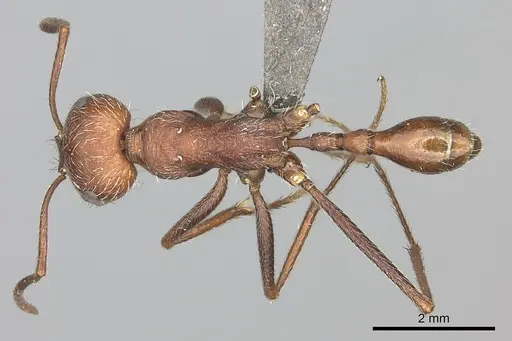
CASENT0900404
View on AntWeb
Literature
Loading distribution map...Loading products...